

Cannabis Market
Cannabis Market Size, Market Share & Trends Analysis Report By Product (Flowers, Concentrates, Edibles, Topicals & Tinctures), By Compound (Tetrahydrocannabinol, Cannabidiol, Balanced THC & CBD), By Application (Medical (Pain management), Neurological health management, Mental health management, Recreational) and By Region (North America, Europe, Asia-Pacific, Middle East and Africa, LATAM) – Industry Analysis Report, Regional Outlook, Growth Potential, Price Trends, Competitive Market Share & Forecast, 2024–2033

Historical Period: 2019-2024
Forecast Period: 2025-2033
Report Code : ASIFBR1006
CAGR: 12.46%
Last Updated : August 12, 2026
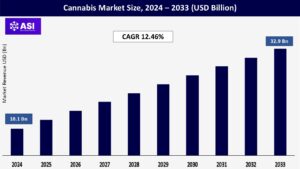
The Cannabis Market size is projected to grow from USD 18.1 Billion in 2024 to USD 32.9 billion by 2033, exhibiting a compound annual growth rate (CAGR) of 12.46% during the forecast period (2024 – 2029).
Cannabis, also known as marijuana, weed, or pot, is a plant with a variety of uses and effects. It has been the subject of extensive discussion, research, and legal regulation due to its psychoactive properties and potential therapeutic benefits.
Cannabis has very different legal statuses in different countries. While decriminalizing or simply allowing medical usage, other nations have fully legalized cannabis for both recreational and medical use. Cannabis is still prohibited or subject to tight regulations in many places.
Growing public acceptance of cannabis usage, fueled by shifting cultural norms and growing knowledge of its therapeutic advantages, has been a major contributor to legalization initiatives. Policy reforms have been impacted by growing research into the medicinal advantages of cannabis. Research demonstrating its efficacy in treating ailments such as multiple sclerosis, epilepsy, and chronic pain have bolstered arguments in favor of legalization.
Several governments have legalized and regulated cannabis due to the possibility of large tax revenues, the creation of jobs, and economic growth. The legalization of cannabis in the United States has been particularly noteworthy, with a patchwork of state laws permitting both medical and recreational use despite the fact that it is still classified as a controlled substance by federal law.
States with sizable legal cannabis markets include Colorado, Illinois, and California. Legalization can boost the economy by generating new jobs, more tax income, and business prospects.
The expenses of upholding prohibition are also decreased by the legal market. The socioeconomic and racial injustices brought forth by cannabis prohibition are being addressed by many legalization initiatives.
This may entail funding local communities impacted by the drug fight as well as erasing criminal records for prior offenses. Legalization may lower the health hazards connected with unchecked use of cannabis by enabling more regulation and quality assurance of cannabis products. Still, worries about the effects on young people and drunk driving persist.
Cannabis-related recreational items, such as sweets, beverages, concentrates, and flowers, are gaining popularity among consumers. The need for leisure and alternative recreational activities is what fuels this demand. Patients looking for relief from anxiety, chronic pain, and other ailments are increasingly in demand for medical cannabis.
The emphasis on product reliability and treatment efficacy that characterizes this category. Due to its potential health advantages without the euphoric effects of THC, cannabidiol, or CBD, has becoming more and more popular.
For conditions like anxiety, insomnia, and pain relief, consumers utilize CBD in a variety of formulations, such as topicals, tinctures, and oils. In response to a wide range of consumer tastes, the cannabis business has witnessed a spike in product innovation.
This covers novel strains, extraction techniques, and product categories (such as candies, vape pens, and tinctures). Younger generations are typically more in favor of legalizing and using cannabis.
They are more inclined to believe that cannabis usage is a part of contemporary culture and acceptable in social settings. Older generations’ attitudes about cannabis use vary; some have more conventional beliefs. But as more information becomes available and legalization advances, opinions are gradually changing.
Market saturation and intense competition are emerging as significant challenges in the cannabis industry. Businesses need to spend money on research and development to provide distinctive features and goods if they want to stay competitive. This can entail designing novel consumption techniques, refining product formulas, or cultivating new strains.
It’s essential to build a solid reputation and brand presence. To create and maintain a competitive edge, businesses must prioritize quality control, customer involvement, and efficient marketing techniques. Complying with intricate and diverse regulations can be expensive and difficult.
Companies need to make sure they follow all legal regulations while still offering reasonable prices and high levels of quality. A company’s financial burden can be increased by the cost of obtaining and maintaining permits, particularly in highly regulated markets.
Companies can set themselves apart in certain areas, with superior products, or by delivering unique offerings. For instance, appealing to particular market segments may involve emphasizing luxury or organic items.
Businesses can develop a devoted customer base by improving the customer experience through tailored services, loyalty plans, and informative content. Enhancing supply chain management, automation, and cost containment can help companies control costs and maintain their competitiveness.
Competitiveness can be increased and strategic decisions can be guided by using data analytics to comprehend consumer behavior, market trends, and operational performance.
Businesses may stand out in a competitive market by making significant investments in their branding and marketing campaigns. Creating an engaging social media presence, successful ad campaigns, and a captivating brand story are all part of this.
The cannabis sector is being significantly impacted by ongoing medical research and innovation, which is also affecting consumer views, growing product offers, and bringing about legal reforms.
Scientific justification for the use of cannabis in treating a range of health disorders is being provided by research into the plant’s therapeutic qualities. Research on the effects of cannabinoids, such as THC and CBD, on a variety of ailments, including anxiety, multiple sclerosis, seizures, and pain, is ongoing.
The establishment of dosage, safety, and efficacy of cannabis-based medicines depends heavily on clinical research. If these trials prove successful, medicinal cannabis prescriptions may become more commonplace. Research is still ongoing to find novel therapeutic applications for cannabis. Studies are looking into its possible application in the treatment of mental health issues, neurological diseases, and cancer-related symptoms.
Cannabis-infused edibles present a range of opportunities within the cannabis market, tapping into both the recreational and medicinal sectors. Edibles are a broad category of goods that include candies, chocolates, baked goods, drinks, and salty nibbles.
This versatility enables brands to accommodate a range of dietary requirements and taste preferences. Custom formulations offer opportunities for innovation, such as the ability to provide edibles with extra functional components (like vitamins or adaptogens) or specific cannabinoid profiles (such high CBD or balanced THC/CBD).
Edibles are a discreet and practical cannabis consumption method that appeals to users who would rather not vape or smoke. Edibles with accurate dosing are more appealing to medical users and beginners to cannabis since they enable them to better control their consumption. Strict quality control procedures, such as laboratory testing to ensure consistent cannabis content and contamination-free production, can be used to edibles.
| Report Metric | Details |
|---|---|
| Segmentations | |
| By Product |
Flowers Concentrates Edibles Topicals & Tinctures |
| By Compound |
Tetrahydrocannabinol Cannabidiol Balanced THC & CBD |
| By Applications |
Medical (Pain management) Neurological health management Mental health management Recreational |
| Key Players |
|
| Geographies Covered | |
| North America |
U.S. |
| Europe |
U.K. |
| Asia Pacific |
China |
| Middle East & Africa |
Saudi Arabia |
| Latin America |
Brazil |
The cannabis market is a rapidly growing industry, driven by increasing legalization, medical applications, and recreational use. Below is a detailed segmental analysis based on Product, Compound, and Application, along with examples for each segment:
The market is segmented into Flowers, Concentrates, Edibles, and Topicals & Tinctures, based on the form in which cannabis is consumed.
Cannabis flowers, also known as buds, are the most traditional and widely consumed form of cannabis. They are typically smoked or vaporized. For example, in the United States, cannabis flowers are popular among recreational users for their potency and variety of strains.
In Canada, licensed producers offer a wide range of cannabis flowers with different THC and CBD levels to cater to both medical and recreational users. The demand for flowers remains high due to their versatility and ease of use.
Cannabis concentrates are highly potent extracts that contain high levels of cannabinoids like THC and CBD. Examples include oils, wax, shatter, and live resin. In California, cannabis concentrates are widely used for dabbing, a method of vaporizing the concentrate for a potent effect. In Europe, CBD concentrates are gaining popularity for their therapeutic benefits without the psychoactive effects of THC. The concentrates segment is growing due to the increasing demand for high-potency products.
Edibles are cannabis-infused food products, such as gummies, chocolates, and baked goods. For instance, in Colorado, cannabis edibles are a popular choice among recreational users for their discreet and convenient consumption.
In Canada, edibles are regulated to ensure consistent dosing and safety. The edibles segment is expanding as consumers seek alternative methods of consumption that do not involve smoking.
Topicals & Tinctures
Topicals are cannabis-infused creams, balms, and lotions applied to the skin, while tinctures are liquid extracts taken sublingually. For example, in the United States, CBD topicals are widely used for pain relief and skincare. In the UK, CBD tinctures are popular for their ease of use and precise dosing. The topicals and tinctures segment is growing due to the increasing demand for non-invasive and targeted cannabis products.
The market is segmented into Tetrahydrocannabinol (THC), Cannabidiol (CBD), and Balanced THC & CBD, based on the primary cannabinoids present in the product.
THC is the psychoactive compound in cannabis responsible for the “high” sensation. For example, in the United States, THC-dominant products are popular among recreational users. In Germany, medical cannabis with high THC content is prescribed for conditions like chronic pain and multiple sclerosis. The THC segment dominates the recreational market due to its psychoactive effects.
CBD is a non-psychoactive compound known for its therapeutic benefits. For instance, in the United States, CBD oils and tinctures are widely used for anxiety, pain relief, and sleep disorders. In the UK, CBD products are legal and sold as food supplements. The CBD segment is growing rapidly due to its wide range of health benefits and legal status in many regions.
Balanced products contain equal or similar levels of THC and CBD, offering a combination of psychoactive and therapeutic effects. For example, in Canada, balanced cannabis products are popular among medical users for conditions like epilepsy and chronic pain. In Australia, balanced oils and capsules are prescribed for patients seeking the entourage effect, where THC and CBD work synergistically. The balanced segment is gaining traction due to its ability to provide both recreational and medical benefits.
The market is segmented into Medical (Pain Management), Neurological Health Management, Mental Health Management, and Recreational, based on the primary use of cannabis.
Cannabis is widely used for pain management, particularly for chronic pain, arthritis, and cancer-related pain. For example, in Israel, medical cannabis is prescribed for pain management, with a focus on THC-dominant products. In the United States, CBD topicals and tinctures are used for localized pain relief. The medical segment is driven by the increasing acceptance of cannabis as a viable alternative to opioids.
Cannabis is used to manage neurological conditions such as epilepsy, multiple sclerosis, and Parkinson’s disease. For instance, in the United States, Epidiolex, a CBD-based drug, is approved for treating rare forms of epilepsy. In the UK, medical cannabis is prescribed for children with severe epilepsy. The neurological health segment is growing due to the proven efficacy of cannabinoids in managing neurological disorders.
Cannabis is increasingly used for mental health conditions like anxiety, depression, and PTSD. For example, in Canada, CBD oils and tinctures are popular for managing anxiety and stress. In the United States, cannabis is used by veterans for PTSD treatment. The mental health segment is expanding as more research highlights the potential benefits of cannabinoids for mental well-being.
Recreational cannabis is used for its psychoactive effects and is legal in many regions. For instance, in California, recreational cannabis is widely available in dispensaries, with a focus on flowers, edibles, and concentrates. In Uruguay, the first country to legalize recreational cannabis, the market is regulated to ensure safe and controlled access. The recreational segment is driven by increasing legalization and consumer demand for diverse cannabis products.
North America leads the global cannabis market, driven by progressive legalization and high consumer demand. In the United States, states like California and Colorado dominate, with California generating over $5 billion in sales in 2023. The U.S. market thrives on recreational and medical cannabis, though federal restrictions remain a challenge.
In Canada, full legalization since 2018 has spurred growth, with companies like Aurora Cannabis and Canopy Growth leading the market. Canada’s cannabis industry reached CAD 4.5 billion in 2023, supported by domestic consumption and exports. However, oversupply and pricing pressures are ongoing challenges in the region.
Europe is emerging as a key cannabis market, with Germany leading in medical cannabis. The country imported over 20 tons of medical cannabis in 2023, primarily from Canada and the Netherlands. The United Kingdom has also made strides, legalizing medical cannabis in 2018 and developing drugs like Epidiolex for epilepsy.
Other countries, such as Spain and Portugal, are advancing medical cannabis legalization. However, regulatory hurdles and varying legal frameworks across Europe pose challenges. The region’s focus on research and development, coupled with increasing consumer awareness, is driving growth, particularly in the medical cannabis sector.
The Asia-Pacific region is experiencing rapid cannabis market growth, driven by evolving legal frameworks. In Australia, medical cannabis prescriptions exceeded 100,000 in 2023, focusing on conditions like chronic pain and epilepsy.
Thailand decriminalized cannabis in 2022, becoming a leader in Southeast Asia, with a focus on medical and wellness applications. South Korea has also legalized medical cannabis, albeit with strict regulations. The region’s large population, rising disposable incomes, and growing awareness of cannabis benefits are key growth drivers. However, cultural stigmas and regulatory challenges in some countries remain significant barriers to market expansion.
Latin America is becoming a global cannabis hub, thanks to favorable cultivation conditions and progressive legalization. Uruguay, the first country to fully legalize recreational cannabis in 2013, has a well-established, state-controlled market.
Colombia is a major exporter, shipping over 10 tons of medical cannabis in 2023, primarily to Canada and Europe. Other countries, like Mexico and Argentina, are advancing medical and industrial cannabis legalization. The region’s low production costs and ideal climate make it a key player in global cannabis cultivation. However, regulatory complexities and political instability in some countries hinder market growth.
The Middle East and Africa are in the early stages of cannabis market development. Israel is a pioneer in cannabis research, exporting over 8 tons of medical cannabis in 2023 to Europe and North America. South Africa decriminalized private cannabis use in 2018, but the lack of a regulatory framework limits growth.
Countries like Morocco and Lesotho are exploring cannabis cultivation for export. The region faces significant challenges, including cultural stigmas, regulatory barriers, and limited infrastructure. Despite these hurdles, the potential for growth remains as legalization efforts progress and global demand for cannabis increases.
The global cannabis market was valued at USD 18.1 billion in 2024.
The market is projected to reach USD 32.9 billion by 2029.
The market is expected to grow at a CAGR of 12.46% during the forecast period.
Asia-Pacific is the dominant region in the global cannabis market, driven by rapid legislative changes and increasing medical cannabis use in countries like Australia, New Zealand, South Korea, and Thailand.
1.1 Summary
1.2 Research methodology
2.1 Research Objectives
2.2 Market Definition
2.3 Limitations & Assumptions
2.4 Market Scope & Segmentation
2.5 Currency & Pricing Considered
3.1 Drivers
3.2 Geopolitical Impact
3.3 Human Factors
3.4 Technology Factors
4.1 Porters Five Forces Analysis
4.2 Value Chain Analysis
4.3 Average Pricing Analysis
4.4 M & A, Agreements & Collaboration Analysis
5.1 Cannabis Market, By Product
5.1.1 Introduction
5.1.2 Market Size & Forecast
5.2 Cannabis Market, By Compound
5.3 Cannabis Market, By Application
6.1 Cannabis Market, By Country Type
6.1.1 Cannabis Market, By Product
6.1.2 Cannabis Market, By Compound
6.1.3 Cannabis Market, By Application
6.2 U.S.
6.1.1 Cannabis Market, By Product
6.1.2 Cannabis Market, By Compound
6.1.3 Cannabis Market, By Application
6.3 Canada
7.1 U.K.
7.2 Germany
7.3 France
7.4 Spain
7.5 Italy
7.6 Russia
7.7 Nordic
7.8 Benelux
7.9 The Rest of Europe
8.1 China
8.2 South Korea
8.3 Japan
8.4 India
8.5 Australia
8.6 Taiwan
8.7 South East Asia
8.8 The Rest of Asia-Pacific
9.1 UAE
9.2 Turkey
9.3 Saudi Arabia
9.4 South Africa
9.5 Egypt
9.6 Nigeria
9.7 Rest of MEA
10.1 Brazil
10.2 Mexico
10.3 Argentina
10.4 Chile
10.5 Colombia
10.6 Rest of Latin America
11.1 Global Market Share (%) By Players
11.2 Market Ranking By Revenue for Players
11.3 Competitive Dashboard
11.4 Product Mapping