

Brain Health Supplements Market
Brain Health Supplements Market share & trends analysis report, By Product Type (Natural Molecules, Herbal Extracts, Vitamins & Minerals), By Application (Memory Enhancement, Mood & Depression Management, Attention & Focus, Sleep & Recovery, Anti-Aging & Longevity, Stress & Anxiety Reduction), By End User (Individual Consumers, Athletes & Fitness Enthusiasts, Students, Corporate Professionals, Geriatric Population) and By Region (North America, Europe, APAC, Middle East and Africa, LATAM) – Industry Analysis Report, Regional Outlook, Growth Potential, Price Trends, Competitive Market Share & Forecast, 2025–2033

Historical Period: 2019-2024
Forecast Period: 2025-2033
Report Code : ASIPHR1012
CAGR: 7.55%
Last Updated : July 15, 2025
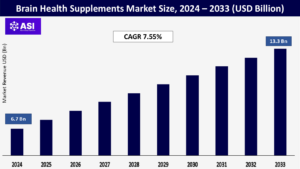
The global Brain Health Supplements Market was valued at approximately USD 6.7 billion in 2024 and is projected to reach USD 13.3 billion by 2033, growing at a CAGR of 7.55% during the forecast period (2025–2033).
Brain health supplements are a group of dietary formulations meant to assist an individual with attention, memory, focus, and mental clarity. Brain supplements include herbal extracts such as Ginkgo biloba, Bacopa monnieri, vitamins, omega-3 fatty acids, and amino acids which aid in neural protection against cognitive decline. People of all ages, from students and young professionals can use brain supplements in order to boost mental performance while older people can use it to help preserve memory and reduce the chances of developing neurodegenerative diseases. Increasing mental health awareness around the world, growing elder populations, anxiety and depression are the main factors that drive the market growth. The increasing use of brain health support and the growing need for natural, non-prescription supplements also contribute to the expansion.
The market for brain health supplements is significantly impacted by the rising prevalence of mental diseases, Alzheimer’s disease, and cognitive impairment. Dementia affects around 55 million individuals, and almost 10 million new cases are diagnosed each year. Of them, Alzheimer’s disease accounts for 60 to 70 percent of new cases. Additionally, people of all ages are becoming more likely to experience chronic stress, anxiety, and depression. According to estimates from the Global Burden of Disease Study, about 280 million people suffered from depression in 2023. This has led some people to look for balance and mental protection without a prescription. Ginkgo biloba, omega-3, and B-vitamin supplements have been linked to improved memory and mood stability. Additionally, some research contends that omega-3 fatty acids slow down the rate at which older people’s cognitive abilities deteriorate. The demand for these supplements is also rising as a result of public knowledge, media attention, and medical professionals’ support. The usage of health supplements is expected to increase as a result of increased consumer and clinical attention being paid to mental health.
The brain health supplements market is growing primarily because of the growth in the world’s older population. Based on the United Nations statistics, individuals older than 65 years will increase from 771 million in 2022 to over 1.6 billion by the year 2050. Aging is also well-documented to be associated with cognitive impairment that encompasses memory loss, decelerated thought processes, and increased vulnerability to neurodegenerative conditions like Alzheimer’s and Parkinson’s.
Older individuals are now more and more dependent on supplements that enhance memory, concentration, and brain functions to stay independent and enhance their quality of life. Because of their neuroprotective properties, these people are primarily interested in supplements containing curcumin, phosphatidylserine, and acetyl-L-carnitine. Curcumin has been shown in studies to lower beta-amyloid plaques in the brain, which are linked to the onset of Alzheimer’s disease. Additionally, retirees and the elderly are more likely to spend money on their health and preventative cognitive care. These items benefit from easy access through e-commerce websites and over-the-counter stores, which increases their use. The growing global aging population and growing concerns about brain health will drive an increase in demand for cognitive supplements over the course of the forecast period.
Despite growing consumer demand for brain health supplements, the business is mostly hindered by inconsistent regulatory oversight and a lack of rigorous clinical validation. Dietary supplements are not subject to the same stringent testing requirements as prescription medications by regulatory agencies such as the European Medicines Agency (EMA) or the U.S. Food and Drug Administration (FDA). Due to this regulatory gap, the majority of products are released onto the market with scant or conflicting scientific proof of their safety or effectiveness. For instance, research trials have yielded conflicting results about the true clinical advantages of substances like Ginkgo biloba and Bacopa monnieri, despite the fact that they are frequently marketed for cognitive enhancement, especially in healthy participants.
A 2020 review in The Journal of Clinical Psychopharmacology revealed a lack of evidence to warrant many nootropic supplements for age-related decline. Also, the inconsistency of product quality and dosing provides enough doubt to dissuade healthcare providers from recommending them and cautious consumers from adopting them. The threat of overhyped claims, placebo responses, or even harmful interactions with prescribed drugs provides enough reasons to be concerned. These problems can undermine consumer confidence and discourage health professionals from prescribing brain well-being supplements, thus limiting the potential of the market to growth.
| Report Metric | Details |
|---|---|
| Segmentations | |
| By ProductType |
Natural Molecules Herbal Extracts Vitamins & Minerals |
| By Application |
Memory Enhancement Mood & Depression Management Attention & Focus Sleep & Recovery Anti-Aging & Longevity Stress & Anxiety Reduction |
| By End-User |
Individual Consumers Athletes & Fitness Enthusiasts Students Corporate Professionals Geriatric Population |
| Key Players |
Teva Pharmaceutical Industries Ltd. Reckitt Benckiser Group plc NOW Foods Natural Factors Nutritional Products Ltd. Quincy Bioscience Onnit Labs, Inc. HVMN Inc. AlternaScript LLC Purelife Bioscience Co., Ltd. Intelligent Labs Accelerated Intelligence Inc. |
| Geographies Covered | |
| North America |
U.S. |
| Europe |
U.K. |
| Asia Pacific |
China |
| Middle East & Africa |
Saudi Arabia |
| Latin America |
Brazil |
The Brain Health Supplements Market is divided across product type, application, and end user. All the segments mirror the changing consumer needs, lifestyle trends, and the surging need for cognitive well-being solutions.
Natural Molecules captured the highest market share in 2024 due to the growing demand of consumers towards non-synthetic, bioactive molecules like omega-3 fatty acids, citicoline, and phosphatidylserine. All these ingredients are well known for their contribution towards neuronal health, memory recall, and synapse function, particularly in the elderly. Their well-defined scientific rationale and high consumer confidence are further propelling their adoption geographically.
The segment of Herbal Extracts is likely to see aggressive growth owing to increasing awareness and conventional use of plant-based nootropics such as Ginkgo biloba, Bacopa monnieri, and ashwagandha. These extracts are in high demand for their mood-enhancing, stress-relieving, and memory-boosting properties, particularly in regions like Asia-Pacific and North America. Vitamins & Minerals are widely used to support overall brain function and nutritional balance. Supplements with B-complex vitamins, magnesium, and zinc are being more and more demanded to counteract deficiency associated with mental fatigue and lack of concentration, especially among younger adults and students.
Memory Enhancement supplements lead the application segment due to increased demand from the older population and those with preliminary indicators of cognitive weakening. These supplements are highly promoted to seniors to help maintain long-term memory and brain plasticity. Mood & Depression Management is also on the rise as mental health concerns are raised globally. Natural adaptogens and serotonergic compounds such as St. John’s Wort and 5-HTP are utilized to promote emotional stability, particularly among young adults and career workers exposed to constant stress. Focus & Concentration supplements are becoming increasingly popular among students and professionals seeking to enhance productivity and mental clarity.
Supplements such as L-theanine, caffeine combinations, and Rhodiola rosea help maintain continuous focus and mental clarity by minimizing mental fatigue. Sleep & Recovery apps are on a steady rise, with consumers wanting to maximize sleep and minimize insomnia. Melatonin and herbal sleep aids dominate this category. Anti-Aging & Longevity supplements address oxidative stress and neuroinflammation with such active ingredients as resveratrol and curcumin, benefiting a growing consumer group interested in longevity and brain preservation. Stress & Anxiety Reduction is a new growth area driven by city lifestyle, pandemic consequences, and office burnout. Botanicals such as ashwagandha and lavender are becoming more prominent in soothing products.
Individual Consumers are the biggest end-users, making the largest number of over-the-counter purchases via pharmacies and online channels. They cut across all age ranges and buy supplements for general well-being and proactive brain health. Athletes & Fitness Enthusiasts are also taking brain supplements to improve mind-muscle coordination, response time, and mental stamina. Nootropics are increasingly being incorporated into sports nutrition regimens in tandem with physical performance enhancers. Students are major consumers of attention, focus, and memory-boosting supplements, especially during examination times. This group favors fast-acting and multicomponent products.
North America dominates the brain health supplements market, accounting for the largest share in 2024, driven by increasing awareness of cognitive health, high healthcare expenditure, and a growing aging population. The U.S. is a key contributor, where the use of over-the-counter dietary supplements is well-established and supported by widespread retail and e-commerce distribution channels. The prevalence of mental health conditions, stress-related disorders, and neurodegenerative diseases such as Alzheimer’s has boosted the demand for memory, focus, and mood enhancement supplements. Rising use of natural nootropics like omega-3s and L-theanine among students and professionals is also expanding the market base.
Europe represents a significant portion of the global market, with countries such as Germany, the UK, and France leading due to a health-conscious population and strong regulatory standards under the European Food Safety Authority (EFSA). The increasing elderly population across the continent is driving the use of supplements targeting memory enhancement and neuroprotection. Furthermore, the cultural acceptance of herbal and botanical remedies contributes to the popularity of plant-based brain health products like Ginkgo biloba and valerian root. Preventive healthcare trends and demand for clean-label supplements are also shaping consumer preferences.
Asia-Pacific is the fastest-growing regional market, supported by a large and aging population, rising mental health awareness, and traditional medicine practices. Countries such as China, Japan, India, and South Korea are major contributors. In China and Japan, the high prevalence of cognitive decline among seniors is fueling the demand for supplements aimed at memory retention and anti-aging. Meanwhile, India’s youth-dominated population is turning to brain-boosting supplements for focus, stress management, and academic performance, often driven by Ayurveda-based formulations. Increased digital access and urbanization are making supplements more accessible across both urban and rural markets.
Latin America is witnessing steady growth, with Brazil and Mexico at the forefront of market expansion. Rising stress levels, a shift toward preventive healthcare, and growing middle-class spending are contributing to increased interest in brain health supplements. Herbal ingredients native to the region, such as guarana and yerba mate, are being incorporated into locally preferred formulations. As consumers become more informed through social media and wellness influencers, demand for focus, mood, and sleep-related supplements is increasing, particularly among younger demographics and working professionals.
The Middle East & Africa is an emerging market with increasing awareness of mental health and brain wellness. Countries like the United Arab Emirates and Saudi Arabia are investing in the wellness industry, with consumers adopting supplements as part of lifestyle optimization. Although the market is smaller compared to other regions, rising income levels and urbanization are fostering interest in premium brain supplements, particularly among younger consumers and expatriates. As healthcare infrastructure improves, the region is expected to see gradual yet steady adoption of brain health products across various end-user segments.
The brain health supplements market was valued at USD 6.7 Billion in 2024.
The brain health supplements market is projected to grow at a CAGR of 7.55% from 2025 to 2033
The Memory enhancement holds the largest market share.
The Asia-Pacific region is expected to witness the highest growth rate.
Major players include Teva Pharmaceutical Industries Ltd, Reckitt Benckiser Group plc, NOW Foods, Natural Factors Nutritional Products Ltd.
1.1 Summary
1.2 Research methodology
2.1 Research Objectives
2.2 Market Definition
2.3 Limitations & Assumptions
2.4 Market Scope & Segmentation
2.5 Currency & Pricing Considered
3.1 Drivers
3.2 Geopolitical Impact
3.3 Human Factors
3.4 Technology Factors
4.1 Porters Five Forces Analysis
4.2 Value Chain Analysis
4.3 Average Pricing Analysis
4.4 M & A, Agreements & Collaboration Analysis
5.1 Brain Health Supplement Market, By Product Type
5.1.1 Introduction
5.1.2 Market Size & Forecast
5.2 Brain Health Supplement Market, By Application
5.3 Brain Health Supplement Market, By End-User
6.1 North America Brain Health Supplement Market, By Country
6.1.1 Brain Health Supplement Market, By Product Type
6.1.2 Brain Health Supplement Market, By Application
6.1.3 Brain Health Supplement Market, By End-User
6.2 U.S.
6.2.1 Brain Health Supplement Market, By Product Type
6.2.2 Brain Health Supplement Market, By Application
6.2.3 Brain Health Supplement Market, By End-User
6.3 Canada
7.1 U.K.
7.2 Germany
7.3 France
7.4 Spain
7.5 Italy
7.6 Russia
7.7 Nordic
7.8 Benelux
7.9 The Rest of Europe
8.1 China
8.2 South Korea
8.3 Japan
8.4 India
8.5 Australia
8.6 Taiwan
8.7 South East Asia
8.8 The Rest of Asia-Pacific
9.1 UAE
9.2 Turkey
9.3 Saudi Arabia
9.4 South Africa
9.5 Egypt
9.6 Nigeria
9.7 Rest of MEA
10.1 Brazil
10.2 Mexico
10.3 Argentina
10.4 Chile
10.5 Colombia
10.6 Rest of Latin America
11.1 Global Market Share (%) By Players
11.2 Market Ranking By Revenue for Players
11.3 Competitive Dashboard
11.4 Product Mapping