

Cancer Supportive Care Drugs Market
Cancer Supportive Care Drugs Market Share & Trends Analysis Report By Drug Type (Granulocyte Colony-Stimulating Factors (G-CSFs), Antiemetics, Erythropoiesis-Stimulating Agents (ESAs), Opioid Analgesics and Nonsteroidal Anti-inflammatory Drugs (NSAIDs), Bisphosphonates, Anti-infective Drugs, Other Therapeutic Classes), By Application (Chemotherapy-Induced Nausea and Vomiting (CINV), Chemotherapy-Induced Neutropenia (CIN), Chemotherapy-Induced Anemia, Cancer Pain, Bone Metastasis/Skeletal-Related Events (SREs), Oral Mucositis, Others), By Distribution Channel (Hospital Pharmacies, Retail Pharmacies, Online Pharmacies, Specialty Pharmacies) Industry Analysis Report, Regional Outlook, Growth Potential, Price Trends, Competitive Market Share & Forecast, 2025–2033

Historical Period: 2019-2024
Forecast Period: 2025-2033
Report Code : ASIPHR1007
CAGR: 7.1%
Last Updated : July 17, 2025
The worldwide market for Cancer Supportive Care Drugs Market was valued at approximately USD 21.4 billion in 2024 and is projected to reach USD 36.3 billion by 2033, demonstrating a compound annual growth rate (CAGR) of 7.1% during the forecast period of 2025–2033.
Between 2025 and 2033, the market for cancer supportive care drugs is expected to grow steadily. This trend reflects a deeper, global reality: as more people are diagnosed with cancer, and as treatments become more advanced, patients often face difficult side effects. In response, there’s a growing emphasis on not just treating the disease, but also improving the day-to-day lives of those affected. Supportive care drugs designed to ease symptoms like nausea, pain, fatigue, and more are becoming a vital part of the overall cancer care journey.
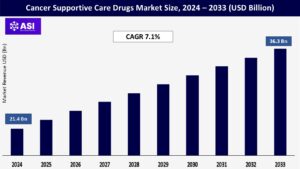
The Cancer Supportive Care Drugs Market is set to grow steadily between 2025 and 2033, fueled by several powerful forces that reflect the changing face of cancer care. This growth isn’t just about numbers it’s rooted in real-world shifts in how cancer is diagnosed, treated, and managed on a deeply human level. Perhaps the most significant factor behind this growth is the increasing number of people being diagnosed with cancer worldwide.
As populations age and grow, cancer has become more common in nearly every corner of the globe. This rising incidence isn’t just a statistic it means more individuals and families navigating the challenges of cancer treatment. With more patients undergoing therapies like chemotherapy, radiation, and immunotherapy, there’s a growing need to manage the often harsh side effects that come with them.
Supportive care drugs play a crucial role here. They help ease pain, reduce nausea, manage fatigue, and improve patients’ ability to continue their treatments and maintain a better quality of life. In short, as more people face cancer, the need for comfort, care, and support grows too and that’s exactly where supportive care drugs step in.
Cancer treatment has entered a new era, with innovative therapies like immunotherapy, targeted treatments, and precision medicine transforming patient outcomes. However, despite these advances, many of these treatments bring their own set of challenging and sometimes severe side effects. Even traditional approaches such as chemotherapy and radiation therapy continue to cause significant physical distress. Supportive care drugs play a crucial role in helping patients cope with these effects, enabling them to better tolerate their treatments and, importantly, complete the full course of therapy.
These drugs address a wide range of complications, from chemotherapy-induced nausea and vomiting (CINV) and neutropenia (a dangerous drop in white blood cells), to anemia, pain including nerve and bone pain persistent fatigue, heightened risk of infections, and bone-related issues. By easing these burdens, supportive care therapies significantly enhance a patient’s comfort, resilience, and overall quality of life during the often difficult cancer journey.
As patents for many well-established supportive care drugs begin to expire, the market is seeing an influx of generic and biosimilar alternatives. On one hand, this is a positive development—it helps lower healthcare costs and makes these important medications more accessible to a broader range of patients. On the other hand, it also creates intense price competition. For companies that manufacture branded drugs, this shift can mean significant pressure to reduce prices, resulting in shrinking market share and declining revenues.
This trend is especially noticeable in commonly used drug classes like G-CSFs (used to boost white blood cell counts) and ESAs (used to treat anemia), where the availability of lower-cost alternatives is rapidly reshaping the competitive landscape.
| Report Metric | Details |
|---|---|
| Segmentations | |
| By Drug Type |
Granulocyte Colony-Stimulating Factors (G-CSFs) Antiemetics Erythropoiesis-Stimulating Agents (ESAs) Opioid Analgesics Nonsteroidal Anti-inflammatory Drugs (NSAIDs) Bisphosphonates Anti-infective Drugs Other Therapeutic Classes |
| By Application |
Chemotherapy-Induced Nausea and Vomiting (CINV) Chemotherapy-Induced Neutropenia (CIN) Chemotherapy-Induced Anemia, Cancer Pain Bone Metastasis/Skeletal-Related Events (SREs) Oral Mucositis Others |
| By Distribution Channel |
Hospital Pharmacies Retail Pharmacies Online Pharmacies Specialty Pharmacies |
| Key Players |
|
| Geographies Covered | |
| North America |
U.S. |
| Europe |
U.K. |
| Asia Pacific |
China |
| Middle East & Africa |
Saudi Arabia |
| Latin America |
Brazil |
The Cancer Supportive Care Drugs Market is categorized by drug type, by application, and by distribution channel. Each segment is rapidly evolving, with different areas of the industry growing at their own pace and shifting in how much of the market they represent.
Supportive care drugs play a vital role in helping cancer patients manage the often difficult side effects of treatment. These medications are typically grouped based on the specific symptoms or complications they address, making this one of the most essential segments of the cancer care landscape.
Granulocyte Colony-Stimulating Factors (G-CSFs) are among the most widely used supportive care drugs. They help the body produce more white blood cells, which are crucial for fighting infections especially important for patients undergoing chemotherapy, who are at high risk of neutropenia (a dangerous drop in white blood cells).
Erythropoiesis-Stimulating Agents (ESAs) help combat anemia by stimulating red blood cell production. Anemia is common in cancer patients and can leave them feeling weak and fatigued. Bisphosphonates are important for managing bone complications, especially in cancers that spread to the bones or cause elevated calcium levels. Medications like zoledronic acid help protect bone health by slowing down bone breakdown. Corticosteroids are used for a range of issues, including inflammation and brain swelling.
Managing cancer-related fatigue remains a challenge, but some off-label and experimental therapies are emerging. Additionally, dermatological agents are used to treat skin reactions from certain cancer treatments, helping patients stay comfortable and continue their care uninterrupted. Together, these supportive care drugs form the backbone of comprehensive cancer treatment, helping patients not only survive but maintain a better quality of life throughout their journey.
Supportive care in cancer isn’t one-size-fits-all it’s tailored to manage specific complications that patients face during their treatment journey. This segmentation focuses on addressing those individual conditions and side effects, each of which can have a profound impact on a patient’s comfort, safety, and ability to continue therapy. Chemotherapy-Induced Nausea and Vomiting (CINV) is one of the most common and distressing side effects of cancer treatment. It can significantly affect a patient’s quality of life and willingness to continue chemotherapy, making this a major area of focus in supportive care.
Medications that prevent or relieve nausea are essential to helping patients stay on track with their treatment plans. Chemotherapy-Induced Neutropenia (CIN) is another critical condition. Chemotherapy often lowers white blood cell counts, weakening the immune system and increasing the risk of severe infections. This potentially life-threatening complication is directly managed with drugs called G-CSFs, which help the body quickly rebuild its defenses.
Chemotherapy-Induced Anemia can leave patients feeling constantly tired, weak, and short of breath. To combat this, doctors may use erythropoiesis-stimulating agents (ESAs) or iron supplements to help boost red blood cell production and restore energy levels. Cancer-related pain is a widespread and often complex issue. It can come in many forms nerve pain, bone pain, or pain from tumors pressing on organs and may range from mild discomfort to severe, persistent agony. Managing this pain is vital to maintaining a patient’s dignity, function, and overall well-being throughout treatment. Bone metastasis and skeletal-related events (SREs) are also a major concern, particularly in cancers that spread to the bones.
These can cause fractures, pain, and mobility issues. Medications like bisphosphonates and denosumab are used to protect bone health and reduce complications. Oral mucositis, the painful inflammation and ulceration of the mouth’s lining, is another debilitating side effect, especially for patients undergoing chemotherapy or radiation. Treating it is essential to ensure patients can eat, drink, and speak comfortably. Finally, there’s a wide array of other symptoms and conditions that supportive care helps manage everything from fatigue, diarrhea, and constipation, to skin reactions, lymphedema, and emotional or psychological distress. While they might be classified as “others” on a chart, these challenges are very real for patients and require compassionate, effective care to address.
Supportive care drugs reach patients through several different channels, each playing a unique role in how treatment is delivered and accessed. Hospital pharmacies are often the primary distribution point, especially since many cancer treatments and the immediate management of serious side effects take place in hospitals or outpatient oncology clinics. These settings are equipped to handle urgent needs and administer drugs that require close monitoring.
Retail pharmacies also play a vital role, particularly for medications that patients can take at home. This includes oral antiemetics to prevent nausea, pain medications, and growth factors that patients may self-administer. For many, the neighborhood pharmacy is a convenient and accessible link in their care. Online pharmacies have seen significant growth, especially in the wake of the COVID-19 pandemic. They offer convenience, home delivery, and often competitive pricing. While they may not be the first choice for initiating complex supportive care regimens, they are becoming an increasingly popular option for refills and ongoing maintenance treatments.
Then there are specialty pharmacies, which focus on high-cost or complex medications that require special handling, storage, or administration. These pharmacies often provide additional services like patient education, insurance navigation, and support programs to ensure patients stay on track with their treatment plans. Together, these distribution channels ensure that patients can access the supportive care they need whether it’s during an urgent hospital visit or from the comfort of home.
North America currently leads the global cancer supportive care drugs market, holding the largest share valued at around $9.21 billion in 2024. This strong position is driven by several key advantages. The region benefits from an advanced healthcare infrastructure and some of the highest healthcare spending in the world.
There’s also a strong embrace of personalized and targeted therapies, which often come with side effects that require supportive care. The presence of major pharmaceutical companies and substantial investments in research and development further fuel innovation in this space. Reimbursement systems in the U.S. and Canada are generally favorable, making it easier for patients to access high-cost treatments.
At the same time, tightening regulations around opioid prescriptions are influencing how pain management is approached. Overall, the United States and Canada remain the dominant markets in North America, thanks to their mature healthcare systems and ongoing commitment to advancing cancer care.
Europe holds a significant share of the global cancer supportive care drugs market, with its value reaching approximately $xx billion in 2024. This strong position is supported by Europe’s well-established pharmaceutical industry and a deep commitment to advancing cancer care. Many countries in the region invest heavily in healthcare, particularly in cancer treatment and supportive services, and benefit from a solid healthcare infrastructure that ensures wide access to care.
The region is also known for its emphasis on innovation and patient-centered approaches, with growing interest in therapies that not only treat cancer but also improve quality of life during treatment. However, Europe’s regulatory environment is notably strict, which helps ensure drug safety and effectiveness but can also slow down the introduction of new treatments. Overall, Europe continues to be a key player in this space, balancing innovation with rigorous standards to support cancer patients effectively.
Asia-Pacific stands out as the fastest-growing region in the global cancer supportive care drugs market, with its value reaching around $xx billion in 2024. This rapid growth is being fueled by several powerful trends. As the region’s population continues to grow and age, and as lifestyles shift often adopting more Western habits the number of cancer cases is rising sharply.
At the same time, access to healthcare is expanding, infrastructure is improving, and more people are gaining the ability to afford treatment thanks to rising incomes. China and India are leading the charge, emerging as key growth markets due to their large populations and increasing focus on healthcare. However, increasing government initiatives aimed at strengthening healthcare systems are helping to close the gap making Asia-Pacific a dynamic and promising frontier for cancer supportive care.
Regions outside of North America, Europe, and Asia-Pacific such as Latin America, the Middle East, and Africa currently represent a smaller share of the global cancer supportive care drugs market. In 2024, these regions were valued at approximately $xx billion and $xxbillion, respectively. While their market presence is modest, they are emerging as areas of opportunity.
Cancer drug adoption is gradually increasing, driven by growing awareness and improving access to healthcare. However, several challenges remain. Many of these countries face underdeveloped healthcare infrastructure and lower levels of disposable income, which can limit both access to and affordability of supportive care drugs. Looking globally, there are a few common threads that influence the cancer supportive care market across all regions. Most notably, cancer rates are on the rise everywhere, and aging populations who are more vulnerable to cancer are contributing significantly to this trend. As newer cancer therapies continue to evolve, they often bring harsh side effects that require dedicated supportive care, making these drugs a crucial part of the treatment journey.
At the same time, there’s growing recognition of the need to prioritize patient comfort, symptom management, and overall quality of life throughout cancer care. Governments in many regions are stepping in to support this shift, offering better reimbursement policies and launching public health initiatives to improve access to essential medications. Technological advancements, such as telemedicine and digital health tools, are also beginning to break down barriers to care especially in underserved or remote areas. Together, these forces are gradually reshaping the global landscape, bringing supportive care closer to the patients who need it most.
The market was valued at USD 21.34 billion in 2024.
The market is projected to grow at a CAGR of 7% from 2025 to 2033.
G-CSF (Granulocyte Colony-Stimulating Factor) segment holds the largest market share.
Asia-Pacific region is expected to witness the highest growth rate.
Major players include large pharmaceutical companies and biotech firms like Amgen, Merck & Co., Johnson & Johnson, Novartis, and Roche.
1.1 Summary
1.2 Research methodology
2.1 Research Objectives
2.2 Market Definition
2.3 Limitations & Assumptions
2.4 Market Scope & Segmentation
2.5 Currency & Pricing Considered
3.1 Drivers
3.2 Geopolitical Impact
3.3 Human Factors
3.4 Technology Factors
4.1 Porters Five Forces Analysis
4.2 Value Chain Analysis
4.3 Average Pricing Analysis
4.4 M & A, Agreements & Collaboration Analysis
5.1 Cancer Supportive Care Drugs Market, By Drug Type
5.1.1 Introduction
5.1.2 Market Size & Forecast
5.2 Cancer Supportive Care Drugs Market, By Application
5.3 Cancer Supportive Care Drugs Market, By Distribution Channel
6.1 North America Cancer Supportive Care Drugs Market, By Country
6.1.1 Cancer Supportive Care Drugs Market, By Drug Type
6.1.2 Cancer Supportive Care Drugs Market, By Application
6.1.3 Cancer Supportive Care Drugs Market, By Distribution Channel
6.2 U.S.
6.2.1 Cancer Supportive Care Drugs Market, By Drug Type
6.2.2 Cancer Supportive Care Drugs Market, By Application
6.2.3 Cancer Supportive Care Drugs Market, By Distribution Channel
6.3 Canada
7.1 U.K.
7.2 Germany
7.3 France
7.4 Spain
7.5 Italy
7.6 Russia
7.7 Nordic
7.8 Benelux
7.9 The Rest of Europe
8.1 China
8.2 South Korea
8.3 Japan
8.4 India
8.5 Australia
8.6 Taiwan
8.7 South East Asia
8.8 The Rest of Asia-Pacific
9.1 UAE
9.2 Turkey
9.3 Saudi Arabia
9.4 South Africa
9.5 Egypt
9.6 Nigeria
9.7 Rest of MEA
10.1 Brazil
10.2 Mexico
10.3 Argentina
10.4 Chile
10.5 Colombia
10.6 Rest of Latin America
11.1 Global Market Share (%) By Players
11.2 Market Ranking By Revenue for Players
11.3 Competitive Dashboard
11.4 Product Mapping