

Asia Pacific Nifedipine Market
Asia Pacific Nifedipine Market size, share & trends Analysis report By Type (Nifedipine Controlled-Release Tablets, Nifedipine Extended Action Tablets), By Application (Primary Pulmonary Hypertension, Heart Failure, Raynaud’s Syndrome, Cephalalgia, Others), By Distribution Channel (Hospital Pharmacies, Retail Pharmacies, Others) – Industry Analysis report, regional outlook growth potential, price trends, competitive market share & forecast 2025-2033

Historical Period: 2019-2024
Forecast Period: 2025-2033
Report Code :
CAGR: 8.30%
Last Updated : July 24, 2025
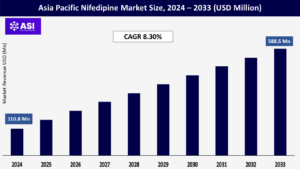
The Asia Pacific Nifedipine market across the globe was worth about USD 310.8 million in the year 2024 and is anticipated to be worth USD 588.5 million by growing at a CAGR of 8.30% from the forecast period of 2025-2033 Nifedipine is a calcium channel blocker that is being used extensively for hypertension and angina. The demand is mainly fueled by the rising incidence of cardiovascular conditions, a geriatric population, and augmented accessibility to healthcare services in emerging economies within the region.
In addition, government programs that enhance cardiovascular well-being and increase awareness of hypertension management further fuel demand for nifedipine. The Asia pacific nifedipine market is expected to expand enormously with growth being fueled by rising occurrences of cardiovascular diseases, an aging population, and improvements in healthcare infrastructure in the region.
The Asia-Pacific region is experiencing a noteworthy demographic transition defined by the fast-growing population that is aging. These nations include Japan, South Korea, and China, where a higher percentage of the population is now aged 60 and over. Older people are at greater risk of developing chronic diseases, especially hypertension, angina, and other cardiovascular illness, for which Nifedipine is a standard medication. The widespread presence of age-related arterial stiffness and enhanced vascular resistance in older people requires successful blood pressure control, fueling demand for long-acting calcium channel blockers such as Nifedipine. The United Nations Economic and Social Commission for Asia and the Pacific (ESCAP) states that by 2050, the number of people in the region aged 60 years or older will be one-quarter of the total population.
In return, many governments have increased elderly care access, insurance coverage for chronic disease medications, and screening routine programs. For example, Japan’s universal health insurance offers antihypertensive medications, such as Nifedipine, at affordable prices and access. This demographic shift will increase market demand considerably in hospitals, geriatric clinics, and pharmacies, further solidifying Nifedipine’s position in the treatment of cardiovascular disease
Increasing Healthcare Infrastructure and Government Initiatives
The continued growth of healthcare facilities and growing government intervention in enhancing public healthcare in Asia-Pacific is a key driver of the Nifedipine market. The rapidly growing emerging markets like India, Indonesia, Vietnam, and the Philippines are investing aggressively in hospital chains, primary care facilities, and health insurance plans to enhance accessibility to primary medicines like antihypertensive drugs. These advances are intended to close healthcare disparities and provide affordable care in rural areas and among underserved communities.
Most countries have launched national programs on non-communicable diseases (NCDs) and place hypertension and heart disease on top of their lists. Such programs are usually through bulk purchase and supply of drugs such as Nifedipine, particularly in public clinics and hospitals. For instance, India’s Ayushman Bharat program and China’s Healthy China 2030 program focus on mass screening and treatment of chronic diseases. This has resulted in a boost in the demand for core generics, with Nifedipine being featured prominently in essential medicines lists.
Limited Access to Healthcare in Rural and Remote Areas Even with improvements in urban health care infrastructure, one of the key constraints in the Asia-Pacific Nifedipine market is poor access to health care in rural and outlying areas. Several regions in countries like India, Indonesia, Myanmar, and Cambodia endure ongoing challenges such as shortages of skilled health care practitioners, under-resourced medical facilities, and patchy access to basic drugs.
These gaps inhibit early diagnosis and timely treatment of cardiovascular diseases and hypertension conditions where Nifedipine is crucial. The condition is further worsened by logistical challenges such as inadequate transport infrastructure that hinders medicine distribution efficiency. Consequently, even when there is policy or funding backing medicine access, the real delivery of care and medicines is not consistent. For instance, in rural Indonesia, healthcare access remains poor on remote islands, with patients resorting to informal health networks or postponing treatment until symptoms are severe.
| Report Metric | Details |
|---|---|
| Segmentations | |
| By Type |
Nifedipine Controlled-Release Tablets Nifedipine Extended Action Tablet |
| By Application |
Primary Pulmonary Hypertension Heart Failure Raynaud’s Syndrome Cephalalgia, Others |
| By Distribution Channel |
Hospital Pharmacies Retail Pharmacies Others |
| Key Players |
Bayer AG Teva Pharmaceutical Industries Ltd Sun Pharmaceutical Industries Ltd Cipla Ltd Zydus Lifesciences Ltd Aurobindo Pharma Ltd Mylan N.V. (now Viatris Inc.) Torrent Pharmaceuticals Ltd Alkem Laboratories Ltd Lupin Limited Dr. Reddy’s Laboratories Apotex Inc |
| Geographies Covered | |
| Asia Pacific |
China |
Out of the formulations available, Nifedipine Controlled-Release Tablets lead the Asia Pacific market. These tablets provide steady drug delivery over long durations, enhancing patient compliance and minimizing blood pressure level fluctuations. Increasing occurrences of chronic hypertension and the necessity for long-term stable treatment are prime motivating factors for their use. Controlled-release tablets in 2024 held more than 45% of the market share within the region, especially in Japan and South Korea, where treatment and adherence are rigidly adhered to.
Nifedipine Extended Action Tablets are becoming popular because of their improved pharmacokinetics and lessened side effects. As the diagnosis of cardiovascular complications increases in new economies such as India and Indonesia, advanced oral therapeutics demand is increasing. The market is likely to register a CAGR of 6.8% during 2025-2030, courtesy of physician preference for once-daily administration and improved systolic blood pressure spikes control.
Primary Pulmonary Hypertension (PPH) is the dominant application of nifedipine in the Asia Pacific region, driven by increasing incidences of idiopathic and secondary pulmonary hypertension. Awareness drives and sophisticated diagnostic facilities available in China and Australia have contributed toward increased early detection and prescription of calcium channel blockers such as
Nifedipine for the treatment of Heart Failure is experiencing consistent growth. Whereas beta-blockers are traditionally first-line therapy, nifedipine’s vasodilation is indicated in those not tolerating them. Aging population countries like Japan and Singapore are experiencing increasing nifedipine use for managing geriatric heart failure. Raynaud’s Syndrome is a specialty but growing segment. Growing sensitivity among doctors and patients, especially in the colder regions of North Asia, is leading to modest growth. The segment has a market share of around 8.5% and will increase with better diagnosis rates.
Hospital Pharmacies dominate the channel of distribution in the Asia Pacific nifedipine market through the prescription-based drug along with the need for professional diagnosis. Hospital pharmacies captured 53.2% of the market in 2024, especially in urban regions where big medical facilities control patient care. Retail Pharmacies are becoming more significant, particularly in Southeast Asia, due to high out-of-pocket healthcare spending.
Greater availability of generic forms of nifedipine and the penetration of pharmacy chains into India, Thailand, and Vietnam have driven growth in this channel. Other Channels, such as online pharmacies and specialty clinics, are growing quickly. As more internet penetration and digital health adoption takes place, especially in countries such as China and South Korea, the segment for e-pharmacy is expected to advance at a CAGR of 9.1% through 2030.
The Asia Pacific region is witnessing the fastest growth in the global nifedipine market, driven by the increasing prevalence of hypertension and cardiovascular diseases, growing elderly population, and expanding access to healthcare services. The market is also expected to register a CAGR of 7.2% during 2025-2032, underpinned by increased awareness, government incentives, and the widespread availability of affordable generics. China holds the largest share of the Asia Pacific nifedipine market, accounting for over 30% in 2024.
The country’s massive population base, high incidence of hypertension, and significant healthcare reforms are fueling demand. Public healthcare spending and an active generic pharmaceutical sector make nifedipine available and affordable. In addition, increased urbanization and health hazards related to lifestyles are pushing more diagnoses and prescriptions.India is emerging as the fastest-growing market within the region. With an increasingly large middle class, rising diagnosis rates of chronic diseases, and enhanced rural health coverage through initiatives such as Ayushman Bharat, the consumption of antihypertensive medications such as nifedipine is gaining pace.
India’s cost-conscious market and capability for large-scale generic production facilitate widespread availability of drugs at reduced prices, fuelling volume-driven growth. Japan, which has one of the most developed pharmaceutical markets within the region, has stable demand for nifedipine, based mainly on its aging population as well as organized chronic disease management initiatives. The Japanese market prioritizes drug efficacy, patient safety, and controlled-release formulations, with physicians preferring long-acting formulations of nifedipine for long-term control of hypertension and angina.
The Asia pacific nifedipine market was worth USD 310.8 million in 2024
The Asia pacific nifedipine market will grow at a CAGR of 8.30% during the period from 2025to 2033
The nifedipine controlled-release tablets have the biggest market share.
The china market is most likely to experience the highest growth market
Major players in the Asia Pacific Nifedipine Market are Bayer AG, Teva Pharmaceutical Industries Ltd, Sun Pharmaceutical Industries Ltd, Cipla Ltd, Zydus Lifesciences Ltd.
1.1 Summary
1.2 Research methodology
2.1 Research Objectives
2.2 Market Definition
2.3 Limitations & Assumptions
2.4 Market Scope & Segmentation
2.5 Currency & Pricing Considered
3.1 Drivers
3.2 Geopolitical Impact
3.3 Human Factors
3.4 Technology Factors
4.1 Porters Five Forces Analysis
4.2 Value Chain Analysis
4.3 Average Pricing Analysis
4.4 M & A, Agreements & Collaboration Analysis
5.1 Asia Pacific Nifedipine Market By Type
5.1.1 Introduction
5.1.2 Market Size & Forecast
5.2 Asia Pacific Nifedipine Market By Application
5.3 Asia Pacific Nifedipine Market By Distribution Channel
8.1 China
8.2 South Korea
8.3 Japan
8.4 India
8.5 Australia
8.6 Taiwan
8.7 South East Asia
8.8 The Rest of Asia-Pacific
11.1 Global Market Share (%) By Players
11.2 Market Ranking By Revenue for Players
11.3 Competitive Dashboard
11.4 Product Mapping