

Biopharmaceutical Excipients Market
Biopharmaceutical Excipients Market Share & Trends Analysis Report, By Excipient (Bulking Agents, Solubilizers and Surfactants, Buffering and Tonicity Agents, Others), By Biologics (Monoclonal Antibodies, Vaccines, Others), By End-User (Pharma and Biotech Companies, CMOS and CDMOS, Academic and Research Institutes)– Industry Analysis Report, Regional Outlook, Growth Potential, Price Trends, Competitive Market Share & Forecast, 2025–2033.

Historical Period: 2019-2024
Forecast Period: 2025-2033
Report Code :
CAGR: 7.10 %
Last Updated : July 25, 2025
The global Biopharmaceutical Excipients Market was valued at approximately USD 2.5 billion in 2024 and is projected to reach USD 4.3 billion by 2033, growing at a CAGR of 7.10% during the forecast period (2025–2033).
The biopharmaceutical excipients market encompasses the sector that manufactures and distributes inactive ingredients, known as excipients, which are essential components in the formulation of biopharmaceutical products. Although excipients have no therapeutic effect on their own, they play vital roles in supporting the stability of active pharmaceutical ingredients (APIs), improving solubility, enhancing bioavailability, and ensuring reliable drug delivery. These substances are crucial for the effective production, storage, and administration of biologic drugs such as vaccines, monoclonal antibodies, and recombinant proteins.
Important characteristics of biopharmaceutical excipients include high levels of purity, compatibility with biological systems, non-toxic nature, and the ability to remain stable under different conditions. With the rising demand for sophisticated biologic therapies, the need for advanced excipients is also growing, fostering progress in drug development and delivery technologies.
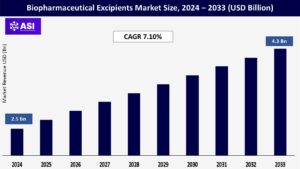
The biopharmaceutical excipients market is growing is because of the rising need for biologic medicines like vaccines, monoclonal antibodies, and protein-based treatments. As more people suffer from long-term illnesses such as cancer, diabetes, and autoimmune diseases, there is a greater demand for modern medicines that work in a targeted and effective way. These biologic drugs are often sensitive and need special ingredients, called excipients, to keep them stable, last longer, and work properly in the body. Because of this, the growing use of biologics is increasing the need for high-quality excipients.
Important reason for market growth is the progress in drug delivery methods. New and improved ways to give medicines like slow release pills, injectable particles, and drug carrying bubbles (liposomes) are becoming more common. These methods need excipients to help control how the drug is released and absorbed in the body, making treatments more effective and easier for patients. As drug companies spend more money on research to make better and more user-friendly medicines, the demand for useful excipients is also rising, helping the market grow even more.
A major factor limiting the growth of the biopharmaceutical excipients market is the strict regulatory guidelines and lengthy approval procedures enforced by agencies like the FDA and EMA. Because excipients are used alongside active ingredients in the complex formulations of biologic drugs, they must adhere to rigorous standards for safety, purity, and compatibility. Unlike conventional small-molecule drugs, biologics are highly sensitive, and even slight modifications in formulation can affect their performance.
As a result, introducing new excipients requires thorough testing and validation, which can be both time-consuming and costly. This regulatory challenge often hinders innovation, particularly for smaller companies with fewer resources. Furthermore, the absence of a unified international regulatory system adds additional hurdles for businesses operating across different countries, making product development and global market entry more difficult.
| Report Metric | Details |
|---|---|
| Segmentations | |
| By Excipient |
Bulking Agents Solubilizers and Surfactants Buffering and Tonicity Agents Others
|
| By Biologics |
Monoclonal Antibodies Vaccines Others |
| By End User |
Pharma and Biotech Companies CMOS and CDMOS Academic and Research Institutes |
| Key Players |
BASF SE Evonik Industries AG Croda International Plc Roquette Frères DFE Pharma Ashland Global Holdings Inc. Merck KGaA Lubrizol Corporation Kerry Group plc Associated British Foods plc Colorcon Inc. Wacker Chemie AG |
| Geographies Covered | |
| North America |
U.S. |
| Europe |
U.K. |
| Asia Pacific |
China |
| Middle East & Africa |
Saudi Arabia |
| Latin America |
Brazil |
In terms of excipient type, the market includes bulking agents, solubilizers and surfactants, buffering and tonicity agents, along with other specialized additives. Bulking agents are mainly used to add volume, especially in freeze-dried (lyophilized) drugs, while solubilizers and surfactants improve the solubility and stability of biologic drugs that are otherwise hard to dissolve. Buffering and tonicity agents are important for maintaining the correct pH and osmotic balance, ensuring patient comfort and drug safety during use.
Based on biologics, the market is categorized into monoclonal antibodies, vaccines, and others such as recombinant proteins and cell-based therapies. Monoclonal antibodies hold a major market share due to their widespread use in treating cancers and autoimmune diseases, while vaccine demand has surged, particularly after the COVID-19 pandemic, requiring dependable excipients for storage and delivery.
In terms of end-users, the market serves pharmaceutical and biotechnology companies, contract manufacturing and development firms (CMOs and CDMOs), as well as academic and research institutions. Pharmaceutical and biotech companies represent the largest consumer group due to their in-house development of biologics, while CMOs and CDMOs are critical for outsourced drug formulation and production. Academic institutions, though smaller in scale, contribute significantly to innovation in excipient
North America, especially the United States, is the top player in the biopharmaceutical excipients market. This is because it has a strong drug industry, spends a lot on healthcare, and has clear rules set by the FDA. Many big pharma and biotech companies are based here and invest heavily in research. There’s also a growing interest in advanced and personalized medicines, which increases the need for high-quality excipients.
Europe also has a largest share in the global excipients market. Countries like Germany, the UK, France, and Switzerland are leaders. The region has a well-developed drug industry and is using more biosimilars (cheaper versions of biologics). The EMA provides good regulatory support. Because of strict quality rules and strong partnerships between universities and companies, there is a high demand for better and more effective excipients.
Asia Pacific is the fastest-growing region in this market. Countries like China, India, South Korea, and Japan are producing more biologic drugs. They offer lower costs, skilled workers, and are improving their healthcare rules. Governments in these countries are also spending more on healthcare and research. As more people suffer from chronic diseases and the middle class grows, the need for biopharmaceuticals and excipients is rising.
Latin America is growing at a steady pace. Brazil and Mexico lead the way with growing pharma industries and more investment in biologic drugs. But challenges like weaker research facilities, changing rules, and unstable economies slow down growth. Still, global partnerships and better awareness of modern treatments are helping the region progress.
This region has the smallest market share but could grow more in the future. Healthcare needs are increasing, especially in Gulf countries and South Africa. Governments are starting to invest in pharma infrastructure. However, problems like limited access to biologics, less local manufacturing, and different rules in each country make progress slow. Over time, better healthcare systems and importing biologics could boost the demand for excipients.
The biopharmaceutical excipients market was valued at USD 2.5 billion in 2024.
The biopharmaceutical excipients market is projected to grow at a CAGR of 7.10% from 2025 to 2033.
The Bulking agents hold the largest biopharmaceutical excipients market share.
The North America, Europe region is expected to witness the highest growth rate.
Major players include BASF SE, Evonik Industries AG and Croda International Plc.
1.1 Summary
1.2 Research methodology
2.1 Research Objectives
2.2 Market Definition
2.3 Limitations & Assumptions
2.4 Market Scope & Segmentation
2.5 Currency & Pricing Considered
3.1 Drivers
3.2 Geopolitical Impact
3.3 Human Factors
3.4 Technology Factors
4.1 Porters Five Forces Analysis
4.2 Value Chain Analysis
4.3 Average Pricing Analysis
4.4 M & A, Agreements & Collaboration Analysis
5.1 Biopharmaceutical Excipients Market, By Excipient
5.1.1 Introduction
5.1.2 Market Size & Forecast
5.2 Biopharmaceutical Excipients Market, By End User
5.3 Biopharmaceutical Excipients Market, By Biologics
6.1 North America Biopharmaceutical Excipients Market, By Country
6.1.1 Biopharmaceutical Excipients Market, By Excipient
6.1.2 Biopharmaceutical Excipients Market, By End User
6.1.3 Biopharmaceutical Excipients Market, By Biologics
6.2 U.S.
6.2.1 Biopharmaceutical Excipients Market, By Excipient
6.2.2 Biopharmaceutical Excipients Market, By End User
6.2.3 Biopharmaceutical Excipients Market, By Biologics
6.3 Canada
7.1 U.K.
7.2 Germany
7.3 France
7.4 Spain
7.5 Italy
7.6 Russia
7.7 Nordic
7.8 Benelux
7.9 The Rest of Europe
8.1 China
8.2 South Korea
8.3 Japan
8.4 India
8.5 Australia
8.6 Taiwan
8.7 South East Asia
8.8 The Rest of Asia-Pacific
9.1 UAE
9.2 Turkey
9.3 Saudi Arabia
9.4 South Africa
9.5 Egypt
9.6 Nigeria
9.7 Rest of MEA
10.1 Brazil
10.2 Mexico
10.3 Argentina
10.4 Chile
10.5 Colombia
10.6 Rest of Latin America
11.1 Global Market Share (%) By Players
11.2 Market Ranking By Revenue for Players
11.3 Competitive Dashboard
11.4 Product Mapping