

Cochlear Implants Market
Cochlear Implants Market Share and Trend Analysis, By Technology (Unilateral Implantation, Bilateral Implantation), By Application (Hospitals, Ambulatory Surgical Centers, Specialty Clinics), By End User (Hospitals, ENT Clinics, Ambulatory Surgical Centers) – Industry Analysis Report, Regional Outlook, Growth Potential, Price Trends, Competitive Market Share & Forecast, 2026–2033.

Historical Period: 2019-2024
Forecast Period: 2025-2033
Report Code :
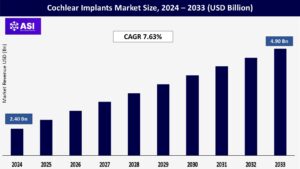
CAGR: 7.63%
Last Updated : August 6, 2025
The global Cochlear Implants Market was valued at USD 2.40 billion in 2024 and is projected to reach USD 4.90 billion by 2033, expanding at a compound annual growth rate CAGR of 7.63% during the forecast period (2025 – 2033).
Cochlear implants are a major technological advancement over traditional approaches to hearing profound loss. In contrast to the overall amplification provided by hearing aids, these devices present an entirely different option for people for whom amplification is of no use. The underlying technology consists of the bypassing of the damaged inner ear components altogether. An external sound processor picks up and processes sounds in the environment. This processed data is received by an internal component, surgically placed beneath the skin. The internal device stimulates the auditory nerve directly through an electrode array inserted into the cochlea to produce a perception of sound.
Demand comes from two main user groups: children born with profound hearing loss, where early implantation is essential for the acquisition of spoken language skills, and older adults who lost their hearing later in life, wanting to restore the capacity for effective communication and independence. The market continues to grow steadily. Major drivers of this growth are the increasing prevalence of hearing impairment worldwide, more favorable healthcare reimbursement systems that enhance patient access, and more public and professional recognition of the availability and value of cochlear implant technology as a treatment choice.
Severe hearing loss is impacting more individuals worldwide than ever. This increase is due to a variety of factors, such as an aging populace whose natural audiological resistance over time weakens and widespread environmental noise pollution both in the workplace and during recreational activities. With increased social awareness comes heightened recognition that millions now need to seek out intervention for serious hearing impairments. Developing healthcare infrastructure in lesser regions is bringing treatment more within reach, prompting more people to seek solutions.
Concurrently, newborn and early‐childhood screening programs supported by public health systems are becoming commonplace, enabling the detection of hearing problems long before educational and social milestones are in danger. Early detection leads to pediatric implantation during windows of speech and language development, with much improved communication outcomes. At the same time, advancing clinical guidelines now accept a broader range of hearing difficulties—like single‐sided deafness—so more individuals become eligible for implantation than ever. Combined, these advances are greatly expanding the number of candidates eligible for cochlear implants and emphasizing the role of the device as a cornerstone in contemporary auditory rehabilitation.
Cochlear implants today enjoy a wave of technology that introduces subtle improvements as well as revolutionary new capabilities. Sound processing technology has become incredibly skilled at separating background noise from speech, providing listeners with cleaner sound in crowded settings. Electrode arrays have been reworked with adjustable stiffness and shape to conform to personal inner‐ear anatomy, minimizing surgical trauma and keeping any residual natural hearing intact. Connectivity improvements now enable smooth streaming of calls and media straight to the implant processor, and progressively smaller external units with more inconspicuous designs have become even more compact for a more natural look.
Rechargeable power systems provide extended use between replacement charges, and robust component design accommodates compatibility with diagnostic imaging procedures. For recipients who preserve low‐frequency hearing, hybrid devices integrate electrical stimulation with acoustic amplification, providing richer quality sound and enhanced music appreciation. Existing recipients are frequently encouraged to upgrade as manufacturers release firmware upgrades and new‐generation hardware, perpetuating a cycle of ongoing improvement and ongoing market vitality. These advances collectively set higher standards of care and increase the appeal of cochlear implantation for a variety of patient needs.
The high cost and inherent surgical hazards of cochlear implants continue to be major impediments to universal use. The overall expense is high, including the high cost of the advanced device itself, charges for the complicated surgery, hospital stay, and the necessary, frequently extended, postoperative rehabilitation and auditory therapy. This presents a significant cost obstacle, rendering the procedure inaccessible for numerous people in low- and middle-income nations and for uninsured or underinsured patients in other areas. In addition, the operation is invasive, with possible complications including damage to facial nerves (which may impair movement or sensation), chronic balance difficulties (vestibular disturbances), or severe infection such as meningitis.
The need for highly trained surgeons and equipment further focuses access and adds to the overall cost. Questions also remain as to the long-term dependability of the implanted device, the possibility of requiring additional expensive and risky revision operations to replace failed parts or upgrade antiquated equipment, and the costs of maintenance. These intertwined forces – the considerable, multi-faceted cost and the concrete medical risks – understandably incline patients, families, and healthcare systems to be guarded. This fear is especially potent in areas with poorly developed healthcare infrastructure, scarce surgical skills, or where overall insurance coverage is minimal, directly constraining the rate of market growth even as demand increases.
| Report Metric | Details |
|---|---|
| Segmentations | |
| By Technology |
Unilateral Implantation Bilateral Implantation
|
| By Application |
Hospitals Ambulatory Surgical Centers Specialty Clinics
|
| By End User |
Hospitals ENT Clinics Ambulatory Surgical Centers
|
| Key Players |
|
| Geographies Covered | |
| North America |
U.S. |
| Europe |
U.K. |
| Asia Pacific |
China |
| Middle East & Africa |
Saudi Arabia |
| Latin America |
Brazil |
The market divides between unilateral and bilateral implantation techniques. Unilateral insertion, using a single device, is considerably more prevalent around the world. This prevalence is due to its overall lower cost and less complex surgery when compared with the fitting of devices into both ears. Bilateral fitting of implants is increasingly being accepted, however. This expansion is driven by the obvious benefits of hearing through two ears, especially the capacity to more precisely pinpoint where sounds are located and hear speech more easily in noisy surroundings such as restaurants or classrooms. Advances in technology in electrode design have a key role to play here; more recent arrays can be inserted more softly into the sensitive cochlea.
This soft approach is favorable to hybrid systems that both supplement with electrical stimulation from the implant any residual natural acoustic hearing the patient may retain, essentially broadening the candidate pool of individuals who may be able to be helped. Bilateral fittings are particularly focused on for children to accommodate optimal development of the pathways of hearing in the brain during those early formative years. While the double surgery is more expensive and takes longer to perform, supportive insurance reimbursement systems in higher-income countries are spurring adoption. Ongoing studies are currently comparing performing both implants as a single versus two-stage surgery to learn the safest and best approach for the future.
Most cochlear implant surgery takes place within hospitals. Hospitals supply the infrastructure necessary: complete surgical staff, specialized anesthesiology, and sophisticated imaging devices such as CT scanners required for accurate electrode implantation and post-op examination. They offer integrated care for the complete pathway, including initial candidacy screening and surgery through inpatient recovery and initiation of rehabilitation, and are thus the site of choice for device activation. Ambulatory surgery centers (ASCs) are increasingly becoming an option, especially for adult patients with uncomplicated cases. Their attractiveness is much lower facility charges and more streamlined, process-based systems that allow patients to return home the same day.
In developing countries, specialized Ear, Nose, and Throat (ENT) clinics, with portable imaging devices and qualified audiologists, are cropping up as potential alternative sites for implantation. This serves to stretch availability to populations beyond large metropolitan hospital centers. In addition to the surgery itself, cochlear implant uses also cover important follow-up diagnostics following newborn hearing testing which indicates a problem and certain interventions for adults undergoing deafness in only one ear. The emergence of tele-audiology services also impacts postoperative care, enabling specialists to make adjustments remotely (mapping) and diagnose issues, greatly enhancing availability for patients residing distant from specialist facilities.
Hospitals, ENT clinics, and ambulatory surgical centers (ASCs) are the primary end users for cochlear implant services and procedures. Hospitals presently account for the highest percentage of revenue in this category. This supremacy is particularly evident in more developed areas and lies in their capacity to provide the complete range of sophisticated, resource-draining services needed for implantation and early rehabilitation in one location. ENT clinics, manned by trained otolaryngologists, serve as crucial centers for necessary ongoing care. They are the setting of choice for critical follow-up outpatient visits, intensive device programming sessions (mapping), and addressing long-term maintenance requirements in children and adults with implants. ASCs are intended primarily for the adult patient base looking for a cost-effective surgical experience. They provide the benefit of same-day discharge, without hospital stays and the attendant higher expense.
A prominent trend entails patients crossing the globe to go to certain medical tourism countries, like India, Thailand, and Malaysia, exclusively for cochlear implantation. These individuals are drawn to the pairing of quality surgical procedures obtainable for a significantly reduced overall price compared to in their native lands, a circumstance frequently supported by beneficial currency exchange rates and robust alliances between public healthcare systems and private hospital chains. In addition, independent service providers and dedicated audiology networks are increasing their scope, providing technical support services, specialized mapping, and auditory rehabilitation therapy, thus driving strong growth in the aftermarket segment.
North America possesses the biggest share, fueled by superior healthcare infrastructure, high rates of reimbursement, and good patient awareness. The U.S. market enjoys efficient FDA approvals and good insurance coverages with more than 60 % of regional demand. Canada’s market also is growing because of government-initiated pediatric screening initiatives. Growth is fostered by ongoing R&D partnerships and specialized cochlear implant facilities in key metropolitan regions.
Europe is the region with the highest growth, with increasing geriatric populations and supportive health policies in EU member countries. Germany dominates in revenue share, supported by solid public reimbursement and leading research institutions. France and the U.K. are next, embracing next-generation devices. Regional guidelines requiring newborn hearing screening are driving pediatric implant volume. Eastern European emerging markets are luring investment to enhance access and affordability.
Asia Pacific is also experiencing fast growth, driven by increasing healthcare spending in China, Japan, and South Korea. Policy initiatives to increase universal health coverage involve cochlear implant subsidies. Private healthcare providers in India and Malaysia provide competitive pricing, attracting domestic and foreign patients. Technological alliances are on the rise, with local manufacturers signing licensing agreements to create affordable implant solutions.
LAMEA region is in its nascent stage but full of promise. Major markets like Brazil and South Africa are establishing reimbursement channels, while Gulf Cooperation Council nations invest in state-of-the-art ENT centers. Improved awareness campaigns and programs sponsored by NGOs are enhancing candidacy identification. Infrastructure remains a challenge, but public–private partnerships seek to enhance surgical capacity and training.
The global cochlear implants market was valued at USD 2.40 billion in 2024.
The cochlear implants market is projected to grow at a CAGR of 7.63 % from 2025 to 2033.
The Unilateral Implantation hold the largest market share of cochlear implants.
The Asia-Pacific region is expected to witness the highest growth rate.
Major players include Cochlear Ltd., MED-EL, Sonova (Advanced Bionics), William Demant Holding A/S, and Nurotron Biotechnology Co. Ltd.
1.1 Summary
1.2 Research methodology
2.1 Research Objectives
2.2 Market Definition
2.3 Limitations & Assumptions
2.4 Market Scope & Segmentation
2.5 Currency & Pricing Considered
3.1 Drivers
3.2 Geopolitical Impact
3.3 Human Factors
3.4 Technology Factors
4.1 Porters Five Forces Analysis
4.2 Value Chain Analysis
4.3 Average Pricing Analysis
4.4 M & A, Agreements & Collaboration Analysis
5.1 Cochlear Implants Market, By Technology
5.1.1 Introduction
5.1.2 Market Size & Forecast
5.2 Cochlear Implants Market, By Application
5.3 Cochlear Implants Market, By End User
6.1 Cochlear Implants Market, By Country
6.1.1 Cochlear Implants Market, By Technology
6.1.2 Cochlear Implants Market, By Application
6.1.3 Cochlear Implants Market, By End User
6.2 U.S.
6.2.1 Cochlear Implants Market, By Technology
6.2.2 Cochlear Implants Market, By Application
6.2.3 Cochlear Implants Market, By End User
6.3 Canada
7.1 U.K.
7.2 Germany
7.3 France
7.4 Spain
7.5 Italy
7.6 Russia
7.7 Nordic
7.8 Benelux
7.9 The Rest of Europe
8.1 China
8.2 South Korea
8.3 Japan
8.4 India
8.5 Australia
8.6 Taiwan
8.7 South East Asia
8.8 The Rest of Asia-Pacific
9.1 UAE
9.2 Turkey
9.3 Saudi Arabia
9.4 South Africa
9.5 Egypt
9.6 Nigeria
9.7 Rest of MEA
10.1 Brazil
10.2 Mexico
10.3 Argentina
10.4 Chile
10.5 Colombia
10.6 Rest of Latin America
11.1 Global Market Share (%) By Players
11.2 Market Ranking By Revenue for Players
11.3 Competitive Dashboard
11.4 Product Mapping