

Wellness Supplements Market
Wellness Supplements Market Share & Trends Analysis Report, By Product Type (Dietary Supplements, Functional Food and Beverages, Weight Management Products, Sports Nutrition, Other Wellness Supplements), By Ingredient Type (Vitamins, Minerals, Proteins and Amino Acids, Botanical Extracts, Fibers & Specialty Carbohydrates, Omega Fatty Acids, Others), By Form (Tablets, Capsules, Powder, Liquid, Others), By Distribution Channel (Supermarkets/Hypermarkets, Pharmacies & Drug Stores, Online Channels, Specialty Stores, Others), By End User (Adults, Geriatric, Pregnant Women, Children, Infants)– Industry Analysis Report, Regional Outlook, Growth Potential, Price Trends, Competitive Market Share & Forecast, 2025–2033.

Historical Period: 2019-2024
Forecast Period: 2025-2033
Report Code :
CAGR: 7.15%
Last Updated : August 14, 2025
The global Wellness Supplements Market was valued at approximately USD 270.15 billion in 2024 and is projected to reach USD 494.26 billion by 2033, growing at a CAGR of 7.15% during the forecast period (2025–2033).
The Wellness Supplements Market refers to the broad category of dietary and nutritional products formulated to support overall health, enhance physical and mental performance, and prevent nutritional deficiencies. This market includes vitamins, minerals, herbal extracts, probiotics, amino acids, and functional foods. These supplements are commonly used for immune support, energy boosting, bone and joint health, digestive health, and anti-aging purposes.
Their properties vary depending on the formulation but typically include bioactive compounds that help improve metabolic functions, strengthen immunity, and promote well-being. Increasing health awareness and lifestyle-related diseases have driven consumer interest in these supplements as part of preventive healthcare.
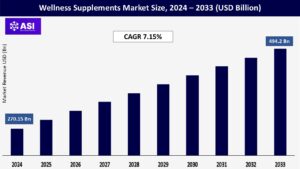
There is a growing global shift toward preventive healthcare, with individuals proactively seeking ways to improve their health and immunity before illness occurs. Factors such as rising healthcare costs, lifestyle-related diseases, and the impact of the COVID-19 pandemic have accelerated interest in personal wellness.
Consumers are increasingly adopting supplements such as vitamins, probiotics, and herbal extracts to support immunity, mental clarity, and overall well-being. This trend has driven consistent growth in the wellness supplements market.
The rapid growth of online retail and direct-to-consumer marketing has played a key role in driving supplement sales globally. Digital platforms enable supplement brands to reach a broad audience with personalized marketing, product education, and convenient delivery options. Influencers, fitness experts, and wellness blogs have also fueled demand by promoting specific products to niche audiences. The ease of online access and subscription-based models further encourage regular use, making e-commerce a major growth catalyst for the wellness supplements market.
A significant challenge restraining the wellness supplements market is the lack of strict regulatory frameworks and standardization, especially in developing regions. Unlike pharmaceutical drugs, dietary supplements are often not subject to rigorous testing or approval by health authorities like the FDA (in the U.S.) before reaching consumers.
This can lead to inconsistent product quality, mislabeling, contamination, and even ineffectiveness or harm. Consumer trust can be compromised due to safety scandals or misleading health claims. Moreover, the presence of unregulated players in the market increases competition but reduces overall credibility, thereby affecting the growth potential of responsible and high-quality supplement brands.
| Report Metric | Details |
|---|---|
| Segmentations | |
| By Product |
Dietary Supplements Functional Food and Beverages Weight Management Products Sports Nutrition Other Wellness Supplements |
| By Ingredient |
Vitamins Minerals Proteins and Amino Acids Botanical Extracts Fibers & Specialty Carbohydrates Omega Fatty Acids Others |
| By Form |
Tablets Capsules Powder Liquid Others |
| By Distribution Channel |
Supermarkets/Hypermarkets Pharmacies & Drug Stores Online Channels Specialty Stores Others |
| By End User |
Adults Geriatric Pregnant Women Children Infants |
| Key Players |
|
| Geographies Covered | |
| North America |
U.S. |
| Europe |
U.K. |
| Asia Pacific |
China |
| Middle East & Africa |
Saudi Arabia |
| Latin America |
Brazil |
The Wellness Supplements Market is segmented by Product Type, Ingredient Type, form, Distribution Channels and End User. Each factor significantly contributes to empowering individuals to take proactive control of their health, increasing the integration of supplements into daily routines, and encouraging innovation in product formulations that align with evolving consumer preferences for natural, preventive, and personalized wellness solutions.
By product type, dietary supplements hold the largest share, driven by growing awareness of nutritional gaps and preventive healthcare. Functional food and beverages are rapidly expanding, appealing to health-conscious consumers seeking convenient nutrition in their daily diets.
Weight management products are witnessing sustained demand due to rising obesity rates and lifestyle-related health concerns, while sports nutrition caters to athletes and fitness enthusiasts aiming for enhanced performance and recovery. Other wellness supplements, including immune boosters and anti-aging products, are also gaining popularity post-pandemic.
By ingredient type, vitamins and minerals lead the market owing to their foundational role in daily health maintenance, while proteins and amino acids dominate the sports nutrition and meal replacement segments. Botanical extracts, including herbal and plant-based ingredients, are growing rapidly due to consumer preference for natural and clean-label products. Fibers and specialty carbohydrates support digestive health, while omega fatty acids, particularly omega-3s, are widely used for cardiovascular and cognitive support.
The form segment shows that tablets and capsules are the most commonly used formats due to accurate dosing and portability. However, powders and liquids are gaining traction among consumers who prefer customizable dosing or have difficulty swallowing pills.
Distribution channels are increasingly diversified; supermarkets/hypermarkets and pharmacies/drug stores remain traditional strongholds, offering wide accessibility and trust. Online channels have experienced explosive growth, driven by e-commerce convenience, personalized product recommendations, and subscription models. Specialty stores, including health food shops and wellness boutiques, also play a key role in premium product distribution.
In terms of end user, adults represent the largest consumer base, using supplements for immunity, energy, and stress management. The geriatric population segment is expanding rapidly due to increased focus on bone health, cognition, and chronic disease prevention. Pregnant women form a crucial demographic for prenatal vitamins and nutrient-rich supplements, while children and infants represent specialized segments catered to by pediatric vitamins and growth support formulas. This comprehensive segmentation reflects the increasing personalization and functional focus within the global wellness supplements market.
North America holds a leading position in the global wellness supplements market, largely driven by high consumer awareness, a strong focus on preventive healthcare, and robust demand for natural and personalized nutrition. The United States is the primary contributor, with a large population actively using dietary supplements, functional foods, and sports nutrition products.
Widespread availability of wellness products through both physical and online retail, along with heavy investment in product innovation and marketing, has significantly boosted the market. Regulatory guidance from the FDA and growing trust in clean-label, plant-based, and immune-boosting supplements further strengthen the region’s dominance.
Europe is the second-largest regional market, fueled by increasing health consciousness, an aging population, and strong demand for organic and sustainable products. Countries like Germany, the UK, France, and Italy are key players, supported by structured healthcare systems and an emphasis on nutritional self-care. The region also benefits from stringent regulatory standards, such as those from the European Food Safety Authority (EFSA), which help maintain product quality and build consumer trust. Rising adoption of vegan and gluten-free supplements and growing online retail penetration are key growth drivers in this market.
Asia-Pacific is the fastest-growing region in the wellness supplements market, driven by a huge population base, increasing disposable incomes, and a rising awareness of holistic health and nutrition. Countries like China, India, Japan, South Korea, and Australia are witnessing a surge in demand for vitamins, minerals, herbal supplements, and functional foods. Traditional medicine systems (e.g., Ayurveda, Traditional Chinese Medicine) are also being integrated into modern formulations, appealing to culturally aware consumers. Rapid urbanization, a growing fitness culture, and an expanding middle class are expected to further accelerate market growth across the region.
Latin America is experiencing steady growth in the wellness supplements market, led by countries such as Brazil, Mexico, Chile, and Argentina. The growing influence of health and fitness trends, particularly among millennials and urban dwellers, is driving demand for supplements focused on weight management, immunity, and beauty from within. However, challenges such as economic volatility and regulatory differences across countries can impact growth. Nevertheless, increased investments by global brands and the expansion of e-commerce are helping improve product access and awareness.
The Middle East & Africa region is showing gradual but promising growth, driven by rising lifestyle-related health issues, a growing youth population, and an increasing preference for natural and halal-certified supplements. The Gulf countries, particularly the UAE and Saudi Arabia, are at the forefront due to their higher disposable incomes and growing wellness tourism. In Africa, rising urbanization and government-led health awareness campaigns are supporting market development, though affordability and limited access in rural areas still pose barriers. International players entering the region are expected to boost innovation and accessibility in the coming years.
The market was valued at USD 270.15 billion in 2024.
The market is projected to grow at a CAGR of 7.15% from 2025 to 2033.
Dietary Supplements hold the largest market share.
The North America region is expected to witness the highest growth rate.
Major players include Amway Corp., Herbalife Nutrition Ltd. And Abbott Laboratories.
1.1 Summary
1.2 Research methodology
2.1 Research Objectives
2.2 Market Definition
2.3 Limitations & Assumptions
2.4 Market Scope & Segmentation
2.5 Currency & Pricing Considered
3.1 Drivers
3.2 Geopolitical Impact
3.3 Human Factors
3.4 Technology Factors
4.1 Porters Five Forces Analysis
4.2 Value Chain Analysis
4.3 Average Pricing Analysis
4.4 M & A, Agreements & Collaboration Analysis
5.1 Wellness Supplements Market , By Product Type
5.1.1 Introduction
5.1.2 Market Size & Forecast
5.2 Wellness Supplements Market, By Ingredient Type
5.3 Wellness Supplements Market, By Distribution Channel
5.4 Wellness Supplements Market, By End User
6.1 North America Wellness Supplements Market, By Country
6.1.1 Wellness Supplements Market, By Product Type
6.1.2 Wellness Supplements Market, By Ingredient Type
6.1.3 Wellness Supplements Market, By Distribution Channel
6.1.4 Wellness Supplements Market, By End User
6.2 U.S.
6.2.1 Wellness Supplements Market, By Product Type
6.2.2 Wellness Supplements Market, By Ingredient Type
6.2.3 Wellness Supplements Market, By Distribution Channel
6.2.4 Wellness Supplements Market, By End User
6.3 Canada
6.1 U.K.
6.2 Germany
6.3 France
6.4 Spain
6.5 Italy
6.6 Russia
6.7 Nordic
6.8 Benelux
6.9 The Rest of Europe
8.1 China
8.2 South Korea
8.3 Japan
8.4 India
8.5 Australia
8.6 Taiwan
8.7 South East Asia
8.8 The Rest of Asia-Pacific
9.1 UAE
9.2 Turkey
9.3 Saudi Arabia
9.4 South Africa
9.5 Egypt
9.6 Nigeria
9.7 Rest of MEA
10.1 Brazil
10.2 Mexico
10.3 Argentina
10.4 Chile
10.5 Colombia
10.6 Rest of Latin America
11.1 Global Market Share (%) By Players
11.2 Market Ranking By Revenue for Players
11.3 Competitive Dashboard
11.4 Product Mapping