

Cardiac Resynchronization Therapy (CRT) Market
Cardiac Resynchronization Therapy (CRT) Market Share & Trends Analysis Report By Product Type (CRT-Defibrillators, CRT-Pacemakers) By End User (Hospitals, Cardiac Centers, Ambulatory Surgical Centers, Others) Industry Analysis Report, Regional Outlook, Growth Potential, Price Trends, Competitive Market Share & Forecast, 2025–2033.

Historical Period: 2019-2024
Forecast Period: 2025-2033
Report Code :
CAGR: 5.5%
Last Updated : March 7, 2026
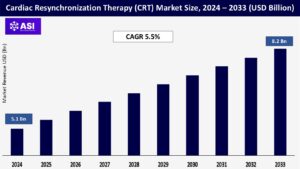
The global Cardiac Resynchronization Therapy (CRT) Market was valued at approximately USD 5.1 billion in 2024 and is projected to reach USD 8.2 billion by 2033, growing at a CAGR of 5.5% during the forecast period (2025–2033).
Cardiac Resynchronization Therapy (CRT) consists of two special implantable devices (CRT-Pacemakers [CRT-P] and CRT-Defibrillators [CRT-D]) designed to improve or correct the rhythm and performance of the heart, especially in individuals with heart failure and electrical conduction abnormalities. CRT devices work by providing direct electrical stimulation to both the left and right ventricles; thus helping the heart perform more efficiently and with lower heart failure symptoms.
The CRT market’s growth is being driven by several factors, including an increasing incidence of heart failure, an aging population, and technology developments in the area of implantable cardiac devices. CRT outcomes are improving for patients providing a better reimburseable narrative, and the increasing awareness of treatment options for those with heart failure.
The arrival of MRI-compatible devices beginning to roll out flow through to remote monitoring in healthcare systems has furthered support in uptake of devices and CRT through developed, and emerging, healthcare systems.
The upward trend of heart failure occurrence in larger global populations, particularly among the older population, drives the CRT market. Heart failure is often due to a history of high blood pressure, coronary artery disease, and/or previous acute myocardial infarctions that create compromised or impaired cardiac functioning.
Cardiac resynchronization therapy (CRT), which can be done through implanted pacemakers or implantable cardioverter defibrillators, allows a patient whose heart has impaired motion to return to prescribed coordinated heartbeats, as well as to help improve their symptoms and increase their quality of life with a longer period of survival. According to the American Heart Association (2024), over 6.7 million Americans currently live with heart failure, which is projected to increase 46% by 2030.
Globally, heart failure affects over 64 million people. Natural declines in heart function and comorbidities among this age group also put the older population at greater risk with more severe forms of heart failure. Furthermore, the United Nations (2020) estimates that the global population of people over the age of 60 will reach 2.1 billion by 2050 – double the population of people over the age of 60 in 2020.
There will continue to be demand for CRT implants for the treatment and management of heart failure, especially in developed regions like North America, Japan, and Europe. More patients will be diagnosed earlier in the clinical trajectory of their heart failure population cycle. Because clinical practice guidelines involve the implementation of CRT with patients across the entire clinical care spectrum, device-based therapy will begin to play a larger role in global long-term management as developed regions continue to treat heart failure patients.
Technological advances in CRT technology are accelerating the market at a fast rate. Next-generation device innovations include longer-lasting batteries, smaller size, MRI compatibilities, plus new and advanced features such as Bluetooth-enabled remote monitoring. These advancements allow real-time cardiac function tracking, timely indicators of decompensation, better patient compliance and lesser rates of hospital visits.
For example, Medtronic recently launched the Cobalt™ XT CRT-D system in April of 2024, which has wireless connectivity and arrhythmia detection algorithms, while Boston Scientific’s Resonate™ CRT devices include HeartLogic™, a multi-sensor platform that predicts heart failure events before symptoms emerge. These innovations enhance therapeutic effectiveness and improve the concept of physician preference based on previous advancements with CRT.
Moreover, significant regulatory support and favorable reimbursement frameworks (especially in the US and EU) will fast track their adoption. Remote patient monitoring is also consistent with a worldwide transition toward value-based care and chronic disease management. Increased financing by many governments into digital health infrastructure will further aid transition toward increasing remote monitoring toward CRT devices.
As the World Economic Forum reported, health expenditures reached over $9.8 trillion as of 2021 and has only continued to increase. These latest advancements will make CRT more accessible, efficacious, and critical for incorporating CRT strategies for heart failure management.
One of the main barriers to the development of the cardiac resynchronization therapy (CRT) market has been the cost of device implantation and follow-up care. CRT devices, in particular CRT-D (with defibrillator), are much more expensive than routine pacemakers or medical therapy, and while the device costs vary, the total treatment costs (including hospital costs, operating surgeon fees, and follow-up care) often bog each patient down over USD 30,000–50,000 (Mardini, 2018).
Cost is a limiting factor for utilization in low and middle-income countries (LMICs) since CRT patients often face heavily constrained healthcare budgets and reimbursement coverage is non-existent or marginal at best. Further, advanced CRT devices that incorporate remote monitoring functionality require unavailable digital infrastructure and specialist staff time. Even in the predominant developed markets, access to CRT may also be impeded by strict eligibility criteria, long prior authorization processes, and differences in insurance coverage.
According to the World Bank, over 50% of the global population do not have access to essential health care services (World Bank, n.d.). In access limited regions around the world are barriers to economic and logistical access to CRT treatments that ultimately limit uptake and slows broader global acceptance of CRT within the treatment of heart failure as standard care.
| Report Metric | Details |
|---|---|
| Segmentations | |
| By Product Type |
CRT-Defibrillators CRT-Pacemakers |
| By End User |
Hospitals Cardiac Centers Ambulatory Surgical Centers Others |
| Key Players |
Medtronic plc Boston Scientific Corporation Abbott Laboratories Biotronik SE & Co. KG MicroPort Scientific Corporation LivaNova PLC Lepu Medical Technology Sorin Group (part of MicroPort CRM) Shree Pacetronix Ltd. Osypka Medical GmbH |
| Geographies Covered | |
| North America |
U.S. |
| Europe |
U.K. |
| Asia Pacific |
China |
| Middle East & Africa |
Saudi Arabia |
| Latin America |
Brazil |
The Cardiac Resynchronization Therapy (CRT) Market is segmented by product type and end-user. Each segment plays a crucial role in improving cardiac function and reducing hospitalizations in heart failure patients.
CRT-Defibrillators (CRT-D) had the biggest market share in 2024 due to their ability to offer two advances in one device – synchronized pacing therapy and defibrillation, in order to prevent sudden cardiac death. In addition, CRT-D are preferred in high-risk patients who have advanced heart failure and have a history of ventricular arrhythmias.
CRT-D are been increasingly adopted as clinical guidelines have become more positive about their use, and cardiologists now have a greater awareness of their advantages when compared to stand-alone pacemakers. CRT-Pacemakers (CRT-P) will have modest growth, especially, in the elderly or those patients who are contraindicated for defibrillator therapy.
The CRT-P also works well with resynchronization in patients that are less symptomatic of heart failure and had less arrhythmic risk. In addition, technological advances in CRT-P devices, such as size, battery longevity, and MRI compatibility have furthered their adoption in select patient populations.
Hospitals take the largest segment of the CRT market in 2024. Hospitals provide the most CRT implants, and have an advanced cardiac care infrastructure, seasoned electrophysiologists, and comprehensive postoperative follow-up systems. Cardiac Centers are also growing quickly, benefitting from their complex heart failure training and advanced cardiac device-based therapy.
The strongly integrated care pathway and specialty nature of care locations create opportunities for them to ramp up CRT procedures. Ambulatory Surgical Centers (ASCs) are a low-cost option for potentially appropriate CRT patients, especially in developed countries with improvements in minimally invasive techniques and abbreviated recovery times.
ASCs have begun to offer CRT implantations for low-risk patients. ‘Other’ includes specialty clinics and academics and only holds a marginal share of the market, but is important for training, research, and early adoption of next-generation CRT devices.
In terms of regional markets, North America will represent the largest share of the CRT market in 2024 at 38.5%. This is attributed to its established and high-volume healthcare system, high incidence of heart failure cases, and increasing adoption of implantable cardiac devices.
The U.S. is the largest contributor to North America due to its established network of hospitals and cardiac centers where CRT is implemented. Various factors are in place to support the continued growth of these markets, including an increase in patient awareness, favorable reimbursement policies, and continued technological innovation.
Europe will represent the second largest share of the CRT market at approximately 28.2% in 2024. The U.K., Spain, Germany, Italy, and France are all large contributors to the CRT market attributed to the high burden of cardiovascular disease and aging population. The steady growth of the CRT market is anticipated to continue partly due to the growth of the older population receiving cardiac care and increasing availability of cardiac care facilities and healthcare funding.
The increasing adoption of remote monitoring technologies in CRT devices among European healthcare systems as well as the older population demographics will be factors contributing to CRT market growth.
Asia Pacific is the fastest-growing region with a 2024 market share of 20.4% and a projected CAGR of over 8% during the forecast period. The region’s rapid urbanization, increasing expenditure on healthcare, increasing prevalence of heart failure, and growing healthcare infrastructure in some major markets including China, India, Japan, and South Korea are driving demand. Accessibility to advanced cardiac therapies and government initiatives to improve chronic disease management would be key enablers of future growth.
Latin America and Middle East and Africa represent approximately 13% of the global CRT market in 2024. The two regions are not displaying factors of growth beyond a moderate level, which includes expanding investments in healthcare infrastructure, and increasing awareness of cardiovascular disease, and public will to improve health.
However, a range of challenge factors including disparity in economic growth, limited access to advanced cardiac therapies, and limited reimbursement coverage limits market access. If access to healthcare improves, and the affordability of the devices improves, these regions may open further opportunities.
The market was valued at USD 5.1 billion in 2024.
The market is projected to grow at a CAGR of 5.5% from 2025 to 2033.
The CRT- Defibrillators hold the largest market share.
The Asia-Pacific region is expected to witness the highest growth rate.
Major players include Medtronic plc, Boston Scientific Corporation and Abbott Laboratories
1.1 Summary
1.2 Research methodology
2.1 Research Objectives
2.2 Market Definition
2.3 Limitations & Assumptions
2.4 Market Scope & Segmentation
2.5 Currency & Pricing Considered
3.1 Drivers
3.2 Geopolitical Impact
3.3 Human Factors
3.4 Technology Factors
4.1 Porters Five Forces Analysis
4.2 Value Chain Analysis
4.3 Average Pricing Analysis
4.4 M & A, Agreements & Collaboration Analysis
5.1 Cardiac Resynchronization Therapy (CRT) Market By Product Type
5.1.1 Introduction
5.1.2 Market Size & Forecast
5.2 Cardiac Resynchronization Therapy (CRT) Market By End User
6.1 North America Cardiac Resynchronization Therapy (CRT) Market, By Country
6.1.1 Cardiac Resynchronization Therapy (CRT) Market, By Product Type
6.1.2 Cardiac Resynchronization Therapy (CRT) Market By End User
6.2 U.S.
6.2.1 Cardiac Resynchronization Therapy (CRT) Market, By Product Type
6.2.2 Cardiac Resynchronization Therapy (CRT) Market By End User
6.3 Canada
7.1 U.K.
7.2 Germany
7.3 France
7.4 Spain
7.5 Italy
7.6 Russia
7.7 Nordic
7.8 Benelux
7.9 The Rest of Europe
8.1 China
8.2 South Korea
8.3 Japan
8.4 India
8.5 Australia
8.6 Taiwan
8.7 South East Asia
8.8 The Rest of Asia-Pacific
9.1 UAE
9.2 Turkey
9.3 Saudi Arabia
9.4 South Africa
9.5 Egypt
9.6 Nigeria
9.7 Rest of MEA
10.1 Brazil
10.2 Mexico
10.3 Argentina
10.4 Chile
10.5 Colombia
10.6 Rest of Latin America
11.1 Global Market Share (%) By Players
11.2 Market Ranking By Revenue for Players
11.3 Competitive Dashboard
11.4 Product Mapping