

Coding and Marking Market
Coding and Marking Market Share & Trends Analysis Report, By Technology (Continuous Inkjet (CIJ), Thermal Inkjet (TIJ), Laser Marking, Drop‑on‑Demand (DOD),Thermal Transfer Overprint (TTO), Other Equipment), By Ink Type (Solvent‑Based Inks, Water‑Based Inks, UV‑Curable Inks, Other Ink Formulations), By Application (Food & Beverage, Pharmaceuticals, Electronics, Automotive, Personal & Home Care, Other Industries)- Industry Analysis Report, Regional Outlook, Growth Potential, Price Trends, Competitive Market Share & Forecast, 2025–2033.

Historical Period: 2019-2024
Forecast Period: 2025-2033
Report Code :
CAGR: 8.30%
Last Updated : December 16, 2025
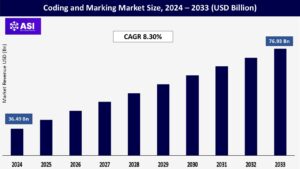
The global Coding and Marking Market size was valued at approximately USD 36.49 billion in 2024 and is projected to reach USD 76.93 billion by 2033, growing at a CAGR of 8.30% during the forecast period (2025–2033).
The Coding and Marking Market encompasses the industry focused on providing solutions for labeling and identifying products and packaging through printed information such as barcodes, batch numbers, manufacturing/expiry dates, logos, or QR codes.
These codes are essential for product traceability, regulatory compliance, quality control, and inventory management across industries like food and beverage, pharmaceuticals, cosmetics, automotive, and consumer goods. Coding and marking technologies include inkjet printers (CIJ, TIJ), laser coding, thermal transfer overprinting (TTO), and print-and-apply label systems.
The primary uses of coding and marking are to enable anti-counterfeiting measures, ensure safety recall traceability, and support automation in production lines. Key properties of these systems include high-speed printing capability, durability of prints, resistance to environmental factors (like heat or moisture), and integration with industrial control systems.
As global manufacturing becomes more automated and regulations become stricter, demand for efficient, eco-friendly, and high-resolution coding technologies is growing rapidly, driving innovation in the market.
The growing emphasis on product safety, traceability, and regulatory compliance especially in sectors like pharmaceuticals, food & beverage, and healthcare is a major driver for the coding and marking market.
Government regulations such as the EU Falsified Medicines Directive (FMD), U.S. FDA’s Drug Supply Chain Security Act (DSCSA), and food labeling standards mandate accurate and permanent coding of packaging to track products throughout the supply chain.
These regulations require companies to invest in reliable and high-quality coding solutions to ensure consumer safety and prevent counterfeiting, thereby boosting market demand.
With the rise of Industry 4.0 and smart factories, there is growing adoption of automated and integrated coding systems within production lines. Manufacturers are seeking high-speed, efficient, and cost-effective coding solutions that can seamlessly integrate with automated packaging machinery.
Technologies like continuous inkjet (CIJ), laser coders, and thermal transfer printers are being increasingly deployed to meet the demands of high-volume production with minimal downtime. The push for operational efficiency, coupled with digital transformation in manufacturing processes, continues to drive market expansion globally.
One of the primary restraints in the Coding and Marking market is the high initial cost of installation and ongoing maintenance of advanced coding systems, particularly for small and medium-sized enterprises (SMEs). Technologies such as laser coding and thermal inkjet systems require significant upfront investment in equipment and infrastructure.
In addition to installation, there are recurring costs related to consumables (inks, ribbons), maintenance, and system upgrades. For companies with limited budgets, especially in developing regions, this becomes a barrier to adoption.
Furthermore, integrating these systems with existing production lines may require technical expertise and operational adjustments, leading to increased complexity and additional training requirements. These financial and logistical challenges slow down the market penetration of coding and marking technologies in price-sensitive markets.
| Report Metric | Details |
|---|---|
| Segmentations | |
| By Technology |
Continuous Inkjet (CIJ) Thermal Inkjet (TIJ) Laser Marking Drop‑on‑Demand (DOD) Thermal Transfer Overprint (TTO) Other Equipment |
| By Ink Type |
Solvent‑Based Inks Water‑Based Inks UV‑Curable Inks Other Ink Formulations |
| By Application |
Food & Beverage Pharmaceuticals Electronics Automotive Personal & Home Care Other Industries |
| Key Players |
|
| Geographies Covered | |
| North America |
U.S. |
| Europe |
U.K. |
| Asia Pacific |
China |
| Middle East & Africa |
Saudi Arabia |
| Latin America |
Brazil |
The Coding and Marking Market is segmented by Technology, Ink Type and Application. Each factor tightening regulatory requirements, technological innovation, and the shift toward automation plays a critical role in ensuring product traceability, improving manufacturing efficiency, and supporting compliance across industries. Together, these drivers are accelerating the adoption of advanced coding and marking systems, shaping the future of safe, efficient, and transparent supply chains.
Continuous Inkjet (CIJ) dominates the market due to its high-speed printing capabilities, flexibility on various substrates, and suitability for dynamic production lines in sectors like food, beverage, and pharmaceuticals.
Thermal Inkjet (TIJ) is gaining popularity for its high-resolution, maintenance-free operation and clean printing, especially in industries requiring sharp, readable codes such as electronics and cosmetics.
Laser Marking, which uses a non-contact, permanent coding method, is increasingly used in high-value, high-precision industries like electronics, pharmaceuticals, and automotive, due to its ability to deliver durable and tamper-proof marks.
Drop-on-Demand (DOD) systems, known for their ability to print larger characters with minimal maintenance, are commonly used for marking on cartons, wood, and secondary packaging. Thermal Transfer Overprint (TTO) is favored in flexible packaging applications, especially for variable data such as barcodes and expiry dates. Other Equipment, including large character printers and embossing systems, serve niche or specialized applications where conventional technologies are less effective.
Solvent-Based Inks lead the market owing to their fast-drying properties and strong adhesion to non-porous surfaces like plastics, metals, and glass. These inks are essential for high-speed industrial environments.
Water-Based Inks are preferred for their eco-friendliness and are typically used on porous surfaces such as paper and cardboard in sustainable packaging operations. UV-Curable Inks are gaining traction for their instant curing under UV light, chemical resistance, and use in high-resolution applications, especially where permanence and durability are critical. Other Ink Formulations, including edible inks and thermochromic inks, cater to specialized needs in the food and pharmaceutical sectors, where safety and regulatory compliance are paramount.
The Food & Beverage sector is the largest contributor, driven by strict labeling regulations, traceability demands, and the need for high-speed coding on diverse packaging types. The Pharmaceuticals industry also represents a significant share due to global serialization laws, anti-counterfeiting measures, and the need for accurate batch and expiry data.
The Electronics sector requires precise, small character coding for components, often using laser and TIJ systems for high-contrast marks on sensitive materials. In the Automotive sector, durable coding solutions are essential for parts traceability, often involving DOD and laser systems.
The Personal & Home Care industry demands high-quality, aesthetically appealing codes on varied packaging types like tubes and bottles. Other Industries, including chemicals, logistics, and construction materials, continue to adopt coding technologies for improved supply chain visibility and regulatory compliance.
North America holds a significant share of the global coding and marking market, driven by stringent regulatory compliance across industries such as pharmaceuticals, food and beverage, and medical devices. The U.S. leads the region due to strong enforcement of product serialization laws by the FDA, such as the Drug Supply Chain Security Act (DSCSA), and the presence of major manufacturing hubs that demand high-speed, automated coding solutions.
The region’s focus on product traceability, anti-counterfeiting, and inventory control fuels the adoption of advanced technologies like laser marking, thermal inkjet, and thermal transfer overprinting. Moreover, the integration of Industry 4.0 practices and increasing investments in packaging automation further boost market growth in North America.
Europe represents a mature and regulated coding and marking market, where manufacturers are under pressure to meet strict standards related to packaging, labeling, and traceability. Regulations such as the EU Falsified Medicines Directive (FMD) and food safety guidelines significantly influence demand for robust and permanent coding solutions. Countries like Germany, the UK, France, and Italy are leading adopters of laser and CIJ (continuous inkjet) technologies for industrial and retail packaging lines.
Sustainability is also a growing focus in the region, prompting manufacturers to invest in eco-friendly inks and energy-efficient coding equipment. The strong presence of multinational packaging equipment manufacturers and high automation levels support continued market expansion in Europe.
The Asia-Pacific region is the fastest-growing market for coding and marking, fueled by rapid industrialization, expanding manufacturing sectors, and increasing government emphasis on product safety and export compliance. China, India, Japan, and South Korea are key contributors, with China leading due to its vast manufacturing base and focus on digitalization.
In India, the booming food processing and pharmaceutical industries are creating substantial demand for efficient and cost-effective marking technologies like thermal inkjet and CIJ. As regional manufacturers scale up production and enter international markets, the need for globally compliant labeling and traceability systems is rising sharply. Affordable, locally produced coding equipment and increasing automation adoption in mid-sized enterprises also propel regional growth.
The coding and marking market in Latin America is growing steadily, with Brazil, Mexico, and Argentina leading adoption across food, beverage, and agrochemical sectors. Regulatory improvements around product safety, traceability, and labeling are gradually strengthening demand for standardized coding technologies.
While the market is still price-sensitive, local manufacturers are beginning to embrace automation to improve efficiency and reduce manual errors. The region benefits from increased foreign investment in food and pharmaceutical manufacturing, which in turn encourages the use of modern coding systems. However, economic instability and inconsistent enforcement of regulations remain challenges for broader adoption.
The Middle East & Africa (MEA) region is an emerging market for coding and marking solutions, supported by growth in FMCG, pharmaceuticals, and industrial goods. Countries like the UAE, Saudi Arabia, and South Africa are seeing increased demand for modern marking systems due to growing export requirements, rising consumer safety awareness, and government initiatives to combat counterfeiting.
Adoption is currently led by multinational firms and large regional producers, while small and medium enterprises are slower to upgrade due to cost constraints. Nonetheless, increasing industrial investments and digital transformation efforts in Gulf countries offer strong long-term growth potential for the market.
The coding and marking market was valued at USD 11.14 billion in 2024.
The coding and marking market is projected to grow at a CAGR of 5.80% from 2025 to 2033.
Continuous Inkjet (CIJ) hold the largest coding and marking market share.
The North America region is expected to witness the highest growth rate.
Major players include Danaher Corporation (Videojet Technologies Inc.), Dover Corporation (Markem-Imaje) and Domino Printing Sciences plc.
1.1 Summary
1.2 Research methodology
2.1 Research Objectives
2.2 Market Definition
2.3 Limitations & Assumptions
2.4 Market Scope & Segmentation
2.5 Currency & Pricing Considered
3.1 Drivers
3.2 Geopolitical Impact
3.3 Human Factors
3.4 Technology Factors
4.1 Porters Five Forces Analysis
4.2 Value Chain Analysis
4.3 Average Pricing Analysis
4.4 M & A, Agreements & Collaboration Analysis
5.1 Coding and Marking Market, By Technology
5.1.1 Introduction
5.1.2 Market Size & Forecast
5.2 Coding and Marking Market, By Ink Type
5.3 Coding and Marking Market, By Application
6.1 North America Coding and Marking Market , By Country
6.1.1 Coding and Marking Market, By Technology
6.1.2 Coding and Marking Market, By Ink Type
6.1.3 Coding and Marking Market, By Application
6.2 U.S.
6.2.1 Coding and Marking Market, By Technology
6.2.2 Coding and Marking Market, By Ink Type
6.2.3 Coding and Marking Market, By Application
6.3 Canada
7.1 U.K.
7.2 Germany
7.3 France
7.4 Spain
7.5 Italy
7.6 Russia
7.7 Nordic
7.8 Benelux
7.9 The Rest of Europe
8.1 China
8.2 South Korea
8.3 Japan
8.4 India
8.5 Australia
8.6 Taiwan
8.7 South East Asia
8.8 The Rest of Asia-Pacific
9.1 UAE
9.2 Turkey
9.3 Saudi Arabia
9.4 South Africa
9.5 Egypt
9.6 Nigeria
9.7 Rest of MEA
10.1 Brazil
10.2 Mexico
10.3 Argentina
10.4 Chile
10.5 Colombia
10.6 Rest of Latin America
11.1 Global Market Share (%) By Players
11.2 Market Ranking By Revenue for Players
11.3 Competitive Dashboard
11.4 Product Mapping