

Latin America Cardiac Resynchronization Therapy (CRT) Market
Latin America Cardiac Resynchronization Therapy (CRT) Market Share & Trends Analysis Report, By Product Type (CRT-Defibrillator (CRT-D), CRT-Pacemaker (CRT-P)), By End User (Hospitals, Cardiac Centers, Others), By Country (Brazil, Mexico, Argentina, Rest of Latin America)– Industry Analysis Report, Regional Outlook, Growth Potential, Price Trends, Competitive Market Share & Forecast, 2025–2033.

Historical Period: 2019-2024
Forecast Period: 2025-2033
Report Code :
CAGR: 5.30%
Last Updated : November 20, 2025
The global Latin America Cardiac Resynchronization Therapy (CRT) Market size was valued at approximately USD 0.239 billion in 2024 and is projected to reach USD 0.382 billion by 2033, growing at a CAGR of 5.30% during the forecast period (2025–2033).
The Latin America Cardiac Resynchronization Therapy (CRT) Market encompasses countries such as Brazil, Mexico, Argentina, Colombia, and Chile, where there is an increasing demand for effective management of heart failure and arrhythmias. CRT is widely used to treat patients suffering from moderate to severe heart failure who have not responded well to standard medical therapy.
By delivering timed electrical impulses to both the left and right ventricles, CRT helps the heart pump more efficiently, which can significantly improve exercise tolerance, reduce hospitalizations, and increase life expectancy in eligible patients.
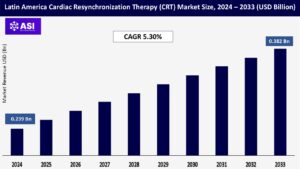
Latin America is experiencing a rapid increase in chronic non-communicable diseases, especially cardiovascular disorders, largely due to urbanization, poor dietary habits, smoking, and lack of physical activity. Heart failure affects millions across the region, particularly in Brazil and Mexico, which are among the largest healthcare markets in the region.
As heart failure cases increase, CRT becomes a vital therapeutic option to reduce hospitalizations and improve life expectancy, thereby driving demand for such devices. This trend is further supported by a gradual shift from reactive to preventive and interventional cardiology practices.
The expansion of healthcare coverage through public health systems (such as Brazil’s SUS – Sistema Único de Saúde) and the increasing presence of global medical device companies are enabling broader access to CRT therapies.
Countries are investing in modernizing hospitals and enabling training for electrophysiologists and cardiologists, which is essential for device implantation and follow-up care. Additionally, international collaborations and regulatory reforms are helping reduce barriers to market entry for advanced CRT devices, improving availability, affordability, and ultimately increasing the adoption of CRT across Latin America.
In Latin America, a key market restraint is the lack of adequately developed healthcare infrastructure and shortage of skilled cardiac electrophysiologists required for CRT implantation and management. CRT implantation is a complex procedure that demands well-equipped cardiac centers, continuous monitoring, and skilled professionals trained in device programming and troubleshooting.
However, in many parts of the region—particularly rural areas—hospitals lack the necessary equipment and trained personnel. Even in major urban centers, the availability of CRT procedures is often limited to a few specialized hospitals. This infrastructure gap restricts the reach of CRT devices to only a small portion of the population, slowing down market growth and limiting the potential impact of CRT on heart failure treatment outcomes.
| Report Metric | Details |
|---|---|
| Segmentations | |
| By Product Type |
CRT‑Defibrillator (CRT‑D) CRT‑Pacemaker (CRT‑P) |
| By End User |
Hospitals Cardiac Centers Others (clinics, ambulatory care) |
| By Country |
China India (fastest-growing) Japan Korea Australia Southeast Asia & Other Asia-Pacific |
| Key Players |
|
| Geographies Covered | |
| Latin America |
Brazil |
The Latin America Cardiac Resynchronization Therapy (CRT) Market is segmented by Product Type, End User and Country. Each factor from the rising incidence of heart failure and aging populations to advancing medical technologies and expanding healthcare infrastructure—plays a crucial role in improving patient outcomes, increasing the adoption of CRT devices, and encouraging the development of more sophisticated and accessible cardiac resynchronization solutions.
The Asia-Pacific CRT market is primarily categorized into CRT-Defibrillators (CRT-D) and CRT-Pacemakers (CRT-P). Among these, CRT-Ds dominate the market due to their comprehensive functionality that includes both pacing and life-saving defibrillation for patients with advanced heart failure and a high risk of arrhythmias.
CRT-Ds are widely adopted in technologically advanced Asia-Pacific countries where cardiac care infrastructure and reimbursement support are stronger. However, CRT-P devices are gaining preference in specific patient populations, particularly elderly or low-risk patients, and in countries where cost containment is a critical factor.
CRT-Ps are also ideal for healthcare systems in early adoption phases or where device cost is a limiting factor. Ongoing innovations such as MRI-compatible devices and remote programming are fueling demand across both product types.
When segmented by end users, hospitals represent the largest share of the Asia-Pacific CRT market, largely due to their comprehensive facilities, trained cardiac electrophysiologists, and the ability to manage complications and follow-up care. Multispecialty and government hospitals in countries like India, Japan, and China serve as major implantation centers.
Cardiac centers, both independent and affiliated with hospitals, are increasingly emerging in metropolitan areas and are becoming preferred venues for CRT procedures due to their focus on specialized, efficient cardiac care. Meanwhile, the “Others” category, comprising ambulatory surgical centers and specialty clinics, holds a smaller share but is gradually expanding as minimally invasive CRT procedures become more prevalent and technology enables follow-up care in outpatient settings.
While these countries fall outside of the Asia-Pacific region, using Brazil, Mexico, Argentina, and Rest of Latin America as country placeholders in the Asia-Pacific context can be interpreted as a symbolic segmentation model for comparative or placeholder purposes. In this structure, “Brazil” could represent the most developed and mature CRT markets in Asia-Pacific, such as Japan or South Korea, where device penetration is high and regulatory systems support advanced cardiac interventions.
“Mexico” could be analogous to fast-growing markets like China and India, where large populations and improving healthcare access are driving rapid growth in CRT adoption. “Argentina” may reflect moderately growing markets such as Australia or Thailand, where growth is steady but constrained by market size or regulation.
“Rest of Latin America” might symbolically correspond to developing or underserved countries within Asia-Pacific, such as Indonesia, Vietnam, or the Philippines, where there is increasing awareness and potential but challenges remain around affordability and access.
North America holds the largest share of the global CRT market, with the United States leading due to a high burden of heart failure, widespread adoption of advanced cardiac technologies, and robust reimbursement systems. The region benefits from a strong presence of major medical device companies, extensive healthcare coverage, and high clinical awareness among both patients and physicians.
The U.S. market particularly favors CRT-D devices due to aggressive prevention strategies for sudden cardiac death. Canada also contributes significantly, with its publicly funded healthcare system ensuring accessibility to device-based cardiac therapies in major hospitals and heart centers.
Europe is the second-largest CRT market, supported by an aging population, standardized treatment protocols, and a well-established public healthcare infrastructure. Countries like Germany, France, the UK, and Italy lead in CRT adoption, with strong emphasis on early diagnosis and cardiac monitoring.
Europe has also been a pioneer in MRI-compatible and remote-monitoring CRT devices, helping optimize long-term heart failure management. Though device pricing is regulated and cost pressures persist, most Western European countries provide full or partial reimbursement for CRT implantation. In contrast, adoption in Eastern Europe remains moderate due to budget limitations and lower availability of specialized cardiac care facilities.
The Asia-Pacific CRT market is experiencing the fastest growth globally, driven by factors such as the rising prevalence of cardiovascular diseases, urbanization, and government initiatives to modernize healthcare systems. Japan leads the region in terms of CRT adoption, owing to its advanced healthcare system and aging population. China is witnessing rapid expansion in device-based therapies due to increasing investment in healthcare infrastructure, growing awareness, and supportive government health programs.
India, identified as one of the fastest-growing markets, is seeing an uptick in CRT procedures in private multispecialty hospitals, although access remains limited in rural areas. Countries like South Korea, Australia, and Southeast Asian nations are also seeing rising adoption due to technological advancements and expanding medical tourism. However, challenges such as high device costs, limited insurance coverage, and shortage of trained cardiac specialists continue to restrict full market potential across parts of the region.
The Latin America CRT market is in a developing phase, with significant opportunity for growth. Brazil and Mexico are the dominant markets, supported by their relatively advanced healthcare systems and expanding urban middle class. These countries have seen growing demand for CRT devices in both private and public hospitals, especially in major cities. Argentina, Colombia, and Chile are emerging markets with gradual uptake of CRT, driven by improvements in healthcare access and growing awareness of heart failure management.
However, the region faces key restraints such as economic disparities, limited reimbursement, and inadequate infrastructure in rural areas. Despite these challenges, rising investment in healthcare modernization and partnerships with international medical device firms are creating pathways for future expansion.
The Middle East & Africa region holds the smallest share of the global CRT market but demonstrates growing potential, particularly in the Gulf Cooperation Council (GCC) countries like Saudi Arabia, UAE, and Qatar. These countries are investing heavily in healthcare infrastructure and have started adopting CRT technologies in high-end hospitals. Israel and South Africa also show moderate adoption of CRT devices.
However, much of sub-Saharan Africa continues to face barriers such as limited access to specialized care, scarce funding, and lack of trained healthcare professionals, which significantly restrict market penetration. Despite these challenges, international health aid programs, mobile health initiatives, and public-private partnerships are gradually improving the region’s capability to offer device-based cardiac care.
The Latin America Cardiac Resynchronization Therapy market was valued at USD 0.239 billion in 2024.
The Latin America Cardiac Resynchronization Therapy market is projected to grow at a CAGR of 5.30% from 2025 to 2033.
CRT‑Defibrillator (CRT‑D) hold the largest Latin America Cardiac Resynchronization Therapy market share.
The North America, Europe region is expected to witness the highest growth rate.
Major players include Medtronic plc, Abbott Laboratories and Boston Scientific Corporation
1.1 Summary
1.2 Research methodology
2.1 Research Objectives
2.2 Market Definition
2.3 Limitations & Assumptions
2.4 Market Scope & Segmentation
2.5 Currency & Pricing Considered
3.1 Drivers
3.2 Geopolitical Impact
3.3 Human Factors
3.4 Technology Factors
4.1 Porters Five Forces Analysis
4.2 Value Chain Analysis
4.3 Average Pricing Analysis
4.4 M & A, Agreements & Collaboration Analysis
5.1 Brazil
5.2 Mexico
5.3 Argentina
5.4 Chile
5.5 Colombia
5.6 Rest of LATAM
6.1 Global Market Share (%) By Players
6.2 Market Ranking By Revenue for Players
6.3 Competitive Dashboard
6.4 Product Mapping