

ECG Patch and Holter Monitor Market
ECG Patch and Holter Monitor Market Share & Trends Analysis Report, By Product Type (ECG Patch Monitors, Holter Monitors, Mobile Cardiac Telemetry (MCT), Wearable ECG Devices), By Technology (Wired, Wireless, Cloud-Based, Smartphone-Integrated), By Application (Diagnostics, Monitoring (Ambulatory, Telemetry), QT Interval Analysis, Chronic Disease Management), By End User (Hospitals & Clinics, Specialty Clinics, Home Healthcare, Ambulatory Facilities), By Distribution Channel (Direct Sales, Online Retail, Distributor Partners, HCP Partnerships)– Industry Analysis Report, Regional Outlook, Growth Potential, Price Trends, Competitive Market Share & Forecast, 2025–2033.

Historical Period: 2019-2024
Forecast Period: 2025-2033
Report Code :
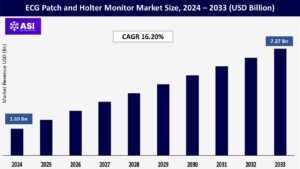
CAGR: 16.20%
Last Updated : November 22, 2025
The global ECG patch and holter monitor market size was valued at approximately USD 1.69 billion in 2024 and is projected to reach USD 7.27 billion by 2033, growing at a CAGR of 16.20% during the forecast period (2025–2033).
The ECG Patch and Holter Monitor Market and the 3D Medical Imaging Market represent two crucial segments in the medical diagnostics industry, both playing vital roles in early disease detection and patient monitoring. The ECG Patch and Holter Monitor Market includes wearable and portable devices designed to continuously monitor the heart’s electrical activity, primarily used for identifying arrhythmias, atrial fibrillation, and other transient cardiac anomalies that may not be captured during routine check-ups.
ECG patches are small, adhesive, wireless devices placed directly on the skin, offering comfort, mobility, and extended monitoring (up to several days), making them ideal for home-based or outpatient care. In contrast, Holter monitors are slightly bulkier but provide longer recording durations and are commonly used in hospitals or specialty clinics. These devices are non-invasive, user-friendly, and provide high-quality diagnostic data, enabling physicians to make accurate cardiac assessments and treatment plans.
The growing global burden of cardiovascular diseases, such as arrhythmias, atrial fibrillation, ischemic heart disease, and heart failure, is a major driver for the ECG patch and Holter monitor market.
According to the World Health Organization (WHO), CVDs are the leading cause of death worldwide, accounting for nearly 18 million deaths annually. These conditions often require continuous and long-term cardiac monitoring for accurate diagnosis and timely intervention.
As traditional short-term ECGs may miss intermittent episodes, wearable ECG patches and long-duration Holter monitors are becoming essential tools in detecting silent or asymptomatic cardiac events, especially in elderly and high-risk populations.
Innovation in sensor technology, wireless communication, and cloud-based data analytics has significantly improved the efficiency and user experience of ECG patches and Holter monitors. Modern devices are now lightweight, waterproof, wireless, and capable of transmitting real-time data to healthcare providers via mobile apps or remote monitoring platforms.
Features like AI-driven arrhythmia detection, extended battery life, and integration with telemedicine are enhancing diagnostic accuracy while supporting at-home patient care and reducing hospital readmissions. These advancements are increasing adoption among both patients and clinicians, driving market growth.
One of the major restraints affecting the adoption of ECG patches and Holter monitors is the lack of uniform reimbursement policies, especially in developing or underfunded healthcare systems. While technologically advanced wearable ECG monitoring devices are more comfortable and efficient, they often come at a higher cost compared to traditional monitoring methods.
In many countries, health insurance providers may not fully cover these advanced diagnostics, making them financially inaccessible to a large segment of the population. This can deter both healthcare providers and patients from using newer devices despite their clinical benefits. Additionally, procurement of wearable ECG systems for large-scale screening programs or primary care setups may be limited due to budget constraints in public healthcare institutions.
| Report Metric | Details |
|---|---|
| Segmentations | |
| By Product Type |
ECG Patch Monitors Holter Monitors Mobile Cardiac Telemetry (MCT) Wearable ECG Devices |
| By Technology |
Wired Wireless Cloud-Based Smartphone-Integrated |
| By Application |
Diagnostics Monitoring (Ambulatory, Telemetry) QT Interval Analysis Chronic Disease Management |
| By End-User |
Hospitals & Clinics Specialty Clinics Home Healthcare Ambulatory Facilities |
| By Distribution Channel |
Direct Sales Online Retail Distributor Partners HCP Partnerships |
| Key Players |
|
| Geographies Covered | |
| North America |
U.S. |
| Europe |
U.K. |
| Asia Pacific |
China |
| Middle East & Africa |
Saudi Arabia |
| Latin America |
Brazil |
The ECG Patch and Holter Monitor Market is segmented by Product Type Technology, Application, Distribution Channels and End User. Each factor driving the ECG Patch and Holter Monitor Market plays a critical role in advancing cardiac care by enabling earlier detection, continuous remote monitoring, and improved patient compliance.
These technologies are transforming how arrhythmias and other heart rhythm disorders are diagnosed and managed — especially outside hospital settings — by making cardiac monitoring more accessible, accurate, and patient-friendly.
The market is categorized into ECG Patch Monitors, Holter Monitors, Mobile Cardiac Telemetry (MCT), and Wearable ECG Devices. ECG patch monitors are gaining significant traction due to their compact design, patient comfort, and ease of use for continuous, real-time monitoring, particularly in outpatient or homecare settings.
Holter monitors, while more traditional, remain widely used in hospital and diagnostic lab settings for their ability to provide long-term, high-quality cardiac data. MCT devices offer real-time transmission of cardiac events to healthcare providers, making them essential for high-risk patients. Wearable ECG devices, including smartwatches with ECG capabilities, are driving consumer interest and empowering patients to take a proactive role in heart health monitoring.
The market is divided into Wired, Wireless, Cloud-Based, and Smartphone-Integrated systems. Wireless and cloud-based technologies are leading the segment due to their convenience, portability, and ability to facilitate remote monitoring and data storage.
Smartphone-integrated ECG devices, often app-driven, are becoming increasingly popular among tech-savvy users and younger demographics for real-time feedback and teleconsultation capabilities. Wired systems, although still in use, are gradually being phased out due to limitations in patient mobility and data accessibility.
The market is segmented into Diagnostics, Monitoring (including Ambulatory Monitoring and Telemetry), QT Interval Analysis, and Chronic Disease Management. Diagnostic applications account for a significant market share, as these devices enable early detection of arrhythmias and other cardiovascular anomalies.
Ambulatory and telemetry monitoring allow clinicians to track patient health over extended periods without hospitalization, reducing clinical workload and enhancing patient comfort. QT interval analysis is particularly critical for patients on medications known to affect heart rhythms.
Chronic disease management, especially in patients with conditions like hypertension, diabetes, or heart failure, is emerging as a high-growth segment due to the need for continuous cardiac surveillance.
The market includes Hospitals & Clinics, Specialty Clinics, Home Healthcare, and Ambulatory Facilities. Hospitals and specialty clinics dominate the market owing to the availability of diagnostic infrastructure and skilled personnel.
However, the home healthcare segment is witnessing rapid expansion, driven by the rise in remote monitoring solutions, the aging population, and increased demand for post-discharge patient care. Ambulatory care centers are also contributing to market growth as they adopt portable ECG technologies for quick, non-invasive assessments.
The market is categorized into Direct Sales, Online Retail, Distributor Partners, and Healthcare Provider (HCP) Partnerships. Direct sales remain the preferred channel for hospitals and clinics requiring large-scale procurement with technical support.
Online retail channels are rapidly growing, especially among end-users and small healthcare providers looking for cost-effective, consumer-friendly wearable ECG products. Distributor partnerships facilitate regional market penetration, while HCP partnerships are enabling broader integration into chronic disease management programs and clinical workflows.
Holds the largest share of the ECG Patch and Holter Monitor Market, driven by a high prevalence of cardiovascular diseases, an aging population, and widespread adoption of remote patient monitoring solutions.
The United States leads the region with strong investments in digital health, a mature regulatory framework (e.g., FDA approvals for wearable ECG devices), and favorable reimbursement policies under Medicare and private insurers. In Canada, rising awareness and demand for home-based cardiac monitoring are also propelling market growth.
The second-largest market, supported by a strong healthcare infrastructure and government-backed initiatives for preventive healthcare. Countries like Germany, the UK, and France are at the forefront, adopting wearable ECG patches and ambulatory monitoring to manage chronic cardiac conditions in aging populations.
The EU’s emphasis on digital health transformation and data-driven care models is accelerating the integration of wireless ECG technologies in both public and private healthcare systems.
The fastest-growing region due to its large population, increasing cardiovascular disease burden, improving healthcare access, and technological adoption. Countries like China, India, and Japan are investing in modern healthcare infrastructure, while rising smartphone penetration supports the adoption of app-based ECG monitoring devices. Government initiatives in telemedicine and digital health, especially post-COVID-19, have also created new avenues for market expansion.
Presents moderate but consistent growth, led by countries such as Brazil and Mexico, which are expanding public and private cardiology services. However, challenges such as limited reimbursement structures, economic volatility, and uneven access to advanced technologies restrain broader market penetration in rural areas.
Market growth is emerging, driven by healthcare modernization efforts in GCC countries (notably Saudi Arabia and the UAE) and increasing awareness of heart disease. However, limited healthcare infrastructure and affordability remain barriers in much of Sub-Saharan Africa. Still, growing urban populations and digital health investments are creating long-term growth opportunities.
The ECG Patch and Holter Monitor market was valued at USD 1.69 billion in 2024.
The ECG Patch and Holter Monitor market is projected to grow at a CAGR of 16.20% from 2025 to 2033.
ECG Patch Monitors hold the largest ECG Patch and Holter Monitor market share.
The North America region is expected to witness the highest growth rate.
Major players include iRhythm Technologies, Inc., BioTelemetry, Inc. (a Philips company) and GE Healthcare
1.1 Summary
1.2 Research methodology
2.1 Research Objectives
2.2 Market Definition
2.3 Limitations & Assumptions
2.4 Market Scope & Segmentation
2.5 Currency & Pricing Considered
3.1 Drivers
3.2 Geopolitical Impact
3.3 Human Factors
3.4 Technology Factors
4.1 Porters Five Forces Analysis
4.2 Value Chain Analysis
4.3 Average Pricing Analysis
4.4 M & A, Agreements & Collaboration Analysis
5.1 ECG Patch and Holter Monitor Market, By Product Type
5.1.1 Introduction
5.1.2 Market Size & Forecast
5.2 ECG Patch and Holter Monitor Market, By Technology
5.3 ECG Patch and Holter Monitor Market, By Application
5.4 ECG Patch and Holter Monitor Market, By End-User
5.5 ECG Patch and Holter Monitor Market, By Distribution Channel
6.1 North America ECG Patch and Holter Monitor Market , By Country
6.1.1 ECG Patch and Holter Monitor Market, By Product Type
6.1.2 ECG Patch and Holter Monitor Market, By Technology
6.1.3 ECG Patch and Holter Monitor Market, By Application
6.1.4 ECG Patch and Holter Monitor Market, By End-User
6.1.5 ECG Patch and Holter Monitor Market, By Distribution Channel
6.2 U.S.
6.2.1 ECG Patch and Holter Monitor Market, By Product Type
6.2.2 ECG Patch and Holter Monitor Market, By Technology
6.2.3 ECG Patch and Holter Monitor Market, By Application
6.2.4 ECG Patch and Holter Monitor Market, By End-User
6.2.5 ECG Patch and Holter Monitor Market, By Distribution Channel
6.3 Canada
7.1 U.K.
7.2 Germany
7.3 France
7.4 Spain
7.5 Italy
7.6 Russia
7.7 Nordic
7.8 Benelux
7.9 The Rest of Europe
8.1 China
8.2 South Korea
8.3 Japan
8.4 India
8.5 Australia
8.6 Taiwan
8.7 South East Asia
8.8 The Rest of Asia-Pacific
9.1 UAE
9.2 Turkey
9.3 Saudi Arabia
9.4 South Africa
9.5 Egypt
9.6 Nigeria
9.7 Rest of MEA
10.1 Brazil
10.2 Mexico
10.3 Argentina
10.4 Chile
10.5 Colombia
10.6 Rest of Latin America
11.1 Global Market Share (%) By Players
11.2 Market Ranking By Revenue for Players
11.3 Competitive Dashboard
11.4 Product Mapping