

Natural Killer (NK) Cell Therapeutics Market
Natural Killer (NK) Cell Therapeutics Market Share & Trends Analysis Report, By Therapy Type (Autologous NK Cell Therapy, Allogeneic NK Cell Therapy), By Application (Cancer (Hematologic Malignancies, Solid Tumors), Viral Infections, Immunotherapy, Others), By Indication (Acute Myeloid Leukemia, Non-Hodgkin’s Lymphoma, Melanoma, Multiple Myeloma, Others), By End User (Hospitals, Clinics, Research Institutes, Specialty Cancer Centers), By Route of Administration (Intravenous, Intratumoral, Others)– Industry Analysis Report, Regional Outlook, Growth Potential, Price Trends, Competitive Market Share & Forecast, 2025–2033.

Historical Period: 2019-2024
Forecast Period: 2025-2033
Report Code :
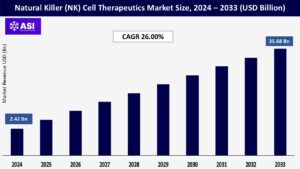
CAGR: 26.00%
Last Updated : January 22, 2026
The global natural killer (NK) cell therapeutics market size was valued at approximately USD 2.42 billion in 2024 and is projected to reach USD 35.68 billion by 2033, growing at a CAGR of 26.00% during the forecast period (2025–2033).
The Natural Killer (NK) Cell Therapeutics Market is a global industry focused on creating and selling treatments that use natural killer (NK) cells, positioning the natural killer (NK) cell therapeutics industry as a key segment of immuno-oncology. NK cells are a type of white blood cell that can quickly find and kill infected or cancerous cells without needing to “learn” about them first.
Scientists are working on ways to improve these cells or make more of them to treat illnesses like cancer, viral infections, and autoimmune diseases. One of the biggest benefits of NK cell therapies is that they attack only the harmful cells and leave healthy ones alone, which means fewer side effects compared to other treatments.
These therapies can be made using NK cells from a donor (allogeneic) or from the patient’s own body (autologous). They can also be made stronger using genetic changes or by combining them with other treatments like antibodies.
As research continues, these NK cell therapies are becoming more popular, especially for cancer treatment, and many companies and scientists are working together to make them widely available.
A major reason for the growth of the NK cell therapeutics market is the rising number of people being diagnosed with cancer and long-term infections around the world. As reported by the World Health Organization (WHO), cancer is one of the top causes of death globally, with millions of new cases every year.
In addition, diseases like HIV, hepatitis B and C, and newer viruses such as COVID-19 have created a strong demand for better immune-based treatments. NK cells, which are naturally able to detect and destroy cancerous and infected cells, are seen as a powerful treatment option.
This has led to increased interest in NK cell therapies as a way to provide targeted and effective care, encouraging more research, investment, and product development in this field, supporting sustained growth in the natural killer (NK) cell therapeutics market size.
The NK cell therapeutics market is also growing due to major progress in cell therapy and genetic engineering. In the past, NK cell treatments had issues like short cell life and difficulty in growing enough cells for treatment.
But with the development of advanced technologies—such as CRISPR gene editing, CAR-NK cell engineering, and better methods for freezing and multiplying cells—these challenges are being solved.
Another key advancement is the creation of ready-to-use (allogeneic) NK therapies, which removes the need for custom treatments for each patient.
These breakthroughs are drawing more attention and funding from pharmaceutical companies, speeding up clinical trials, and making it more likely that NK therapies will become widely available in healthcare.
A major challenge for the Natural Killer (NK) Cell Therapeutics Market is the high cost and complicated process of manufacturing NK cell-based treatments, which may limit short-term expansion of the natural killer (NK) cell therapeutics market size. These therapies require advanced technologies, specialized labs, and strict quality standards to ensure they are safe and effective.
The production process includes collecting NK cells from either donors or patients, growing them in the lab, modifying them—often using gene editing and testing them thoroughly before use. Each step needs skilled professionals, costly materials, and high-end equipment, making the entire process expensive and time-intensive.
In addition, personalized treatments, like autologous NK therapies (using a patient’s own cells), are difficult to scale up because they must be customized for each individual. Even off-the-shelf (allogeneic) therapies, which are designed for broader use, face obstacles in mass production, such as maintaining cell health, proper storage, transportation, and meeting regulatory standards.
These factors raise costs for companies and healthcare providers, and limit access for patients. Until more affordable and efficient manufacturing solutions are found, these production challenges will continue to slow the wider use of NK cell therapies.
| Report Metric | Details |
|---|---|
| Segmentations | |
| By Therapy Type |
Autologous NK Cell Therapy Allogeneic NK Cell Therapy |
| By Application |
Cancer (Hematologic Malignancies, Solid Tumors) Viral Infections Immunotherapy Others |
| By Indication |
Acute Myeloid Leukemia Non-Hodgkin’s Lymphoma Melanoma Multiple Myeloma Others |
| By End User |
Hospitals Clinics Research Institutes Specialty Cancer Centers |
| By Route of Administration |
Intravenous Intratumoral Others |
| Key Players |
|
| Geographies Covered | |
| North America |
U.S. |
| Europe |
U.K. |
| Asia Pacific |
China |
| Middle East & Africa |
Saudi Arabia |
| Latin America |
Brazil |
The following section presents a detailed natural killer (NK) cell therapeutics market analysis across Therapy Type, Drug class, Application, Indication, End User, and Route of Administration. Each factor contributes significantly to improving treatment precision, boosting the acceptance of NK cell-based immunotherapies, and advancing the development of safer, more effective, and scalable solutions for managing cancer, viral infections, and immune-related disorders.
Autologous NK Cell Therapy: This treatment uses NK cells taken from the patient’s own body. The cells are changed and then given back to help fight disease. It’s more personal and less likely to be rejected by the body, but it’s also expensive and takes a lot of time to prepare. That’s why it’s mostly used in early-stage studies or special cases.
Allogeneic NK Cell Therapy: These therapies use NK cells from healthy donors, making them easier to prepare and available for many patients. They are faster to produce, cost less, and can be used in more situations. That’s why this type is growing quickly and is expected to capture a rising natural killer (NK) cell therapeutics market share in ongoing research and trials.
Blood cancers (like leukemia and lymphoma): NK cells are naturally good at fighting these types of cancers, so there’s a lot of focus and research happening in this area.
Solid tumors (like lung, breast, and liver cancer): These are harder to treat with NK cells, but new ways of using engineered NK cells and combination treatments are showing promise.
Viral Infections: NK cell therapies are being tested for diseases like HIV and hepatitis. They’re also being explored as support for fighting viruses like COVID-19.
Immunotherapy: NK cells are often used alongside other immune-based treatments, like checkpoint inhibitors and antibody therapies, to boost results.
Others: These therapies may also help with autoimmune diseases or recovery after organ transplants, though this is still being studied.
Acute Myeloid Leukemia (AML) is a fast-growing blood cancer that responds well to NK cell therapies. Many clinical studies are focusing on this.
Non-Hodgkin’s Lymphoma (NHL): This type of cancer also shows promise when treated with NK cells, especially new forms like CAR-NK cells. It’s becoming an area of growing interest.
Melanoma NK cells are being tested as another option (or in combination) with other immune treatments for skin cancer.
Multiple Myeloma: A difficult cancer to treat, but some patients are showing better results when using NK cell therapies.
Others: This includes cancers like ovarian, liver, and pancreatic cancer, which are still being researched.
Hospitals: These are the main users of NK therapies because they have the facilities and staff needed to deliver advanced treatments and run clinical trials.
Clinics: Some clinics, especially those focused on cancer, are starting to offer these treatments as part of personalized care.
Research Institutes: These play a key role in discovering and testing new NK therapies, often working with biotech companies.
Specialty Cancer Centers: These centers often try out the newest treatments early and treat complex cancer cases, making them important users of NK therapies.
Intravenous (IV): The most common method for NK cells is given through a vein, allowing the treatment to travel throughout the body.
Intratumoral: In some cases, NK cells are injected directly into the tumor. This targets the cancer more directly and may reduce side effects.
Others: New methods, like under-the-skin injections or combining with pills, are being studied but are not yet common.
North America is the top region in the NK cell therapy market and holds the largest market share due to strong clinical activity and investment. It has advanced hospitals and research facilities, and many people suffer from cancer and infections, driving demand for new treatments.
The United States leads due to a high number of clinical trials, support from government bodies like the NIH and FDA, and investment from big pharma companies.
The country also has good insurance systems and government funding for cancer care. Canada is also growing, thanks to its strong healthcare system and involvement in research.
Europe is a strong and growing market. It has world-class research centers, well-funded healthcare, and increasing public and private spending on cancer immunotherapy. Countries like Germany, the UK, France, and Switzerland are leading the way with active trials and innovation in NK therapies.
The European Medicines Agency (EMA) is working to make approvals faster, which helps bring treatments to patients sooner. People in Europe are also becoming more aware of personalized treatments, which boosts demand.
Asia-Pacific is the fastest-growing region for NK cell therapies, supported by rising healthcare spending and strong natural killer (NK) cell therapeutics market growth. More people are being diagnosed with cancer, and countries are spending more on healthcare and research. Nations like China, Japan, South Korea, and India are investing heavily in cancer treatment and personalized medicine.
China and Japan have strong research systems and supportive government policies. Lower costs for clinical trials also make this region attractive for companies developing new treatments.
Latin America is in the early stages of growth. Countries like Brazil, Mexico, and Argentina are seeing better healthcare systems and rising cancer rates, which increases interest in NK cell therapies.
However, limited funding, fewer high-tech facilities, and slower regulations make progress slower. Still, hospitals and researchers are showing more interest, and the region could grow more in the future.
The Middle East & Africa have the smallest share of the market but have room to grow. Wealthier countries like Saudi Arabia, the UAE, and Qatar are building better healthcare systems and forming partnerships with global biotech companies.
They are also running national programs to fight cancer. On the other hand, many African countries face challenges like low access to care, limited awareness, and fewer treatment centers. However, with rising investments and interest, this region could slowly develop its NK therapy market.
The market was valued at USD 2.42 billion in 2024.
The market is projected to grow at a CAGR of 26.00% from 2025 to 2033.
Autologous NK Cell Therapy hold the largest market share.
The North America region is expected to witness the highest growth rate.
Major players include Fate Therapeutics, Nkarta, Inc. and Innate Pharma.
1.1 Summary
1.2 Research methodology
2.1 Research Objectives
2.2 Market Definition
2.3 Limitations & Assumptions
2.4 Market Scope & Segmentation
2.5 Currency & Pricing Considered
3.1 Drivers
3.2 Geopolitical Impact
3.3 Human Factors
3.4 Technology Factors
4.1 Porters Five Forces Analysis
4.2 Value Chain Analysis
4.3 Average Pricing Analysis
4.4 M & A, Agreements & Collaboration Analysis
5.1 Natural Killer (NK) Cell Therapeutics Market, By Therapy Type
5.1.1 Introduction
5.1.2 Market Size & Forecast
5.2 Natural Killer (NK) Cell Therapeutics Market, By Application
5.3 Natural Killer (NK) Cell Therapeutics Market, By Indication
5.4 Natural Killer (NK) Cell Therapeutics Market, By End User
5.5 Natural Killer (NK) Cell Therapeutics Market, By Route of Administration
6.1 North America Natural Killer (NK) Cell Therapeutics Market , By Country
6.1.1 Natural Killer (NK) Cell Therapeutics Market, By Therapy Type
6.1.2 Natural Killer (NK) Cell Therapeutics Market, By Application
6.1.3 Natural Killer (NK) Cell Therapeutics Market, By Indication
6.1.4 Natural Killer (NK) Cell Therapeutics Market, By End User
6.1.5 Natural Killer (NK) Cell Therapeutics Market, By Route of Administration
6.2 U.S.
6.2.1 Natural Killer (NK) Cell Therapeutics Market, By Therapy Type
6.2.2 Natural Killer (NK) Cell Therapeutics Market, By Application
6.2.3 Natural Killer (NK) Cell Therapeutics Market, By Indication
6.2.4 Natural Killer (NK) Cell Therapeutics Market, By End User
6.2.5 Natural Killer (NK) Cell Therapeutics Market, By Route of Administration
6.3 Canada
7.1 U.K.
7.2 Germany
7.3 France
7.4 Spain
7.5 Italy
7.6 Russia
7.7 Nordic
7.8 Benelux
7.9 The Rest of Europe
8.1 China
8.2 South Korea
8.3 Japan
8.4 India
8.5 Australia
8.6 Taiwan
8.7 South East Asia
8.8 The Rest of Asia-Pacific
9.1 UAE
9.2 Turkey
9.3 Saudi Arabia
9.4 South Africa
9.5 Egypt
9.6 Nigeria
9.7 Rest of MEA
10.1 Brazil
10.2 Mexico
10.3 Argentina
10.4 Chile
10.5 Colombia
10.6 Rest of Latin America
11.1 Global Market Share (%) By Players
11.2 Market Ranking By Revenue for Players
11.3 Competitive Dashboard
11.4 Product Mapping