

OTC Braces and Supports Market
OTC Braces and Supports Market Share & Trends Analysis Report, By Product Type (Soft & Elastic Braces, Hinged Braces, Hard & Rigid Braces), By Body Region (Knee Braces & Supports, Ankle & Foot Braces, Back & Spine Supports, Shoulder Braces, Elbow Braces, Wrist & Hand Braces, Other Regions), By Application (Preventive Care, Ligament Injury Repair, Post‑Operative Rehabilitation, Osteoarthritis, Compression Therapy, Other Uses), By Distribution Channel (Pharmacies & Drugstores, Orthopedic Clinics, E‑Commerce / Online Retail), By End User (Adults, Pediatrics)– Industry Analysis Report, Regional Outlook, Growth Potential, Price Trends, Competitive Market Share & Forecast, 2025–2033.

Historical Period: 2019-2024
Forecast Period: 2025-2033
Report Code :
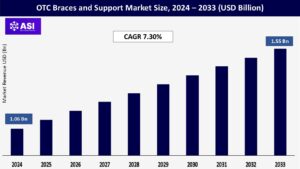
CAGR: 7.30%
Last Updated : December 15, 2025
The global OTC Braces and Supports Market size was valued at approximately USD 1.06 billion in 2024 and is projected to reach USD 1.55 billion by 2033, growing at a CAGR of 7.30% during the forecast period (2025–2033).
The OTC (Over-the-Counter) Braces and Supports Market includes orthopedic devices that are accessible without a medical prescription and are designed to provide external support to musculoskeletal structures. These devices, such as knee braces, ankle supports, wrist braces, and back supports, are primarily used to stabilize joints, prevent injuries, manage chronic conditions, or assist in rehabilitation.
Consumers use OTC braces and supports for conditions like arthritis, sprains, ligament injuries, and general joint pain, especially during sports or physical activities. The key properties of these products include their ergonomic design, adjustability, reusability, and lightweight construction.
They are typically made from materials such as neoprene, spandex, elastic fabrics, and sometimes reinforced with plastic or metal components for added support. These braces are user-friendly, allowing patients to apply and remove them without professional assistance, and often feature moisture-wicking and breathable materials for comfort during prolonged use.
One of the primary drivers of the OTC braces and supports market is the increasing incidence of musculoskeletal disorders such as arthritis, osteoarthritis, and ligament injuries. Additionally, growing participation in sports and physical fitness activities among youth and adults has led to a rise in acute injuries like sprains, strains, and fractures.
These conditions often require external support for pain relief and healing, making OTC braces and supports a convenient, accessible, and cost-effective option for self-care without the need for a prescription.
The growing geriatric population is highly susceptible to joint-related disorders, balance issues, and mobility limitations. This demographic shift is significantly boosting the demand for braces and supports that help manage chronic pain, reduce the risk of falls, and enhance the quality of life.
Additionally, increasing health awareness and the trend toward preventive healthcare are encouraging individuals to adopt OTC supports for everyday joint and muscle protection, especially during work, travel, or light physical activity.
One significant restraint in the OTC braces and supports market is the limited knowledge among consumers regarding the correct selection and usage of these devices. Since OTC products are sold without a prescription, users often purchase and use them without professional medical guidance.
This can result in improper fit, incorrect application, or misuse of braces, which may worsen the condition rather than aid recovery. Moreover, without proper evaluation of the underlying medical issue, users may rely on braces for symptomatic relief while ignoring the root cause, potentially delaying necessary medical treatment.
This lack of user education reduces product effectiveness and can result in negative perceptions of product reliability, hampering overall market growth.
| Report Metric | Details |
|---|---|
| Segmentations | |
| By Product Type |
Soft & Elastic Braces Hinged Braces Hard & Rigid Braces |
| By Body Region |
Knee Braces & Supports Ankle & Foot Braces Back & Spine Supports Shoulder Braces Elbow Braces Wrist & Hand Braces Other Regions |
| By Application |
Preventive Care Ligament Injury Repair Post‑Operative Rehabilitation Osteoarthritis Compression Therapy Other Uses |
| By Distribution Channel |
Pharmacies & Drugstores Orthopedic Clinics E‑Commerce / Online Retail |
| By End User |
Adults Pediatrics |
| Key Players |
|
| Geographies Covered | |
| North America |
U.S. |
| Europe |
U.K. |
| Asia Pacific |
China |
| Middle East & Africa |
Saudi Arabia |
| Latin America |
Brazil |
The OTC Braces and Supports Market is segmented by Product Type, Body Region, Application, Distribution Channels and End User. Each factor rising awareness of musculoskeletal health, increased sports-related injuries, aging populations, and growing interest in self-managed care plays a pivotal role in enhancing patient mobility, promoting early intervention, and driving the adoption of non-invasive treatment options.
These elements collectively support the evolution of the OTC braces and supports market toward more accessible, user-friendly, and preventative orthopedic care solutions.
The market is classified into Soft & Elastic Braces, Hinged Braces, and Hard & Rigid Braces. Among these, soft and elastic braces dominate due to their lightweight design, ease of use, affordability, and broad applications in preventive care and mild conditions.
Hinged braces, which provide enhanced joint stabilization, are commonly used in moderate injuries or post-surgical rehabilitation, especially for knees and elbows. Hard and rigid braces cater to more severe conditions requiring firm immobilization, such as spinal injuries or serious ligament damage.
The market includes Knee Braces & Supports, Ankle & Foot Braces, Back & Spine Supports, Shoulder Braces, Elbow Braces, Wrist & Hand Braces, and Other Regions. Knee braces hold the largest market share due to the high incidence of knee injuries, especially in sports and aging populations.
Ankle and foot braces follow closely, driven by increasing sports-related foot injuries and diabetic foot complications. Back and spine supports are seeing steady demand from sedentary lifestyles and chronic back pain. Wrist and hand braces are popular among individuals with carpal tunnel syndrome or repetitive strain injuries.
The market is categorized into Preventive Care, Ligament Injury Repair, Post-Operative Rehabilitation, Osteoarthritis, Compression Therapy, and Other Uses. Preventive care is gaining momentum with rising awareness of joint protection during physical activity and everyday tasks.
Ligament injury repair and post-operative rehabilitation remain crucial applications, particularly for athletes and post-surgery patients. The growing prevalence of osteoarthritis, especially among the elderly, has further fueled the demand for braces that aid in joint pain relief and movement support. Compression therapy, used to reduce swelling and improve blood flow, also contributes to market growth.
The market is segmented into Pharmacies & Drugstores, Orthopedic Clinics, and E-Commerce / Online Retail. Pharmacies and drugstores remain the dominant channel due to ease of access and trusted in-person service.
However, e-commerce and online retail is the fastest-growing segment, driven by digital health trends, consumer convenience, broader product availability, and the growth of health-focused platforms. Orthopedic clinics also play an important role, especially for patients seeking professional recommendations or post-surgical care.
The market is divided into Adults and Pediatrics. The adult segment constitutes the largest share owing to the higher prevalence of orthopedic conditions, sports injuries, and post-surgical rehabilitation needs.
The pediatric segment, although smaller, is gradually expanding with increased use of braces in treating congenital musculoskeletal disorders and managing injuries in active children and adolescents.
Dominates the OTC braces and supports market due to its well-established healthcare infrastructure, high awareness of musculoskeletal health, and widespread adoption of preventive orthopedic solutions.
The presence of major market players, aging baby boomer demographics, and high participation in sports and fitness activities further support market growth.
Follows closely, driven by an increasing geriatric population, favorable reimbursement policies, and the rising prevalence of conditions like osteoarthritis and ligament injuries. Countries such as Germany, the UK, and France are key contributors.
Region is experiencing rapid market expansion due to rising healthcare spending, increasing awareness about self-care, and a growing burden of joint-related disorders. Markets like China, Japan, and India are showing strong growth potential due to rising middle-class populations and expanding retail and e-commerce sectors.
Gradually adopting OTC braces, driven by improvements in healthcare access and sports participation, though the market remains price-sensitive.
Growth is slower but improving, with increasing urbanization, awareness of orthopedic wellness, and government efforts to enhance healthcare delivery supporting long-term demand.
The market was valued at USD 1.06 billion in 2024.
The market is projected to grow at a CAGR of 7.30% from 2025 to 2033.
Soft & Elastic Braces hold the largest market share.
The North America region is expected to witness the highest growth rate.
Major players include DJO Global, Inc. (Enovis Corporation), Bauerfeind AG and Breg, Inc.
1.1 Summary
1.2 Research methodology
2.1 Research Objectives
2.2 Market Definition
2.3 Limitations & Assumptions
2.4 Market Scope & Segmentation
2.5 Currency & Pricing Considered
3.1 Drivers
3.2 Geopolitical Impact
3.3 Human Factors
3.4 Technology Factors
4.1 Porters Five Forces Analysis
4.2 Value Chain Analysis
4.3 Average Pricing Analysis
4.4 M & A, Agreements & Collaboration Analysis
5.1 OTC Braces and Supports Market, By Product Type
5.1.1 Introduction
5.1.2 Market Size & Forecast
5.2 OTC Braces and Supports Market, By Body Region
5.3 OTC Braces and Supports Market, By Application
5.4 OTC Braces and Supports Market, By Distribution Channel
5.5 OTC Braces and Supports Market, By End User
6.1 North America OTC Braces and Supports Market , By Country
6.1.1 OTC Braces and Supports Market, By Product Type
6.1.2 OTC Braces and Supports Market, By Body Region
6.1.3 OTC Braces and Supports Market, By Application
6.1.4 OTC Braces and Supports Market, By Distribution Channel
6.1.5 OTC Braces and Supports Market, By End User
6.2 U.S.
6.2.1 OTC Braces and Supports Market, By Product Type
6.2.2 OTC Braces and Supports Market, By Body Region
6.2.3 OTC Braces and Supports Market, By Application
6.2.4 OTC Braces and Supports Market, By Distribution Channel
6.2.5 OTC Braces and Supports Market, By End User
6.3 Canada
7.1 U.K.
7.2 Germany
7.3 France
7.4 Spain
7.5 Italy
7.6 Russia
7.7 Nordic
7.8 Benelux
7.9 The Rest of Europe
8.1 China
8.2 South Korea
8.3 Japan
8.4 India
8.5 Australia
8.6 Taiwan
8.7 South East Asia
8.8 The Rest of Asia-Pacific
9.1 UAE
9.2 Turkey
9.3 Saudi Arabia
9.4 South Africa
9.5 Egypt
9.6 Nigeria
9.7 Rest of MEA
10.1 Brazil
10.2 Mexico
10.3 Argentina
10.4 Chile
10.5 Colombia
10.6 Rest of Latin America
11.1 Global Market Share (%) By Players
11.2 Market Ranking By Revenue for Players
11.3 Competitive Dashboard
11.4 Product Mapping