

Truck Fender Market
Truck Fender Market Share & Trends Analysis Report, By Material Type (Steel, Aluminum, Fiberglass, Plastic, and Others), Vehicle Type (Light-Duty Trucks, Medium-Duty Trucks, Heavy-Duty Trucks), End-User (Commercial, Industrial, Personal) Industry Analysis Report, Regional Outlook, Growth Potential, Price Trends, Competitive Market Share & Forecast, 2025–2033.

Historical Period: 2019-2024
Forecast Period: 2025-2033
Report Code :
CAGR: 4.5%
Last Updated : December 15, 2025
The global truck fender market size was valued at USD 4.76 billion in 2024 and is expected to grow from USD 4.97 billion in 2025 to reach USD 7.08 billion by 2033, growing at a CAGR of 4.5% during the forecast period (2025-2033).
The growing need for trucks in the commercial sector has led to a rapid expansion of the worldwide truck fender market in recent years. There is a strong demand for truck fenders because of the growing specifications for electrified and autonomous trucks.
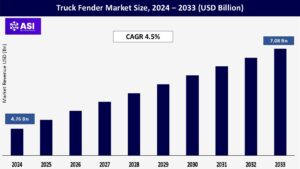
Several key drivers are propelling the truck fender market forward. One of the primary drivers is the booming logistics and transportation sector. With e-commerce growth projected to reach $5.4 trillion in 2024g, there is a notable increase in demand for freight transportation, thereby expanding the market for trucks and their components.
The adoption of stricter environmental regulations further encourages the development of advanced fender systems, which contribute to improved fuel economy and reduced emissions.
For instance, the Environmental Protection Agency (EPA) has mandated various fuel efficiency standards that indirectly boost the need for innovative fender solutions in commercial vehicles.
The market growth faces significant challenges due to the volatile prices of raw materials like plastic and steel, which are crucial for manufacturing truck fenders. This makes it difficult for manufacturers to maintain profitability, as accurately estimating and budgeting production costs becomes challenging.
Moreover, intense competition presents hurdles for new entrants seeking traction in the market. The COVID-19 pandemic further exacerbated these challenges, disrupting manufacturing and supply chain operations and thereby impeding the market growth.
As a result, industry players are compelled to navigate a complex landscape characterized by fluctuating material prices, competitive pressures, and pandemic-induced disruptions, posing formidable obstacles to sustained growth and profitability.
| Report Metric | Details |
|---|---|
| Segmentations | |
| By Material Type |
Steel Aluminum Fiberglass Plastic Others |
| By Vehicle Type |
Light-Duty Trucks Medium-Duty Trucks Heavy-Duty Trucks |
| By End-User Type |
Commercial Industrial Personal |
| Key Players |
|
| Geographies Covered | |
| North America |
U.S. |
| Europe |
U.K. |
| Asia Pacific |
China |
| Middle East & Africa |
Saudi Arabia |
| Latin America |
Brazil |
Aluminum fenders are gaining traction due to their lighter weight and corrosion-resistant properties with 43% market shares. These characteristics are particularly valuable in environments that are prone to rust and wear, such as coastal areas or regions with heavy snowfall.
The ability of aluminum fenders to enhance fuel efficiency without compromising on strength makes them an attractive choice across various vehicle types. Additionally, aluminum’s recyclability aligns with growing sustainability trends, further bolstering its market appeal.
Fiberglass and plastic fenders represent 38% market shares. the forefront of innovation in the truck fender market. These materials offer a unique combination of lightweight construction, flexibility, and ease of manufacturing, making them ideal for custom designs and applications requiring specific performance characteristics.
Fiberglass fenders are particularly popular in the aftermarket segment due to their customizable nature and aesthetic versatility. Plastic, meanwhile, offers a cost-effective alternative with excellent weather resistance and reduced maintenance needs.
Steel remains a traditional choice due to its robustness and cost-effectiveness. It offers high impact resistance, making it suitable for heavy-duty applications that require durability and strength.
However, the weight of steel can be a disadvantage in terms of fuel efficiency, prompting a shift towards lighter alternatives. Despite this, steel fenders continue to enjoy significant demand, especially in regions where cost constraints are a primary consideration.
The “Others” category includes emerging materials and hybrid composites that leverage the strengths of multiple material types to achieve superior performance.
These materials are often at the cutting edge of research and development, offering unprecedented benefits such as enhanced strength-to-weight ratios, increased durability, and superior resistance to environmental factors.
As automotive technology continues to evolve, the role of innovative materials in the truck fender market is expected to grow, providing opportunities for manufacturers to differentiate their offerings through material advancements.
Light-duty trucks, often used for personal and commercial purposes, demand fenders that offer a balance between aesthetics and functionality.
The growing popularity of urban delivery services and personal utility vehicles has increased the demand for light-duty truck fenders, encouraging manufacturers to focus on stylish designs and lightweight materials that enhance fuel efficiency.
Medium-duty trucks, serving as a critical link in the logistics chain, require fenders that can withstand moderate levels of wear and tear while maintaining cost-effectiveness. These trucks are commonly used in municipal services, small-scale logistics, and regional transportation, necessitating a balance between durability and affordability.
The demand for medium-duty truck fenders is sustained by the steady growth of regional supply chains and the expansion of municipal infrastructure projects, which rely heavily on these versatile vehicles.
Heavy-duty trucks, the backbone of long-haul transportation and industrial operations, demand fenders that can endure extreme conditions and heavy loads. The fenders for these vehicles must offer the highest levels of durability, impact resistance, and corrosion protection. As global supply chains become more complex and demanding, the importance of reliable heavy-duty truck components like fenders cannot be overstated.
Personal end-users, comprising individual truck owners and enthusiasts, tend to focus on customization and aesthetic appeal. For these users, fenders are not just functional components but also accessories that enhance the visual and performance aspects of their vehicles.
The aftermarket segment is particularly important for this group, offering a wide range of options for personalization, from high-performance materials to unique design elements.
Industrial end-users, including mining, construction, and agricultural sectors, require fenders that can withstand harsh environments and heavy-duty usage. The focus here is on fenders that offer exceptional durability, impact resistance, and protection against environmental factors such as corrosion and abrasion.
The demand for heavy-duty fenders is driven by the need to protect valuable machinery and ensure the safety of operations in challenging conditions.
Commercial end-users, encompassing businesses in logistics, transportation, and delivery services, are focused on efficiency, durability, and cost-effectiveness. The need for reliable and robust fenders is paramount in ensuring minimal downtime and maintaining the operational efficiency of commercial fleets. These users often prioritize fenders that offer good value for money while meeting necessary safety and durability standards.
Asia Pacific is poised as a dominant region, accounting for a substantial 24% share of the market due to its rapidly expanding automotive industry and increasing infrastructure investments.
The market is expected to grow at an impressive CAGR of 6.0% over the forecast period, driven by countries like China, India, and Japan. These nations are experiencing a surge in demand for commercial and industrial vehicles, bolstered by robust economic growth and urbanization.
Europe has a 28% share of the market, Europe represents a mature yet dynamic market for truck fenders, characterized by a strong emphasis on sustainability and innovation. The region’s automotive industry is at the forefront of developing eco-friendly vehicles and components, including fenders made from recyclable and advanced materials.
Countries such as Germany, France, and the United Kingdom are key contributors to market growth, driven by stringent environmental regulations and a focus on reducing carbon emissions.
North America acquired market share 34%. North America is another significant market for truck fenders, underpinned by advanced manufacturing capabilities and a mature automotive sector. The region’s stringent regulatory frameworks focused on vehicle safety and emissions standards contribute to the demand for high-quality, durable fenders.
The United States, in particular, plays a critical role in driving market growth due to its extensive logistics network and the increasing adoption of electric and hybrid trucks.
This region captures a smaller share of around 8 MEA is showing moderate but consistent growth due to increased construction and mining activities, especially in Gulf countries. Rising investments in transportation and off-highway vehicles support fender replacements.
The current size of the market 4.76 Billions in 2024.
The expected CAGR is 4.5% from 2025 to 2033.
North America currently holds the largest market shares.
Ford Motor Company, General Motors Company, Toyota Motor Corporation,Nissan Motor Co., Ltd.
1.1 Summary
1.2 Research methodology
2.1 Research Objectives
2.2 Market Definition
2.3 Limitations & Assumptions
2.4 Market Scope & Segmentation
2.5 Currency & Pricing Considered
3.1 Drivers
3.2 Geopolitical Impact
3.3 Human Factors
3.4 Technology Factors
4.1 Porters Five Forces Analysis
4.2 Value Chain Analysis
4.3 Average Pricing Analysis
4.4 M & A, Agreements & Collaboration Analysis
5.1 Truck Fender Market, By Material Type
5.1.1 Introduction
5.1.2 Market Size & Forecast
5.2 Truck Fender Market, By Vehicle Type
5.3 Truck Fender Market, By End-User Type
6.1 North America Truck Fender Market , By Country
6.1.1 Truck Fender Market, By Material Type
6.1.2 Truck Fender Market, By Vehicle Type
6.1.3 Truck Fender Market, By End-User Type
6.2 U.S.
6.2.1 Truck Fender Market, By Material Type
6.2.2 Truck Fender Market, By Vehicle Type
6.2.3 Truck Fender Market, By End-User Type
6.3 Canada
7.1 U.K.
7.2 Germany
7.3 France
7.4 Spain
7.5 Italy
7.6 Russia
7.7 Nordic
7.8 Benelux
7.9 The Rest of Europe
8.1 China
8.2 South Korea
8.3 Japan
8.4 India
8.5 Australia
8.6 Taiwan
8.7 South East Asia
8.8 The Rest of Asia-Pacific
9.1 UAE
9.2 Turkey
9.3 Saudi Arabia
9.4 South Africa
9.5 Egypt
9.6 Nigeria
9.7 Rest of MEA
10.1 Brazil
10.2 Mexico
10.3 Argentina
10.4 Chile
10.5 Colombia
10.6 Rest of Latin America
11.1 Global Market Share (%) By Players
11.2 Market Ranking By Revenue for Players
11.3 Competitive Dashboard
11.4 Product Mapping