

Three-Wheeler Market
Three-Wheeler Market Size, Share & Trends Analysis Report By Fuel Type (Petrol/ CNG, Diesel, Electric), By Vehicle Type (Passenger Carrier, Load Carrier), By Engine Location (Front Engine, Rear Engine), Analysis Report, Regional Outlook, Growth Potential, Price Trends, Competitive Market Share & Forecast, 2025–2033.

Historical Period: 2019-2024
Forecast Period: 2025-2033
Report Code :
CAGR: 10.48%
Last Updated : July 16, 2026
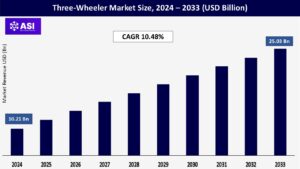
The global Three-wheeler Market size is valued at USD 10.21 billion in 2024 and is expected to reach from USD 11.28 billion in 2025 to USD 25.03 billion in 2033, growing at a CAGR of 10.48% over the forecast period (2025-2033).
Three-wheelers, including auto-rickshaws and cargo vehicles, offer a versatile mode of transportation that caters to passenger and freight needs. Their compact size and superior maneuverability make them ideal for navigating congested city streets, addressing the challenges posed by urbanization and traffic congestion.
The market is characterized by a diverse range of applications, including public transportation, last-mile delivery, and commercial freight. The rising demand for electric three-wheelers is particularly noteworthy, as they align with global trends toward sustainability and environmental responsibility.
These electric vehicles not only reduce emissions but also contribute to lower operational costs, making them an attractive option for businesses involved in logistics and transportation.
Global urbanization is advancing rapidly, driving the need for cost-effective and efficient urban transportation solutions. Three-wheelers, being compact and fuel-efficient, offer a practical option for navigating congested urban environments.
Their affordability, ease of maneuverability, and low operational costs make them a popular choice in densely populated areas, where conventional vehicles often struggle with traffic.
For example, in cities like Bangkok, Thailand, three-wheelers are widely used for short-distance travel due to their ability to easily weave through traffic. Both commuters and tourists favor them as an affordable and time-saving mode of transportation.
Additionally, many developing nations in Southeast Asia and Africa rely on three-wheelers for public transport, last-mile delivery services, and cargo movement in urban areas. This trend is fueled by increasing urban populations, where the demand for economical and efficient mobility solutions continues to grow.
Three-wheelers are increasingly recognized as an affordable and practical business solution, especially for delivery and logistical services, which creates lucrative opportunities for small business owners. These vehicles offer lower operational costs, fuel efficiency, and easier maneuverability in congested urban areas, making them ideal for startups and small enterprises.
In Nigeria, for example, the rise of e-commerce and demand for last-mile delivery has spurred a significant increase in three-wheeler usage. Small businesses are leveraging these vehicles to expand their reach, improve delivery times, and enhance customer satisfaction, thus boosting local economies.
Additionally, countries like India and Bangladesh are witnessing a surge in 3 wheeler adoption for transporting goods and passengers, further empowering small businesses with cost-effective transportation solutions that enhance scalability and profitability.
One of the significant restraining factors in the global market is increasing competition from alternative transportation modes. The rise of ride-sharing applications, improved public transportation networks, and the growing availability of electric scooters and bikes are challenging the dominance of three-wheelers in certain regions.
For example, in cities like San Francisco, ride-sharing services such as Lyft and Uber have disrupted the traditional market, significantly reducing demand. The convenience, affordability, and widespread availability of ride-sharing platforms make them a more attractive option for commuters.
Additionally, the increasing adoption of micro-mobility solutions, such as electric scooters and bicycles, has further intensified competition, particularly in urban areas, limiting the role of three-wheelers as a primary mode of transportation.
One of the main obstacles to the expansion of three-wheelers in the market is the high cost of electric vehicle batteries. Furthermore, using lithium-ion batteries or a motor’s drive mechanism comes at the highest cost, which limits the market’s ability to expand.
| Report Metric | Details |
|---|---|
| Segmentations | |
| By Vehicle Type |
Passenger Carrier Load Carrier |
| By Engine Type |
Front Engine Rear Engine |
| By Fuel Type |
Electric Petrol/CNG Diesel |
| Key Players |
|
| Geographies Covered | |
| North America |
U.S. |
| Europe |
U.K. |
| Asia Pacific |
China |
| Middle East & Africa |
Saudi Arabia |
| Latin America |
Brazil |
Passenger carrier stands as the largest component in 2024, holding around 80.9% of the market. Three-wheeler passenger carriers offer a cost-effective mode of transportation for short to medium distances, making them popular among cost-sensitive consumers.
Furthermore, they can easily navigate through crowded streets and narrow lanes, a feature particularly valuable in densely populated urban areas. Besides this, three-wheeler passenger carriers are generally more fuel-efficient compared to larger four-wheeled vehicles, making them a preferred choice for daily commuting.
Additionally, they require less upkeep compared to larger automobiles, contributing to their overall cost-effectiveness. Load carriers, on the other hand, are playing an increasingly important role in India’s booming last-mile delivery and micro-logistics ecosystem.
Their affordability, fuel efficiency, and low maintenance costs make them ideal for small business owners, street vendors, kirana store deliveries, and e-commerce logistics.
Variants such as open deck, enclosed cargo boxes, and refrigerated carriers are being used across food delivery, FMCG distribution, and intra-city freight movement. The growing need for hyperlocal logistics solutions has made cargo three-wheelers indispensable for India’s urban and rural commercial activity.
Diesel leads the market with around 46.8% of market share in 2024. Diesel continues to be a prevalent fuel in the three-wheeler segment, thanks to its superior fuel efficiency, torque delivery, and affordability for long-distance and heavy-duty use.
Used extensively in urban and rural areas alike, diesel-powered three-wheelers are favored for their capacity to handle heavier loads and deliver better performance in tough conditions. This renders them especially appropriate for cargo carriage and business usage, where reliability and running cost economy are central concerns.
Existing infrastructure for diesel refueling and parts availability as well as servicing also enhance their general adoption, particularly in the developing world. Operators also prefer the reduced operating cost of diesel engines in the long term, which enhances their continued demand.
Petrol/CNG segment is expected to hold the largest share of the three-wheeler market during the forecast period. Petrol or CNG-powered three-wheelers are frequently less expensive to purchase than electric or other alternative fuel vehicles.
In addition, it is possible to immediately refuel gasoline and CNG, which is crucial for commercial three-wheelers that must run for extended periods. They are ideal for both short and long travels because they have a relatively longer range on a single tank.
Gasoline and CNG engines are thought to operate dependably, which is important for commercial applications where downtime reduces profits.
Also, people trust gasoline and CNG engines since their technology is well-established. The industry is expanding due to the government’s supportive policies that encourage the use of CNG as an alternative fuel.
Front Engine three-wheelers, while less common, are typically employed in specific applications where engine accessibility and repair simplicity are prioritized. Their contribution to the market, though smaller, is vital in scenarios where quick maintenance is required.
The rear-engine subsegment has dominated the market due to its inherent benefits in passenger transport and various specialized applications. The rear-engine design offers enhanced passenger comfort and space, which is crucial in cities where three-wheelers serve as a primary mode of public transportation.
For example, the Bajaj RE is a favored choice for autorickshaws in countries like India, as it effectively balances comfort and affordability, making it accessible to a broad demographic.
Moreover, rear-engine three-wheelers are exceptionally maneuverable and compact, making them ideal for navigating congested urban areas like Manila, the Philippines, where rear-engine tricycles are commonplace.
Their design allows for easy movement through tight spaces and heavy traffic, ensuring timely transport. In addition to their maneuverability, these vehicles appeal to operators in cost-sensitive regions due to their impressive fuel efficiency and low operating costs.
In 2024, Asia-Pacific accounted for the largest market share of over 64.4%. Cities across the Asia Pacific region have high population densities, which require compact and highly maneuverable vehicles, such as three-wheelers, to navigate crowded streets.
Furthermore, three-wheelers are cost-effective and fuel-efficient compared to four-wheelers, which aligns with the rising demand for eco-friendly mobility solutions.
Additionally, the imposition of favorable policies by the regional governments encouraging the adoption of three-wheelers to reduce pollution levels and lower carbon footprint is positively influencing the market growth.
Besides this, three-wheelers have been a part of the local culture in many Asian countries, making them a socially accepted mode of transport.
Due to Africa’s fast urbanization, there is a growing need for economical and effective city transit options, as public transportation infrastructure is frequently lacking. When it comes to delivering goods and transporting passengers, 3 wheelers are a sensible and affordable option.
Three wheelers, referred to as “Keke NAPEP” in Nigeria, are commonly utilized as taxis in nations including Nigeria, Kenya, and Egypt. In urban settings, where larger vehicles are either impractical due to traffic congestion or unavailable due to narrow streets, these vehicles are an essential means of short-distance transportation.
The market in Africa is experiencing notable growth driven by expanding city limits increasing demand for affordable, nimble transport solutions. According to the OECD, by 2050, 80% of Africa’s population growth will take place in urban areas, with urbanization increasing from 54% in 2020 to 65% by 2050.
This shift will result in two-thirds of the population residing in cities, fostering the development of larger urban centers. In accordance with this, inadequate public transportation infrastructure in many countries positioning three-wheelers as a practical alternative for last-mile connectivity, is impelling the market.
The rise of informal and small-scale delivery services across urban and peri-urban areas is further fueling market expansion. Additionally, growing access to microfinancing enabling low-income individuals to purchase vehicles for self-employment, is bolstering market development.
The market is expected to grow CAGR of 10.48% from 2025 to 2033.
The current market size is USD 10.21 Billions in 2024.
Asia Pacific currently holds the largest market shares.
Top prominent players in global market are Bajaj Auto Ltd, Mahindra & Mahindra Ltd, Piaggio & C. SpA, TVS Motor Company, Atul Auto Limited, Terra Motors Corporation, Kinetic Green Energy & Power Solutions Ltd, Scooters India Limited, Force Motors, Hero Electric Vehicles Pvt. Ltd
1.1 Summary
1.2 Research methodology
2.1 Research Objectives
2.2 Market Definition
2.3 Limitations & Assumptions
2.4 Market Scope & Segmentation
2.5 Currency & Pricing Considered
3.1 Drivers
3.2 Geopolitical Impact
3.3 Human Factors
3.4 Technology Factors
4.1 Porters Five Forces Analysis
4.2 Value Chain Analysis
4.3 Average Pricing Analysis
4.4 M & A, Agreements & Collaboration Analysis
5.1 Three-Wheeler Market, By Vehicle Type
5.1.1 Introduction
5.1.2 Market Size & Forecast
5.2 Three-Wheeler Market, By Engine Type
5.3 Three-Wheeler Market, By Fuel Type
6.1 North America Three-Wheeler Market , By Country
6.1.1 Three-Wheeler Market, By Vehicle Type
6.1.2 Three-Wheeler Market, By Engine Type
6.1.3 Three-Wheeler Market, By Fuel Type
6.2 U.S.
6.2.1 Three-Wheeler Market, By Vehicle Type
6.2.2 Three-Wheeler Market, By Engine Type
6.2.3 Three-Wheeler Market, By Fuel Type
6.3 Canada
7.1 U.K.
7.2 Germany
7.3 France
7.4 Spain
7.5 Italy
7.6 Russia
7.7 Nordic
7.8 Benelux
7.9 The Rest of Europe
8.1 China
8.2 South Korea
8.3 Japan
8.4 India
8.5 Australia
8.6 Taiwan
8.7 South East Asia
8.8 The Rest of Asia-Pacific
9.1 UAE
9.2 Turkey
9.3 Saudi Arabia
9.4 South Africa
9.5 Egypt
9.6 Nigeria
9.7 Rest of MEA
10.1 Brazil
10.2 Mexico
10.3 Argentina
10.4 Chile
10.5 Colombia
10.6 Rest of Latin America
11.1 Global Market Share (%) By Players
11.2 Market Ranking By Revenue for Players
11.3 Competitive Dashboard
11.4 Product Mapping