

Minivans Market
Minivans Market Size, Share & Industry Analysis, By Propulsion Type (ICE, Hybrid, and Electric), By Application (Commercial Use and Personal Use), Analysis Report, Regional Outlook, Growth Potential, Price Trends, Competitive Market Share & Forecast, 2025–2033.

Historical Period: 2019-2024
Forecast Period: 2025-2033
Report Code :
CAGR: 2.4%
Last Updated : July 8, 2026
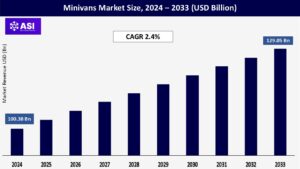
The global Minivans Market size was USD 100.38 billion in 2024. The market is projected to grow from USD 107.17 billion in 2025 to USD 129.05 billion in 2033 at a CAGR of 2.4% during the forecast period.
The Asia Pacific dominated the Minivan Market Share with a share of 58.85 % in 2024. A minivans is a type of vehicle designed for maximum interior space and comfort. It typically features a boxy shape, a high roof, and sliding side doors, making it a popular choice for families and groups.
They often come with three rows of seats, accommodating up to seven or eight passengers. They are built on a car-like platform with low-body sliding or hinged rear doors.
The environmental advantages and fuel savings of electric vehicles have led to their significant rise in popularity. Because manufacturers are increasingly incorporating electric and hybrid technologies into their products, this trend is having a significant impact on the minivan market.
By 2020, there will be 10 million electric vehicles on the road, a 43% increase from the year before, according to the International Energy Agency (IEA). It is anticipated that this growth trajectory will continue due to government incentives, growing consumer awareness of environmental issues, and advancements in battery technology.
In Asia Pacific, where nations like China and Japan are spearheading the trend, the uptake of electric minivans is especially noteworthy. In the EV industry, technological developments are also very important. Customers are becoming more interested in electric minivans due to advancements in battery life, charging infrastructure, and general vehicle performance.
For example, the Hyundai Staria FCEV, an upcoming hydrogen fuel cell minivan, promises increased efficiency and range, resolving some of the common issues with electric vehicles. Electric minivans have financial benefits in addition to environmental ones.
In the long term, EVs are a more economical option due to their lower operating costs, lower maintenance costs, and government incentives. In markets with high fuel prices and strict emissions regulations, this economic appeal is especially potent.
The market’s expansion is severely hampered by the change in consumer preferences. SUVs and crossovers have become extremely popular because of their perceived safety advantages, fashionable designs, and adaptable functionality.
Customers searching for vehicles that can handle a variety of terrains and weather conditions are drawn to these vehicles because they provide a higher driving position, more ground clearance, and frequently all-wheel-drive options.
Additionally, a wider range of consumers, including younger ones and those seeking a car that blends functionality with a modern lifestyle, are drawn to SUVs and crossovers due to their sporty appeal and modern design.
Sales data and marketing tactics show the trend toward SUVs and crossovers. For instance, SUVs and crossovers have surpassed minivan sales in recent years, accounting for more than 50% of all vehicle sales in the United States.
In response to this trend, major automakers are focusing less on minivans and increasing their SUV and crossover lineups. Several sedan and minivan models have been phased out in favor of SUVs and crossovers as a result of brands like Ford changing their production priorities.
SUVs and crossovers’ adaptability has changed to accommodate family needs that minivans have historically met. With features like three-row seats, lots of room for passengers and cargo, cutting-edge safety features, and entertainment systems, modern SUVs and crossovers are now direct rivals.
| Report Metric | Details |
|---|---|
| Segmentations | |
| By Propulsion Type |
ICE Hybrid Electric |
| By Application Type |
Personal Use Commercial Use |
| Key Players |
|
| Geographies Covered | |
| North America |
U.S. |
| Europe |
U.K. |
| Asia Pacific |
China |
| Middle East & Africa |
Saudi Arabia |
| Latin America |
Brazil |
Because of their roomy interiors, adaptability, and safety features, the personal use segment continues to be a favorite and dominant one among families. Family-friendly features like cutting-edge safety systems, entertainment options, and adjustable seating are built into models like the Honda Odyssey and Kia Carnival.
With the release of electric and hybrid models, the personal use market is changing and attracting eco-aware buyers. The development of this market is fueled by ongoing innovation and the modification of minivan designs to accommodate contemporary lifestyle demands.
The need for dependable, fuel-efficient, and adaptable vehicles to transport both passengers and goods makes the commercial segment one of the largest and fastest-driving segments.
Businesses needing flexibility and lots of space are catered to by minivans like the Ford Transit Connect. Demand in this market has been further stimulated by the growth of e-commerce and last-mile delivery services.
Additionally, as businesses look to lower operating costs and adhere to environmental regulations, electric and hybrid models are becoming more popular. Technological developments that improve vehicle efficiency and utility are driving this segment’s growth.
ICE vehicles are most preferred for their reliability and relatively lower initial cost compared to electric counterparts. For example, the Chrysler Pacifica and Toyota Sienna offer robust ICE models that remain popular, especially in regions with less developed EV infrastructure.
However, the ICE segment faces increasing regulatory pressure and a push towards greener alternatives, impacting its long-term growth prospects. This segment continues to be significant, especially in developing regions, where EV infrastructure is still emerging.
Electric segment is the fastest-growing segment, driven by technological advancements, government incentives, and increasing environmental consciousness. Companies such as Nissan and Volkswagen are launching electric models to cater to the growing demand.
The rise of EV infrastructure and consumer incentives, especially in regions such as Europe and North America, further accelerates this segment’s growth. For example, the Volkswagen ID.
Buzz exemplifies the trend towards fully electric minivans, combining zero emissions with modern connectivity features. The market’s future growth heavily relies on continuous improvements in battery technology and expanded charging networks.
The hybrid segment is growing rapidly as consumers seek a balance between traditional ICE benefits and environmental concerns.
Hybrid segment include Toyota Sienna Hybrid which offer improved fuel efficiency and reduced emissions, making them attractive in markets with stringent environmental regulations. Hybrid technology provides a transition for consumers who are not ready to commit to electric vehicles fully and want to reduce their carbon footprint.
This segment’s growth is supported by advancements in battery technology and increased consumer awareness of environmental issues, positioning hybrids as a crucial part of the market’s future.
The Asia Pacific region, led by China and Japan, dominates the market. The demand is fueled by rising disposable incomes, urbanization, and increasing family sizes.
Hybrid and electric models are also gaining traction, supported by government initiatives to reduce emissions. Major players such as Toyota and Nissan dominate this market, with models designed for both personal and commercial use.
Stringent emission regulations and a strong push towards electric vehicles influence Europe’s market. The region shows the fastest growth, with a preference for hybrid and electric models, supported by government incentives and extensive charging infrastructure.
Manufacturers such as Volkswagen and Renault are focusing on electric models, such as the Volkswagen ID. Buzz, to cater to this demand.
In North America and the Rest of the World regions, the market is evolving with a mix of ICE, hybrid, and electric models. The market is characterized by a growing middle class and increasing urbanization. While ICE models remain predominant due to infrastructure challenges, there is a gradual shift towards hybrid and electric models.
Governments are starting to implement policies favoring cleaner vehicles, which will support future growth in these regions. Brands such as Tata Motors and Hyundai are expanding their presence to tap into this potential.
The market is expected to grow CAGR of 2.4% from 2025 to 2033.
The current market size is USD 100.38 Billions in 2024.
Asia Pacific currently holds the largest market shares.
The propulsion type segment is the leading segment in this market.
Some of the prominent players in the Hyundai Motor Company (South Korea),Daimler AG (Germany),Tata Motors Limited (India), Suzuki Motor Corporation (Japan).
1.1 Summary
1.2 Research methodology
2.1 Research Objectives
2.2 Market Definition
2.3 Limitations & Assumptions
2.4 Market Scope & Segmentation
2.5 Currency & Pricing Considered
3.1 Drivers
3.2 Geopolitical Impact
3.3 Human Factors
3.4 Technology Factors
4.1 Porters Five Forces Analysis
4.2 Value Chain Analysis
4.3 Average Pricing Analysis
4.4 M & A, Agreements & Collaboration Analysis
5.1 Minivans Market, By Propulsion Type
5.1.1 Introduction
5.1.2 Market Size & Forecast
5.2 Minivans Market, By Application Type
6.1 North America Minivans Market, By Country
6.1.1 Minivans Market, By Propulsion Type
6.1.2 Minivans Market, By Application Type
6.2 U.S.
6.2.1 Minivans Market, By Propulsion Type
6.2.2 Minivans Market, By Application Type
6.3 Canada
7.1 U.K.
7.2 Germany
7.3 France
7.4 Spain
7.5 Italy
7.6 Russia
7.7 Nordic
7.8 Benelux
7.9 The Rest of Europe
8.1 China
8.2 South Korea
8.3 Japan
8.4 India
8.5 Australia
8.6 Taiwan
8.7 South East Asia
8.8 The Rest of Asia-Pacific
9.1 UAE
9.2 Turkey
9.3 Saudi Arabia
9.4 South Africa
9.5 Egypt
9.6 Nigeria
9.7 Rest of MEA
10.1 Brazil
10.2 Mexico
10.3 Argentina
10.4 Chile
10.5 Colombia
10.6 Rest of Latin America
11.1 Global Market Share (%) By Players
11.2 Market Ranking By Revenue for Players
11.3 Competitive Dashboard
11.4 Product Mapping