

Car Recycle Market
Car Recycle Market Size, Share & Trends Analysis Report By Vehicle Type (Passenger Cars Recycling , Commercial Vehicles Recycling), By Material (Steel, Rubber , Glass, Plastic, Polymer), By Part (Door Panel, Gas Tanks, Engine and Transmission, Wheels,) – Industry Analysis Report, Regional Outlook, Growth Potential, Price Trends, Competitive Market Share & Forecast, 2025–2033.

Historical Period: 2019-2024
Forecast Period: 2025-2033
Report Code :
CAGR: 12.24%
Last Updated : January 23, 2026
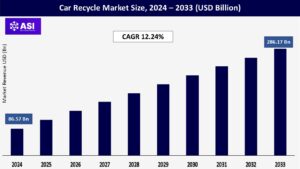
The global car recycle market size was valued at USD 86.57 billion in 2024 and is expected to grow from USD 93.99 billion in 2025 to reach USD 286.17 billion by 2033, growing at a CAGR of 12.24% during the forecast period (2025-2033).
Growing environmental consciousness and stringent government regulations on vehicle emissions and waste management have propelled the demand for car recycling. Moreover, innovations in recycling technologies have made the process more efficient, allowing recyclers to extract a higher volume of reusable materials.
Advanced sorting and separation techniques enable more precise recovery of metals and plastics, contributing to the expansion of the car recycle market size.
Pollution from industrialization and vehicle emissions has reached critical levels, exacerbating climate change and impacting public health. Governments worldwide have responded by implementing policies encouraging recycling and using recycled materials in manufacturing.
In many countries, federal tax incentives motivate individuals to sell their older cars for recycling rather than letting them languish as pollutants. Statistics reveal that nearly half of American cars are over six years old, and about 25% are between eight and ten years old (Gaydos).
Meanwhile, just 1% of the 250 million registered vehicles in the United States were produced in the last five years. This aging vehicle population contributes significantly to the pollution problem, as older cars tend to emit more pollutants due to deteriorated parts and outdated technology.
Furthermore, the high cost of maintenance and repairs for older cars drives the trend toward car recycling. After about six years of use, many car parts wear out, and some components may break beyond repair.
Rather than spending increasingly large sums on upkeep, many car owners find it more economical to sell their vehicles for recycling or to purchase a newer, more efficient model. This growing trend has made car recycling an important industry, providing environmental benefits and promoting sustainable practices, and supporting long-term car recycle market growth.
Recovering valuable components like steel, aluminum, and plastic from old vehicles lowers the carbon footprint associated with manufacturing and lessens the need for new raw materials. This is expected to drive market growth over the forecast period and positively influence the market size.
Recycling a car involves dismantling the vehicle to extract valuable and recyclable components like steel, aluminum, and other materials. This process typically costs around USD 1,400 due to the labor-intensive tasks of disassembly, sorting, and recycling various vehicle components.
Alternatively, scrapping a car is simpler and less expensive, generally costing USD 150 to USD 300 less than recycling. Therefore, some individuals opt to salvage the vehicle to save money, especially if they have the necessary skills and tools.
Salvaging a vehicle involves dismantling it for usable parts or materials without mixing components from different cars. This is crucial for maintaining the integrity and quality of the salvaged parts. Individuals can save money by salvaging a vehicle in compliance with legal requirements while contributing to environmentally sustainable recycling practices. This can hinder market growth.
| Report Metric | Details |
|---|---|
| Segmentations | |
| By Vehicle Type |
Passenger Cars Recycling Commercial Vehicles Recycling |
| By Material Type |
Steel Rubber Glass Plastic Polymer |
| By Part Type |
Door Panel Gas Tanks Engine Transmission Wheels |
| Key Players |
|
| Geographies Covered | |
| North America |
U.S. |
| Europe |
U.K. |
| Asia Pacific |
China |
| Middle East & Africa |
Saudi Arabia |
| Latin America |
Brazil |
The following section presents a detailed car recycle market analysis based on vehicle type, material type, and part type.
The passenger cars segment dominates the type segment with 65% market share. This is due to a combination of governmental regulations and the high volume of cars produced and used on roads. Governments worldwide are enacting stricter norms, rules, and regulations that render older cars obsolete, leading to a surge in the number of end-of-life vehicles (ELVs) requiring recycling.
Because passenger cars are the most common type of vehicle, their recycling plays a crucial role in conserving resources and reducing environmental impact. Recycling passenger cars involves dismantling the vehicle to recover valuable and recyclable components such as steel, aluminum, plastics, and other materials.
Commercial vehicles also contribute significantly to the recycling landscape, which is driven by increased regulations and demand for environmentally friendly disposal methods. Motorcycles present a niche yet notable segment, reflecting trends toward eco-friendly practices among recreational users.
Trucks and buses are crucial in the market as they often contain larger quantities of recyclable materials, making their efficient recycling vital to the overall sustainability goals in the transport sector.
The steel segment owns the highest market share. The steel segment is a significant part of the car recycling process, dominating the materials segment due to steel’s extensive use in the automotive industry, accounting for approximately 60% of a vehicle’s weight.
Recycling steel from end-of-life vehicles is crucial because it conserves energy and natural resources. It also reduces the need for new raw materials, significantly contributing to environmental sustainability. Annually, recycling steel saves enough energy to power about 18 million households.
Rubber, mainly from tires, is another important material in automotive recycling. The recycling of tires involves processes such as shredding, granulating, and devulcanizing to produce rubber granules or powder, which can be used in various applications, including new tire production, asphalt modification, and the manufacturing of rubber products.
The growing emphasis on sustainable waste management and the increasing demand for recycled rubber products are driving the growth of this segment.
Glass, primarily from vehicle windows and windshields, is also a key material in the automotive recycling market. The recycling of automotive glass involves crushing the glass and removing any contaminants, such as plastics or adhesives, to produce clean glass cullets.
These cullets can be melted and reformed into new glass products, reducing the need for raw materials and energy consumption in the glass manufacturing process. The demand for recycled glass is supported by its environmental benefits and cost savings.
Polymers, including plastics and composites, represent another significant segment in the automotive recycling market. The increasing use of lightweight materials in vehicle manufacturing has led to a higher proportion of polymers in end-of-life vehicles (ELVs).
Recycling these materials involves processes such as sorting, cleaning, and reprocessing to produce recycled plastic granules, which can be used in the production of new automotive parts and other products.
The development of advanced recycling technologies has enhanced the efficiency and quality of recycled polymers, driving their demand in various applications.
The door panel segment dominates the global market with 12% market share. This is due to its fundamental role in vehicles’ structural integrity and aesthetic appeal.
Door panels are vital components that ensure safety, insulation, and design continuity. This segment comprises various elements, including the complete car door, lower door skin, rocker panel, dogleg, wheel arch panel, wheelhouse, and quarter panel.
Gas Tanks has acquired only 8% market share of the global car recycling market. Because of their flammability and potential for residue, gas tanks made of steel or HDPE plastic must be removed and handled cautiously.
Tanks made of metal are easier to recycle than those made of plastic. The importance of conventional fuel tanks in recycling is steadily decreasing as EV adoption rises. This category, however, stays steady in areas that still rely on ICE vehicles.
Engine and Transmission hold the largest market shares with 40% market shares. With its basic components rich in metals like steel and aluminum, this is the most valuable section of the auto recycling industry. These parts are either discarded for material recovery or refurbished for sale.
Profitability is increased by the presence of valuable rare earth metals in catalytic converters found in engine systems. This market will shift toward recycling electric drivetrains as EVs take the place of ICE automobiles.
Wheels hold the 15% market share of the global market. Steel and aluminum wheels are two of the simplest and most lucrative parts to recycle. In particular, the demand for alloy wheels encourages greater recycling value.
EVs’ lightweight wheel trends are changing the composition of materials, necessitating the development of new recycling solutions. In both industrialized and emerging nations, there is a consistent aftermarket need for reconditioned wheels.
This regional breakdown offers a comprehensive car recycle market analysis across key global markets.
APAC has acquired the largest 39% market share of the global market. The APAC region is projected to be the fastest-growing region in the vehicle recycling market, with a compound annual growth rate (CAGR) of around 7% expected through 2034.
This rapid growth is being fueled by several interlinked factors, including soaring automotive sales, rapid urbanization, and a rising awareness of sustainability issues. Countries such as China, India, and Japan are at different stages of developing national vehicle scrappage policies and investing in formal recycling infrastructure.
In particular, China’s aggressive push towards circular economy practices and India’s new Vehicle Scrappage Policy are creating favorable conditions for the sustained expansion of the car recycle market size in the Asia-Pacific region.
Europe stands as the second-largest player in the global vehicle recycling market with 31% . The market is driven by comprehensive legislative measures, especially the European Union’s End-of-Life Vehicle Directive (ELV Directive), which requires up to 95% of each ELV to be reused or recycled.
This regulatory rigor has prompted automakers and recyclers to develop highly innovative and efficient recycling solutions. European countries are also at the forefront of adopting green technologies, including chemical recycling and advanced battery recovery systems, to manage the rising volume of electric vehicles.
The North America region represents 24% market. holds the largest share of the global vehicle recycling market, accounting for approximately 40% of the market in 2024. This dominance is attributed to a combination of stringent environmental regulations, mature automotive markets, and the presence of well-established recycling infrastructure.
The United States and Canada have implemented robust frameworks that support the efficient collection, dismantling, and recycling of end-of-life vehicles (ELVs).
MEA acquired approximately 8% of the global car recycling market share. MEA is emerging as a region with significant untapped potential in the vehicle recycling market. While both regions currently lag in terms of formal infrastructure and technological readiness, the growing demand for cost-effective auto parts and the rising government focus on environmental sustainability present key growth opportunities.
In Latin America, countries such as Brazil and Mexico are beginning to implement frameworks aimed at reducing the environmental impact of ELVs and promoting the reuse of auto parts.
The car recycle market was valued at USD 86.57 billion in 2024.
The car recycle market is projected to grow at a CAGR of 12.24% from 2025 to 2033.
The Dry van trailer is dominate the markets.
The Asia-Pacific region dominates the global car recycle market.
The major players in the car recycle market are Sims Metal Management, Veolia Environnement S.A., LKQ Corporation, Redwood Materials.
1.1 Summary
1.2 Research methodology
2.1 Research Objectives
2.2 Market Definition
2.3 Limitations & Assumptions
2.4 Market Scope & Segmentation
2.5 Currency & Pricing Considered
3.1 Drivers
3.2 Geopolitical Impact
3.3 Human Factors
3.4 Technology Factors
4.1 Porters Five Forces Analysis
4.2 Value Chain Analysis
4.3 Average Pricing Analysis
4.4 M & A, Agreements & Collaboration Analysis
5.1 Car Recycle Market, By Vehicle Type
5.1.1 Introduction
5.1.2 Market Size & Forecast
5.2 Car Recycle Market, By Material Type
5.3 Car Recycle Market, By Part Type
6.1 North America Car Recycle Market , By Country
6.1.1 Car Recycle Market, By Vehicle Type
6.1.2 Car Recycle Market, By Material Type
6.1.3 Car Recycle Market, By Part Type
6.2 U.S.
6.2.1 Car Recycle Market, By Vehicle Type
6.2.2 Car Recycle Market, By Material Type
6.2.3 Car Recycle Market, By Part Type
6.3 Canada
7.1 U.K.
7.2 Germany
7.3 France
7.4 Spain
7.5 Italy
7.6 Russia
7.7 Nordic
7.8 Benelux
7.9 The Rest of Europe
8.1 China
8.2 South Korea
8.3 Japan
8.4 India
8.5 Australia
8.6 Taiwan
8.7 South East Asia
8.8 The Rest of Asia-Pacific
9.1 UAE
9.2 Turkey
9.3 Saudi Arabia
9.4 South Africa
9.5 Egypt
9.6 Nigeria
9.7 Rest of MEA
10.1 Brazil
10.2 Mexico
10.3 Argentina
10.4 Chile
10.5 Colombia
10.6 Rest of Latin America
11.1 Global Market Share (%) By Players
11.2 Market Ranking By Revenue for Players
11.3 Competitive Dashboard
11.4 Product Mapping