

Bike Sharing Market
Bike Sharing Market Size, Share & Industry Analysis, By Bike Type (Traditional/Conventional., E-bikes), By Sharing System (Docked, Dock-less), Analysis Report, Regional Outlook, Growth Potential, Price Trends, Competitive Market Share & Forecast, 2025–2033.

Historical Period: 2019-2024
Forecast Period: 2025-2033
Report Code :
CAGR: 14.2%
Last Updated : February 3, 2026
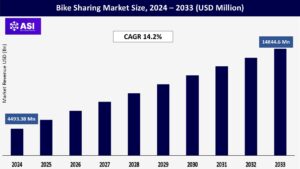
The global bike sharing market size was valued at USD 4493.38 million in 2024 and is expected to grow from USD 5131.45 million in 2025 to reach USD 14844.6 million by 2033, growing at a CAGR of 14.2% during the forecast period (2025-2033).
Bike sharing is a shared transportation service in which individuals are given access to electric or conventional bikes for short periods for a fee or free. Users can pick up bicycles and return at various docked or dockless stations across the city.
In contrast to dock-less bike sharing, which does not require a docking station and allows bikes to be stored inside designated bike racks or on the sidewalk, docks are special bike racks that lock the bike and only allow it to be released by computer control. Both locals and visitors may get around cities quickly, affordably, and effectively with the help of bike sharing.
The critical reason influencing the expansion of ride-hailing and ride-sharing services is the massive increase in regular office commuters’ preference for carpool and bike pool services.
The availability of more services from the top competitors on the market, such as Uber and Ola, as well as the choice of convenient pick-up and drop-off locations, is pushing customers to use ride-hailing and ride-sharing services.
Additionally, the expansion of the bike-sharing industry is fueled by the massive increase in ride-hailing and ride-sharing services, such as bike sharing and auto sharing services, even for short-distance travel.
In addition, ride-sharing service providers provide advantages compared to traditional transportation service providers, including more convenient doorstep pick-up and drop-off prices, co-passenger information, and affordable doorstep pick-up and drop-off. It is forecasted that this will increase demand for ride-sharing services.
To lower the costs of everyday commuters, many service providers also give a variety of amenities, incentives, and discounts, such as a monthly pass on shared transportation. Due to their quick & flexible operations and low carbon emissions, the demand for e-bikes is rising worldwide.
Additionally, the expansion of bike sharing is aided by the growing customer preference for using electric bikes as an economical and environmentally beneficial mode of transportation. In addition, an e-bike is a superior choice since, compared to a pedal-powered bike, it better satisfies the need for increased speed in short-distance commuting.
Additionally, governments worldwide are implementing several measures to encourage e-bikes. For instance, the majority of governments around the world want to switch from gasoline to electric automobiles to address environmental challenges.
To compete in the rising bike-sharing market, some bike-sharing companies have begun to focus on developing their fleet of e-bikes.
Each company often introduces a sizable number of shared bikes into cities to get more market share during the early stages of market introduction. Additionally, substantial subsidies are provided to customers as incentives to obtain a competitive edge, such as free trips, rebates, and lottery tickets.
Additionally, a significant amount of money was needed to set up the necessary infrastructure, such as parking spaces for free-floating bikes, a network of docked bike stations, recharging docks for e-bikes, and others.
For instance, electric bikes need facilities at bicycle docks for battery charging or swapping. Therefore, it is projected that the market growth will be hampered by the high initial setup costs for bike-sharing services.
The lack of public charging infrastructure required for the effective operations of electric bike sharing systems, for the convenience of charging the vehicle anywhere and anytime, is expected to hamper the growth of the bike sharing market demand in the forecast period.
Unlike developed countries, the undeveloped countries, such as African nations and emerging countries such as India, Indonesia, and others, lack the necessary charging infrastructure. These factors are expected to hamper the demand of global bike sharing market.
| Report Metric | Details |
|---|---|
| Segmentations | |
| By Bike Type |
Traditional/Convectional E-Bikes |
| By Sharing System Type |
Docked Dock-Less |
| Key Players |
|
| Geographies Covered | |
| North America |
U.S. |
| Europe |
U.K. |
| Asia Pacific |
China |
| Middle East & Africa |
Saudi Arabia |
| Latin America |
Brazil |
The electric smokers segment dominated the market and accounted for a market revenue share of 61.0% in 2024. Smokers are basic barrel-style drum and vertical box which are designed to cook meat in a slow process.
The product allows the smoke of burning wood such as pecan, hickory, or mesquite logs to enhance the flavor and cooking of the food. These smoker product forms are often made available in the smaller form for outdoor cooking or a refrigerator style to cook pounds of meat at the same time.
The product witness’s growth in sales for the outdoor application of cooking owing to added benefits such as user-friendliness, low maintenance, and easy replacement.
The e-bike section will hold the second-largest share. The main distinction between e-bikes and conventional bicycles is the addition of an electric motor that helps the bike go ahead. Depending on usage habits, the rechargeable battery found in most E-bikes can last up to 20 hours.
The main elements driving the uptake of electric bike sharing are growing environmental and health concerns, increasing transportation congestion, and rising fuel prices.
Furthermore, shared e-bikes are becoming more popular among consumers due to features like quick and flexible operations and economical and environmentally beneficial transportation options. E-bike sharing is also becoming more popular due to the rise in market participants who offer the service and the rising investments in R&D activities.
The docked section is projected to have the most significant revenue holding and grow at a CAGR of 15.6%. Users of the docked bike sharing system must begin their trip by borrowing a bike from the docks or stations and returning their borrowed bike to the same ports or stations where they started.
All bikes in this system have an electronic locking mechanism that operates on GPS and wireless communications, typically smartphones. The adoption of docked bike sharing is predicted to be driven by the increase in docking stations due to bike theft and vandalism during the forecast period.
Additionally, because the bike is docked at a specific station, the user is no longer in charge of the bicycle once the journey is over, limiting user liability and the need to provide adequate security, which also increases docked bike sharing among commuters.
The dockless section will have the second-largest share. Dockless bike sharing programs allow users to check out bicycles and return them anywhere within a given geographic area. With dockless systems, bicycles can be left at a bike rack or on the sidewalk inside a designated district.
The development of consumer-ready mobile payments, IoT, and GPS technology, as well as the falling cost of locking and tracking systems for bikes, has contributed to the development of dockless electric bike-sharing goods.
The feature to pick up and drop off bikes anywhere there is a legal public parking space makes dockless bike sharing even more convenient for users and simplifies access to public transportation.
The Asia Pacific is forecasted to command the regional market while expanding at a CAGR of 13.1%. Due to users’ quick uptake of the bike-sharing service in nations like Vietnam, India, China, and Singapore, demand for the service has been rising quickly throughout the Asia-Pacific region.
Additionally, the entry of new companies into the market with creative ideas like dockless bikes would support the expansion of the bike sharing market in the Asia Pacific throughout the forecast period. For instance, Southeast Asia’s GrabCycle bike-sharing program was introduced in March 2018 by the ride-hailing company Grab.
Europe is forecasted to reach USD 2,586 million, growing at a CAGR of 14.78%. The presence of several service providers in nations like Germany, France, Italy, Spain, and the UK, who prioritize investing extensively in cutting-edge services, will cause the bike sharing market in Europe to experience significant growth.
Byke, Urbo Solutions, Bleeper Bike, Cloudbike, Rekola, YoBike, Pony Bikes, and the Donkey Republic are just a few regional and startup bike-sharing companies operating in Europe.
The expansion of the bike sharing business in the region is also being fueled by an increase in partnerships, collaborations, and joint ventures between supplier authorities and bike share operators to encourage sharing mobility services throughout Europe.
The rapid urbanization, government initiatives, and growing environmental consciousness is impelling the market growth. The market is also driven in part by the region’s increasing focus on sustainable transportation options and the rise in tourism.
As more tourists visit cities across Latin America, bike-sharing services are becoming a popular choice for exploring urban areas due to their convenience, affordability, and eco-friendliness.
According to UNWTO, between 2019 and 2023, 212 tourism investment projects were announced in Latin America and the Caribbean, with a total of US$20.5 billion in capital expenditure. Additionally, supportive government policies are instrumental in expanding bike sharing programs.
The bike sharing market in the Middle East and Africa is driven by urban development, government support, and a growing focus on sustainability. The increasing population in cities across the region is leading to challenges, such as traffic congestion and air pollution.
The International Monetary Fund (IMF) reports that the population in Saudi Arabia is anticipated to reach 34.15 million by 2025. Bike sharing systems provide a practical, cost-effective solution for short-distance travel, helping to address these issues.
In line with this, governments and municipalities are actively promoting bike sharing initiatives to enhance urban mobility and reduce reliance on cars. Investments in cycling infrastructure, like public
The market is expected to grow CAGR of 14.2% from 2025 to 2033.
The current market size is USD 4493.38 Millions in 2024.
Asia Pacific currently holds the largest market shares.
The global Bike Sharing Market report is segmented as follows By Bike Type, By Sharing System
Some of the top industry players in bike sharing market are, Anywheel Pte. Ltd, Beijing Xiaoju Technology Co, Ltd., Bird Rides, Inc, BIXI Montreal, Bond Mobility (Europe) AG, JCDecaux, Lime, LYft, Inc., Mobike, Nextbike GmbH, SG Bike Pte Ltd, Spin, Tembici, Uber Technologies Inc., Youon Technology Co., Ltd., etc.
1.1 Summary
1.2 Research methodology
2.1 Research Objectives
2.2 Market Definition
2.3 Limitations & Assumptions
2.4 Market Scope & Segmentation
2.5 Currency & Pricing Considered
3.1 Drivers
3.2 Geopolitical Impact
3.3 Human Factors
3.4 Technology Factors
4.1 Porters Five Forces Analysis
4.2 Value Chain Analysis
4.3 Average Pricing Analysis
4.4 M & A, Agreements & Collaboration Analysis
5.1 Bike Sharing Market, By Bike Type
5.1.1 Introduction
5.1.2 Market Size & Forecast
5.2 Bike Sharing Market, By Sharing System Type
6.1 North America Bike Sharing Market, By Country
6.1.1 Bike Sharing Market, By Bike Type
6.1.2 Bike Sharing Market, By Sharing System Type
6.2 U.S.
6.2.1 Bike Sharing Market, By Bike Type
6.2.2 Bike Sharing Market, By Sharing System Type
6.3 Canada
7.1 U.K.
7.2 Germany
7.3 France
7.4 Spain
7.5 Italy
7.6 Russia
7.7 Nordic
7.8 Benelux
7.9 The Rest of Europe
8.1 China
8.2 South Korea
8.3 Japan
8.4 India
8.5 Australia
8.6 Taiwan
8.7 South East Asia
8.8 The Rest of Asia-Pacific
9.1 UAE
9.2 Turkey
9.3 Saudi Arabia
9.4 South Africa
9.5 Egypt
9.6 Nigeria
9.7 Rest of MEA
10.1 Brazil
10.2 Mexico
10.3 Argentina
10.4 Chile
10.5 Colombia
10.6 Rest of Latin America
11.1 Global Market Share (%) By Players
11.2 Market Ranking By Revenue for Players
11.3 Competitive Dashboard
11.4 Product Mapping