

Autonomous Agents Market
Autonomous Agents Market Share & Trends Analysis Report, By Deployment Type (Cloud-Based, On-Premises), By Technology (Machine Learning, Natural Language Processing, Computer Vision,), By End-Use (BFSI, Healthcare, Retail, Manufacturing, IT & Telecom, ) Industry Analysis Report, Regional Outlook, Growth Potential, Price Trends, Competitive Market Share & Forecast, 2025–2033.

Historical Period: 2019-2024
Forecast Period: 2025-2033
Report Code :
CAGR: 17.9%
Last Updated : February 3, 2026
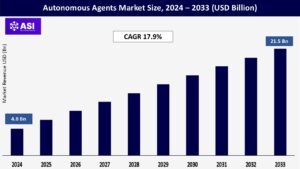
The global Autonomous Agents market was valued at approximately USD 4.8 billion in 2024 and is projected to reach USD 21.5 billion by 2033, expanding at a compound annual growth rate (CAGR) of 17.9% during the forecast period 2025–2033.
Autonomous agents—AI-powered software entities that perform tasks with minimal human intervention—are witnessing accelerated adoption driven by automation in customer service, financial services, healthcare, and more.
The evolution of AI technologies such as reinforcement learning, natural language processing (NLP), and multi-agent systems is enabling more complex and intelligent behavior in these agents.
With businesses increasingly integrating AI into operations, autonomous agents are most important for automating repetitive tasks, optimizing decision-making, and enhancing customer experiences.
Enterprises are rapidly adopting automation to increase activity continuity and decreasing labor costs. Autonomous agents can independently manage workflows, customer interactions, and backend processes in real time, leading to increased scalability and reliability.
Breakthroughs in machine learning algorithms, contextual NLP, and computer vision have enabled agents to learn from interactions and improve over time.
Autonomous agents now own increase reasonables and decision-making capacities, making them suitable for tasks in dynamic and high-stakes environments such as clinical diagnostics and financial trading.
Autonomous agents integrated with IoT devices enable smart and decentralized decision-making. In manufacturing, logistics, and smart cities, these agents analyze data at the edge to control systems and respond to events in real-time, improving performance and resilience.
Autonomous agents handling sensitive operations and data pose cybersecurity threats. Misconfigurations or adversarial attacks could lead to data breaches or incorrect decision-making. Additionally, concerns about job displacement and bias in AI-driven decisions hinder adoption in sensitive sectors.
The development, training, and deployment of fully autonomous agents require significant capital and skilled personnel. Small and medium-sized enterprises (SMEs) often struggle to afford or maintain these systems, especially in highly regulated industries.
| Report Metric | Details |
|---|---|
| Segmentations | |
| By Deployment Type |
Cloud- Based On-Premises |
| By Technology Type |
Machine Learning Natural Language Processing [NLP] Others |
| By End-Use |
BFSI Healthcare Retail Manufacturing IT & Telecommunications |
| Key Players |
|
| Geographies Covered | |
| North America |
U.S. |
| Europe |
U.K. |
| Asia Pacific |
China |
| Middle East & Africa |
Saudi Arabia |
| Latin America |
Brazil |
The cloud-based segment led the autonomous agents market with the largest share in 2024. This is mainly due to the low cost of cloud-based deployment compared to on-premises. Cloud-based autonomous agents are software or programs that work independently.
Cloud-based deployment enables remote access and collaboration, which helps developers and users control and monitor autonomous agents from remote locations. The on-premise segment is expected to witness notable growth during the forecast period.
The on-premise deployment allows the integration of autonomous agents in the organization’s existing infrastructure. The on-premise deployment enhances data security and privacy by offering greater control over data access, making it the preferred choice.
The machine learning segment will augment the growth with a market share of 77.65% by 2033. This growth is owed to the role of machine learning algorithms in enabling AI agents to analyze vast amounts of data and make informed decisions quickly.
This enhances automation and improves overall operational efficiency across various industries. On the other hand, the deep learning segment is projected to witness the fastest CAGR of around 48.89% during the forecasted period.
This can be attributed to numerous factors such as enhanced performance and accuracy, big data availability, advancements in computational power, and real-time processing.
Natural language processing, or NLP, is a branch of computer science that involves the analysis of human language in speech and text. A specific subset of AI and machine learning (ML), NLP is already widely used in many applications today.
NLP is how voice assistants, such as Siri and Alexa, can understand and respond to human speech and perform tasks based on voice commands. NLP is the driving technology that allows machines to understand and interact with human speech, but it is not limited to voice interactions. Natural language processing is also the technology behind apps such as customer service chatbots.
The BFSI (Banking, Financial Services, and Insurance) sector has undergone a conversion impact from Autonomous AI and Autonomous Agents, a change in what ways financial institutions deliver services. These advanced technologies offer unparalleled opportunities for automation, increasing decision-making, and improving customer experiences.
Autonomous AI systems in the BFSI sector employ machine learning procedures to analyze extensive amounts of financial data, detect patterns, and make autonomous decisions in areas such as fraud detections risk management, and investment strategies.
The global AI in healthcare market size was estimated at USD 26.57 billion in 2024 and is projected to grow at a CAGR of 38.62% from 2025 to 2033. AI technologies have become more transformative in different areas, including medical imaging analysis, predictive analytics, personalized treatment planning, and drug discovery, with the potential to transform conventional healthcare practices.
Important factors for increasing growth are the increasing demand in the healthcare sector for increasing efficiency, accuracy, and better patient feedback. The aggressive growth in healthcare data, originating from electronic health records, medical imaging scans, wearable devices, and heredity sequencing, presents significant opportunities for AI-powered solutions to extract actionable insights and support clinical decision-making.
The retail industry stays at the brickwork of change operated by autonomous AI agents that will present hopping experiences, changing advertising strategies, and streamline seller onboarding.
AI agents will assist the personalized shopping assistants, intelligent advertising optimizers, and automated seller support systems, creating an excellent and highly efficient retail ecosystem.
This technological evolution will personalize consumer interactions, automate advertising campaign management, and lower entry barriers for sellers, making e-commerce more usable and profitable for all customers.
In manufacturing, AI helps companies decrease downtime and optimize the manufacturing process. As a result, they can produce quicker and with better quality.
Most of thecompanies are seeing an increase in overall activity efficiency. Better-controlled manufacturing processes and accurate forecasts help limit waste and minimize environmental impact.
Global AI in the telecommunication market will reach $1 billion, with 32% CARG during 2024. The key driver for AI growth in the telco industry is an increasing demand for autonomously driven network solutions.
The networks of the telecommunications industry expand at a rapid pace, becoming more complex and difficult to manage. By using AI-powered network solutions, CSPs can reduce network congestion and improve network quality, therefore enhancing the customer experience.
APAC is fastest growing country in global markets. The AI agents market in Asia Pacific is successfull for the largest CAGR over the future period, fueled by fast digital transportations across industries, top to increased assumptions of AI technologies. Businesses are increasingly leveraging AI to optimize operations, increase customer engagements, and drive innovation.
Factors such as improving internet penetration, rising disposable income, and supportive government policies further involving to this region’s growth potential. In addition, the growing adoption of AI solutions by Small and Medium-Sized Enterprises (SMEs) is increasing regional market developments.
Europe is aquired the 28% market shares of the global autonomous agents markets. The AI agents market in Europe is expected to witness significant growth over the forecast period, driven by proactive government support through regulations and initiatives such as the European Union’s AI strategy.
This strategic framework encourages research, innovation, and the responsible deployment of AI agents across diverse industries such as manufacturing, healthcare, and energy.
Furthermore, increasing investments in AI research and development, coupled with a growing awareness of the benefits of AI agents in improving efficiency and productivity, are fueling market expansion in Europe.
North America AI agents is acquired the 40.1% market shares in 2024. This share is improved to advanced technological infrastructure, a high concentration of leading technological companies, and substantial investments in regional research and development.
Furthermore, the early assumptions of AI technologies across various sectors, including defense, healthcare, finance, and retail, contributes significantly to the AI agent industry’s growth.
For instance, in April 2024, the U.S. Army is channeling investments into AI and machine learning solutions through its Army Applied Small Business Innovation Research (SBIR) Program, which included USD 50 million in phase II funding.
MEA is acquired the 7.7 % of the global market shares. The MEA autonomous enterprise market generated a revenue of USD 3.8 million in 2024. The market is expected to grow at a CAGR of 13% from 2025 to 2033.
In MEA region machine learning and deep learning are the most affecting factors for developing the global market postitions. It focuses on IT & Telecommunications factors which are beneficials for the growth.
The current autonomous agents market size is USD 3.8 Billions in 2024.
The autonomous agents market is expected to grow at a CAGR 25.6% during the forecast period from 2025 to 2033.
North America currently holds the largest market shares, driven by adoption across sectors such as finance, healthcare, and logistics.
R&D investments in AI technologies, regulatory compliance for autonomous decision making and integration capabilities with legacy systems.
Key players include Google DeepMind, Open AI, Amazon Web Services [AWS], IBM Corporation, NVIDIA Corporation and Microsoft Corporation.
1.1 Summary
1.2 Research methodology
2.1 Research Objectives
2.2 Market Definition
2.3 Limitations & Assumptions
2.4 Market Scope & Segmentation
2.5 Currency & Pricing Considered
3.1 Drivers
3.2 Geopolitical Impact
3.3 Human Factors
3.4 Technology Factors
4.1 Porters Five Forces Analysis
4.2 Value Chain Analysis
4.3 Average Pricing Analysis
4.4 M & A, Agreements & Collaboration Analysis
5.1 Autonomous Agents Market, By Deployment Type
5.1.1 Introduction
5.1.2 Market Size & Forecast
5.2 Autonomous Agents Market, By Technology Type
5.3 Autonomous Agents Market, By End-Use
6.1 North America Autonomous Agents Market , By Country
6.1.1 Autonomous Agents Market, By Deployment Type
6.1.2 Autonomous Agents Market, By Technology Type
6.1.3 Autonomous Agents Market, By End-Use
6.2 U.S.
6.2.1 Autonomous Agents Market, By Deployment Type
6.2.2 Autonomous Agents Market, By Technology Type
6.2.3 Autonomous Agents Market, By End-Use
6.3 Canada
7.1 U.K.
7.2 Germany
7.3 France
7.4 Spain
7.5 Italy
7.6 Russia
7.7 Nordic
7.8 Benelux
7.9 The Rest of Europe
8.1 China
8.2 South Korea
8.3 Japan
8.4 India
8.5 Australia
8.6 Taiwan
8.7 South East Asia
8.8 The Rest of Asia-Pacific
9.1 UAE
9.2 Turkey
9.3 Saudi Arabia
9.4 South Africa
9.5 Egypt
9.6 Nigeria
9.7 Rest of MEA
10.1 Brazil
10.2 Mexico
10.3 Argentina
10.4 Chile
10.5 Colombia
10.6 Rest of Latin America
11.1 Global Market Share (%) By Players
11.2 Market Ranking By Revenue for Players
11.3 Competitive Dashboard
11.4 Product Mapping