

Sodium Lactate Market
Sodium Lactate Market & Trends Analysis Report, By Grade (Food Grade, Pharmaceutical Grade, Cosmetic Grade), By Application (Food & Beverage, Pharmaceuticals, Personal care and cosmetics, Industrial Uses), By End Use (Food & Beverage, Pharmaceuticals, Cosmetics & Personal Care, Industrial)– Industry Analysis Report, Regional Outlook, Growth Potential, Price Trends, Competitive Market Share & Forecast, 2025–2033.

Historical Period: 2019-2024
Forecast Period: 2025-2033
Report Code :
CAGR: 5.6%
Last Updated : March 7, 2026
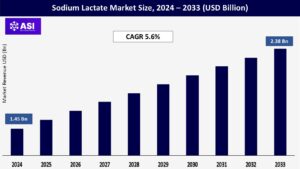
The global sodium lactate market size was valued at approximately USD 1.45 billion in 2024 and is projected to reach USD 2.38 billion by 2033, growing at a CAGR of 5.6% during the forecast period.
Sodium lactate, the sodium salt of lactic acid, is widely used as a multifunctional ingredient in food preservation, cosmetics, pharmaceuticals, and industrial formulations. It offers moisturizing, pH-regulating, antimicrobial, and electrolyte-balancing properties. In the food industry, it extends shelf life in meat, poultry, and bakery products. In cosmetics, it acts as a humectant for skin hydration, while in medical applications, it is used in IV fluids for electrolyte replenishment.
Growth is fueled by the rising demand for clean-label, multifunctional additives, expanding processed food consumption, and increasing usage of sodium lactate in medical and cosmetic formulations.
Growing Need for Food Preservatives with Clean Labels Sodium lactate is becoming more and more popular as a clean-label preservative due to consumer preferences for natural, minimally processed foods.
It prolongs shelf life without sacrificing flavor, aroma, or texture by efficiently preventing microbiological development, especially Listeria monocytogenes, in meat, poultry, and seafood products. This is in line with the trend away from artificial chemicals like nitrites and sodium benzoate, particularly in the luxury and organic food markets.
Because sodium lactate has excellent humectant qualities that help keep skin moisture and improve texture, it is being utilized more and more in cosmetics and personal care products. It is frequently found in anti-aging serums, shampoos, conditioners, lotions, and creams.
Its market penetration is being accelerated by the growing demand for skin hydration products as well as the expansion of the natural beauty and wellness sector globally. It is also appropriate for sensitive-skin products because of its gentle pH-regulating capabilities, which improve formulation stability.
The fermentation of feedstocks high in carbohydrates, such as corn, sugarcane, or sugar beets, is the main process that produces sodium lactate. Harvest yields, global supply-demand mismatches, climate change, and geopolitical trade disruptions all have a significant impact on the prices of various agricultural commodities.
Manufacturer margins may be weakened by abrupt increases in the price of raw materials, particularly for those with little vertical integration. Price volatility may also be exacerbated by competition for the same feedstocks from bioethanol and other bio-based companies.
Despite the U.S. FDA’s classification of sodium lactate as Generally Recognized As Safe (GRAS), regional compliance requirements differ greatly. International trading can be complicated by variations in the EU, North America, and the Asia-Pacific’s allowable concentration limits, purity requirements, and labeling nomenclature.
In order to comply with local regulatory requirements, manufacturers frequently incur additional expenditures for product reformulation, label updates, and region-specific safety evaluations. For international players, these complications can raise operating expenses and delay market entry.
| Report Metric | Details |
|---|---|
| Segmentations | |
| By Grade |
Food Grade (Largest Segment) Pharmaceutical Grade Cosmetic Grade |
| By Application |
Food & Beverage (Largest Segment) Pharmaceuticals Personal care and cosmetics Industrial Uses |
| By End-Use |
Food & Beverage (Largest Market) Pharmaceuticals Cosmetics & Personal Care Industrial |
| Key Players |
|
| Geographies Covered | |
| North America |
U.S. |
| Europe |
U.K. |
| Asia Pacific |
China |
| Middle East & Africa |
Saudi Arabia |
| Latin America |
Brazil |
The Sodium Lactate Market is segmented by Function (Acidulant, Emulsifier, Diuretic), By End-Use (Food & Beverage, Pharmaceuticals, Personal Care, Industrial).
Each factor plays a crucial role in enhancing patient safety, increasing the adoption of self-administered anticoagulant therapies, and supporting the development of more convenient, prefilled drug delivery systems that streamline treatment in the management of thromboembolic and cardiovascular conditions.
Because it is widely used as a preservative and pH regulator in meat, seafood, dairy, and pastry items, food-grade (the largest segment) dominates the market. It is crucial in clean-label and processed food goods because it prolongs shelf life, prevents microbiological growth, and preserves sensory qualities.
Pharmaceutical Grade: Used as a buffering agent in the production of drugs, as well as in injectable formulations and intravenous solutions. For clinical and medicinal applications, its high purity and biocompatibility are essential.
Used as a moisturizer and humectant in lotions, creams, shampoos, and conditioners. It supports high-end personal care applications by enhancing product texture, formulation stability, and skin hydration.
The largest segment, food and beverage, uses sodium lactate mostly in dairy goods, meat, poultry, and seafood to prevent microbial development, prolong shelf life, and preserve freshness. It is particularly appealing in organic and minimally processed foods because to its clean-label status.
Used in injectable solutions, oral drugs, and other therapeutic formulations as an excipient, buffering agent, and pH stabilizer. Reliability in delicate applications is guaranteed by its high solubility and safety profile.
used in anti-aging formulas, skin creams, lotions, shampoos, and conditioners. It stabilizes emulsions, improves skin sensation, and offers superior moisturization.
Used in industrial formulations such as detergents, adhesives, and specialized coatings as a humectant, corrosion inhibitor, and pH regulator.
The largest end-use market is food and beverage, which is fueled by applications in dairy, poultry, seafood, processed meat, and baked goods. Clean-label and minimally processed foods require sodium lactate because it improves microbiological safety, prolongs shelf life, and preserves product quality.
Pharmaceuticals: Used in oral rehydration solutions, intravenous (IV) fluids, and other pharmaceutical formulations for pH stabilization and electrolyte replacement. Reliability in crucial healthcare applications is guaranteed by its high solubility and safety profile.
Cosmetics and Personal Care: Used as a moisturizer and humectant in body lotions, skin creams, shampoos, conditioners, and anti-aging treatments. Both product performance and customer appeal are enhanced by its water-holding capacity and formulation stability.
Industrial: Used in adhesives, detergents, corrosion inhibitors, biodegradable de-icing agents, and specialty chemical formulations. It is useful in a variety of non-food industrial applications, such as environmentally friendly products, due to its multifunctional qualities.
China, India, and Japan are at the forefront of production and consumption, driven by the rapid expansion of food processing, pharmaceutical manufacturing, and cosmetics sectors. Rising urbanization, increasing disposable income, and growing middle-class spending are further fueling demand.
The region sees strong demand from the processed meat industry and the pharmaceutical sector. The U.S. leads due to its well-established meat processing infrastructure and high adoption of clean-label preservatives.
Europe represents a mature market characterized by strong demand for natural cosmetic ingredients and stringent food safety regulations, which encourage the adoption of sodium lactate across both food and personal care segments.
These regions are experiencing moderate growth, supported by increasing demand for shelf-stable foods and the expansion of local cosmetic manufacturing in Brazil, Mexico, and GCC countries.
The global sodium lactate market size was valued at USD 1.45 billion in 2024.
The global sodium lactate market is projected at a CAGR of 5.6%.
The Food & Beverage end-user segment dominates the market, particularly processed meat and bakery products
The Asia-Pacific region shown the growth potential, driven by expanding food processing, pharmaceutical, and cosmetics industries
1.1 Summary
1.2 Research methodology
2.1 Research Objectives
2.2 Market Definition
2.3 Limitations & Assumptions
2.4 Market Scope & Segmentation
2.5 Currency & Pricing Considered
3.1 Drivers
3.2 Geopolitical Impact
3.3 Human Factors
3.4 Technology Factors
4.1 Porters Five Forces Analysis
4.2 Value Chain Analysis
4.3 Average Pricing Analysis
4.4 M & A, Agreements & Collaboration Analysis
5.1 Sodium Lactate Market, By Grade
5.1.1 Introduction
5.1.2 Market Size & Forecast
5.2 Sodium Lactate Market, By Application
5.3 Sodium Lactate Market, By End-Use
6.1 North America Sodium Lactate Market , By Country
6.1.1 Sodium Lactate Market, By Grade
6.1.2 Sodium Lactate Market, By Application
6.1.3 Sodium Lactate Market, By End-Use
6.2 U.S.
6.2.1 Sodium Lactate Market, By Grade
6.2.2 Sodium Lactate Market, By Application
6.2.3 Sodium Lactate Market, By End-Use
6.3 Canada
7.1 U.K.
7.2 Germany
7.3 France
7.4 Spain
7.5 Italy
7.6 Russia
7.7 Nordic
7.8 Benelux
7.9 The Rest of Europe
8.1 China
8.2 South Korea
8.3 Japan
8.4 India
8.5 Australia
8.6 Taiwan
8.7 South East Asia
8.8 The Rest of Asia-Pacific
9.1 UAE
9.2 Turkey
9.3 Saudi Arabia
9.4 South Africa
9.5 Egypt
9.6 Nigeria
9.7 Rest of MEA
10.1 Brazil
10.2 Mexico
10.3 Argentina
10.4 Chile
10.5 Colombia
10.6 Rest of Latin America
11.1 Global Market Share (%) By Players
11.2 Market Ranking By Revenue for Players
11.3 Competitive Dashboard
11.4 Product Mapping