

Magnesium Nitrate Market
Magnesium Nitrate Market Share and Trend Analysis, By Grade (Agricultural Quality, Grade of Pharmaceuticals), By Application (Fertilizers, Detonators, Synthesis of Chemicals, Medicines), By End User (Agriculture, Construction and Mining, Pharmaceuticals, The Chemical Sector) – Industry Analysis Report, Regional Outlook, Growth Potential, Price Trends, Competitive Market Share & Forecast, 2026–2033.

Historical Period: 2019-2024
Forecast Period: 2025-2033
Report Code :
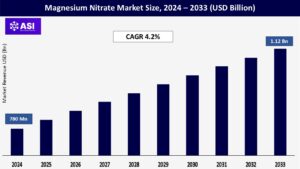
CAGR: 4.2%
Last Updated : March 16, 2026
The global Magnesium Nitrate Market size was valued at approximately USD 780 million in 2024 and is projected to reach USD 1.12 billion by 2033, growing at a CAGR of 4.2% during the forecast period.
Magnesium nitrate is a hygroscopic salt widely used in fertilizers, explosives, and chemical manufacturing due to its high solubility and nitrogen-magnesium content.
As a dual nutrient source, magnesium nitrate supplies both nitrogen and magnesium, which are essential for the proper growth of plants. The need for magnesium nitrate is steadily increasing as agricultural practices around the world shift their focus to improving crop productivity and reestablishing soil health.
In areas with soils lacking in magnesium, where the substance is utilized to rectify nutritional imbalances and increase yields, this trend is especially pronounced.
In its explosive grade form, magnesium nitrate is widely utilized as an oxidizing agent in the production of explosives for use in construction and mining. The need for effective blasting solutions is being driven by the growing number of infrastructure development projects, especially in emerging economies in Asia-Pacific, Latin America, and Africa. This is increasing the demand for magnesium nitrate in this industry.
Because of its strong hygroscopicity, magnesium nitrate easily absorbs moisture from the air. Particularly in humid or tropical areas, this feature presents serious packing, storage, and transportation issues.
Specialized storage facilities and moisture-proof packaging are frequently needed to maintain product stability, which raises the costs of infrastructure and transportation and may put off budget-conscious consumers.
Many nations regulate magnesium nitrate as a dangerous material because it is an oxidizing agent. Strict safety and environmental compliance guidelines govern its use, storage, and transportation.
These can greatly raise operating expenses and include labeling, paperwork, training, and protective infrastructure. Such regulatory costs may restrict its adoption in specific end-use industries and serve as a barrier to entry for small-scale businesses.
| Report Metric | Details |
|---|---|
| Segmentations | |
| By Grade |
Agricultural Quality Grade of Pharmaceuticals |
| By Application |
Fertilizers Detonators Synthesis of Chemicals Medicines |
| By End User |
Agriculture Construction and Mining Pharmaceuticals The Chemical Sector |
| Key Players |
|
| Geographies Covered | |
| North America |
U.S. |
| Europe |
U.K. |
| Asia Pacific |
China |
| Middle East & Africa |
Saudi Arabia |
| Latin America |
Brazil |
The Magnesium Nitrate Market is segmented by Grade (Agricultural Quality, Grade of Pharmaceuticals), By Application (Fertilizers, Detonators, Synthesis of Chemicals, Medicines), By End User (Agriculture, Construction and Mining, Pharmaceuticals, The Chemical Sector).
Each factor plays a crucial role in enhancing patient safety, increasing the adoption of self-administered anticoagulant therapies, and supporting the development of more convenient, prefilled drug delivery systems that streamline treatment in the management of thromboembolic and cardiovascular conditions.
Agricultural Quality (Predominant Market)
Due to its dual function of providing vital nitrogen and magnesium nutrients for plant growth, agricultural-grade magnesium nitrate has the biggest market share.
It is especially preferred in contemporary farming methods where accurate nutrient supply is essential, including fertigation and greenhouse farming. The demand for this grade is still being driven by the increased emphasis on improving soil fertility and agricultural production optimization.
Grade of Pharmaceuticals
Despite having a smaller market share, pharmaceutical-grade magnesium nitrate is becoming more significant because of its high purity levels. It is utilized as a stabilizing agent in the production of pharmaceuticals and in the creation of dietary supplements.
The need for high-quality nutraceuticals and growing health consciousness are anticipated to fuel this market’s steady expansion.
Fertilizers: The Widest Range of Use
Because of its efficiency in delivering nutrients and compatibility with crops that are sensitive to chloride, the agriculture sector accounts for the majority of magnesium nitrate usage worldwide.
Its application improves crop production and nutrient uptake efficiency, especially in fertigation systems. The expansion of this application segment is further supported by the growing use of precision agricultural methods.
Detonators
In the creation of emulsion explosives, which are frequently employed in mining and civil engineering projects, magnesium nitrate is an essential oxidizing ingredient.
It is a dependable option for controlled blasting applications due to its chemical stability and compatibility with other explosive chemicals. Demand in this market is being driven by the global expansion of mining and infrastructure development.
Synthesis of Chemicals
Magnesium nitrate is utilized as a reagent and precursor in a number of organic and inorganic synthesis procedures in the chemical industry. Particularly in high-purity applications, its use in the production of specialty compounds, fine chemicals, and catalysts is fostering a modest but consistent increase.
Medicines
Magnesium nitrate is utilized in pharmaceutical applications for buffer solution formulation and magnesium supplementation, despite being a specialized market. With a greater emphasis on pharmaceutical excipients and high-purity chemicals, demand is steadily increasing.
Agriculture
The main users of magnesium nitrate are agribusinesses and fertilizer manufacturers, making agriculture the largest end-use sector. The substance is widely utilized in fertigation systems, soil conditioners, and foliar spray formulations.
It is essential for sustainable farming because of its compatibility with contemporary farming methods and capacity to remedy crop magnesium deficits.
Construction and Mining
Industrial-grade magnesium nitrate, which is necessary for the manufacturing of emulsion explosives used in blasting operations, is used in large quantities by this industry.
The compound is appropriate for use in mining, tunneling, and other civil engineering operations due to its oxidizing qualities and safety profile. The main sources of demand are ongoing mineral extraction and infrastructure construction.
Pharmaceuticals
High-purity magnesium nitrate is becoming more and more popular in the pharmaceutical sector, despite its relative nicheness. It is used as a component in buffer systems and in the creation of dietary supplements.
Magnesium is becoming more relevant in pharmaceutical excipients and nutraceuticals as a result of growing consumer awareness of health problems linked to the mineral.
The Chemical Sector
Magnesium nitrate is employed in a variety of chemical processes, such as pyrotechnics, corrosion inhibitors, and catalyst synthesis. Its function as a stabilizer and reagent in the manufacturing of fine and specialty chemicals fuels consistent demand in this end-use market.
Asia-Pacific dominates the global magnesium nitrate market in terms of growth rate, led by high consumption in China and India. The region’s strong agricultural foundation, rising population, and expanding mining activities are key drivers.
Government-backed fertilizer subsidy programs and soil health initiatives further accelerate adoption. Additionally, the presence of cost-effective manufacturing hubs and favorable export policies makes Asia-Pacific a critical supply and demand center.
North America represents a mature market with consistent demand, particularly in the U.S. The region benefits from advancements in precision agriculture, controlled-environment farming, and strong regulatory support for efficient nutrient use.
The mining sector, especially in the western U.S. and parts of Canada, also contributes significantly to the consumption of industrial-grade magnesium nitrate.
In Europe, market growth is driven by stringent environmental regulations and increasing adoption of sustainable agricultural practices. Countries such as Germany, France, and the Netherlands are promoting nitrate-based specialty fertilizers to support organic farming and cultivation of high-value crops. The region’s strong focus on eco-friendly inputs is fostering demand for magnesium nitrate in agriculture.
These regions are emerging markets with rising demand in both agriculture and mining sectors. Brazil, with its extensive agricultural base, faces widespread magnesium-deficient soils—prompting the adoption of magnesium-enriched fertilizers.
In Sub-Saharan Africa, growing agro-industrial activities and infrastructural development are spurring demand for magnesium nitrate, particularly in fertilizers and explosives.
The Magnesium Nitrate market was valued at USD 780 million in 2024.
The Magnesium Nitrate market is projected to grow at a CAGR of 4.2% from 2025 to 2033.
Fertilizers hold the largest market share of Magnesium Nitrate.
Asia-Pacific, led by India and China
1.1 Summary
1.2 Research methodology
2.1 Research Objectives
2.2 Market Definition
2.3 Limitations & Assumptions
2.4 Market Scope & Segmentation
2.5 Currency & Pricing Considered
3.1 Drivers
3.2 Geopolitical Impact
3.3 Human Factors
3.4 Technology Factors
4.1 Porters Five Forces Analysis
4.2 Value Chain Analysis
4.3 Average Pricing Analysis
4.4 M & A, Agreements & Collaboration Analysis
5.1 Magnesium Nitrate Market, By Grade
5.1.1 Introduction
5.1.2 Market Size & Forecast
5.2 Magnesium Nitrate Market, By Application
5.3 Magnesium Nitrate Market, By End User
6.1 North America Magnesium Nitrate Market , By Country
6.1.1 Magnesium Nitrate Market, By Grade
6.1.2 Magnesium Nitrate Market, By Application
6.1.3 Magnesium Nitrate Market, By End User
6.2 U.S.
6.2.1 Magnesium Nitrate Market, By Grade
6.2.2 Magnesium Nitrate Market, By Application
6.2.3 Magnesium Nitrate Market, By End User
6.3 Canada
7.1 U.K.
7.2 Germany
7.3 France
7.4 Spain
7.5 Italy
7.6 Russia
7.7 Nordic
7.8 Benelux
7.9 The Rest of Europe
8.1 China
8.2 South Korea
8.3 Japan
8.4 India
8.5 Australia
8.6 Taiwan
8.7 South East Asia
8.8 The Rest of Asia-Pacific
9.1 UAE
9.2 Turkey
9.3 Saudi Arabia
9.4 South Africa
9.5 Egypt
9.6 Nigeria
9.7 Rest of MEA
10.1 Brazil
10.2 Mexico
10.3 Argentina
10.4 Chile
10.5 Colombia
10.6 Rest of Latin America
11.1 Global Market Share (%) By Players
11.2 Market Ranking By Revenue for Players
11.3 Competitive Dashboard
11.4 Product Mapping