

Dehydrated Alcohol Market
Dehydrated Alcohol Market Size, Share & Trends Analysis Report By Purity (Absolute Alcohol, Denatured Alcohol) by Application (Pharmaceutical Industry, Industrial Applications, Personal Care, Chemical Industry) – Industry Analysis Report, Regional Outlook, Growth Potential, Price Trends, Competitive Market Share & Forecast, 2025–2033.

Historical Period: 2019-2024
Forecast Period: 2025-2033
Report Code :
CAGR: 5.7%
Last Updated : March 16, 2026
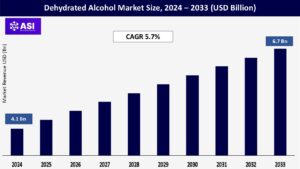
The global dehydratedalcohol market size was valued at approximately USD 4.1 billion in 2024, and is projected to reach USD 6.7 billion by 2033, growing at a CAGR of 5.7% during the forecast period (2025–2033).
Dehydrated alcohol, commonly known as absolute ethanol, is widely used in pharmaceuticals, personal care products, chemical synthesis, and industrial solvents due to its high purity (typically 99.5% or above). Increasing demand for pharmaceutical-grade ethanol and rising adoption in biotechnological and personal care applications are key market drivers.
Pharmaceutical-grade dehydrated alcohol is essential for use as a solvent in injectable and oral medication formulations, as well as in antiseptics and disinfectants. The need for high-purity ethanol has grown dramatically as a result of the aging population, the rising incidence of chronic illnesses, and post-COVID-19 investments in the production of biopharmaceuticals.
Strict ethanol purity criteria are enforced by regulatory bodies like the European Pharmacopeia and the U.S. FDA, which oblige producers to create dehydrated alcohol that meets these exacting standards.
Because of its quick evaporation and antibacterial qualities, dehydrated alcohol, especially ethanol, is essential to the creation of perfumes, deodorants, hair sprays, and hand sanitizers. The need for pharmaceutical and cosmetic-grade ethanol is being driven by the global trend toward high-end, clean-label, and hygiene-focused beauty products.
In emerging markets, where growing disposable incomes and increased awareness of personal hygiene are propelling market expansion, this tendency is particularly noticeable.
Raw ethanol, which can be obtained from fossil fuels or agricultural biomass like corn, wheat, or sugarcane, is necessary for the manufacturing of dehydrated alcohol. Climate, crop harvests, and global crude oil trends all have an impact on these feedstocks’ extremely erratic prices.
Regulatory barriers are also produced by government regulations pertaining to the manufacturing, distribution, and use of ethanol, particularly because of its possible abuse in alcoholic beverages. Further limiting market expansion and flexibility are regional limits on ethanol logistics, licensing regulations, and excise levies.
Because of its extreme volatility and flammability, dehydrated alcohol is categorized as a hazardous material. This calls for strict storage and transportation guidelines, such as safe logistics chains, temperature-controlled facilities, and containers that can withstand flames.
Operating expenses rise dramatically when safety regulations like those established by the Occupational Safety and Health Administration (OSHA), the National Fire Protection Association (NFPA), and REACH (Registration, Evaluation, Authorization, and Restriction of Chemicals) are followed.
Small and medium-sized businesses (SMEs) may find these rules especially onerous, which would hinder their capacity to compete in the market.
| Report Metric | Details |
|---|---|
| Segmentations | |
| By Purity |
Absolute Alcohol Denatured Alcohol |
| By Application |
Pharmaceutical Industry Industrial Applications Personal Care Chemical Industry |
| Key Players |
|
| Geographies Covered | |
| North America |
U.S. |
| Europe |
U.K. |
| Asia Pacific |
China |
| Middle East & Africa |
Saudi Arabia |
| Latin America |
Brazil |
The Dehydrated Alcohol Market is segmented by Purity (Absolute Alcohol, Denatured Alcohol) by Application (Pharmaceutical Industry, Industrial Applications, Personal Care, Chemical Industry).
Each factor plays a crucial role in enhancing patient safety, increasing the adoption of self-administered anticoagulant therapies, and supporting the development of more convenient, prefilled drug delivery systems that streamline treatment in the management of thromboembolic and cardiovascular conditions.
Absolute Alcohol (≥99.5%) – Dominant Segment (64.3% Share in 2024)
Because it is essential to pharmaceutical formulations, especially injectables, as well as analytical and high-precision laboratory settings, absolute alcohol has the biggest market share. Because of its high degree of purity, it is essential for activities like chemical synthesis, biotechnology, and high-performance research settings that call for a low water content.
Denatured Alcohol – Growing Segment
The usage of denatured alcohol in household cleaning, personal care items, and industrial manufacture is growing. Since it is rendered unfit for human eating, its cost-effectiveness and lower taxation in some areas make it appealing. Its increasing use in a variety of industries is a result of its ability to function as a flexible solvent and disinfectant in situations where high-purity ethanol is not necessary.
Pharmaceutical Industry – Largest Segment
The market for dehydrated alcohol is dominated by the pharmaceutical industry. In the formulation of active pharmaceutical ingredients (APIs), antiseptics, disinfectants, and therapeutic injections, ethanol is an essential element.
The need for high-purity ethanol is gradually growing because to factors such rising global healthcare costs, expanded injectable production, and continued expansion in biopharmaceuticals.
Industrial Applications
Dehydrated alcohol is frequently used as a solvent in a variety of chemical processes, industrial cleaning products, and paint and ink formulations. Significant expansion in this market is being driven by the quickening pace of industrialization, particularly in Asia-Pacific and Latin America, as well as the growing need for solvents that are both economical and effective.
Personal Care
Due to growing customer preference for alcohol based goods such as deodorants, hair care products, sanitizers, and perfumes, the personal care market is expanding rapidly. Particularly in emerging economies, the COVID-19 epidemic has increased demand for hygiene products among urban and semi-urban populations.
Chemical Industry
Dehydrated alcohol is a crucial reactant in chemical reactions like etherification, dehydration, and esterification. Due to its versatility as a feedstock, ethanol is becoming more and more relevant in this market as the need for specialty chemicals and intermediates increases.
Asia-Pacific is projected to witness the highest CAGR of 7.2% over the forecast period. China and India are key drivers, supported by large-scale ethanol production, rising healthcare investments, growing pharmaceutical and cosmetic manufacturing bases, and a surge in hygiene-conscious consumers post-pandemic.
North America accounted for approximately USD 1.4 billion in 2024, primarily driven by the robust pharmaceutical and cosmetics industries in the U.S. The region benefits from regulatory clarity, advanced infrastructure, and innovation in bioethanol production technologies. Strong demand for high-purity ethanol in clinical and research applications reinforces its leading position.
Europe holds a significant share of the market, with Germany, France, and the UK at the forefront. The region’s strict purity and safety standards, coupled with high demand from pharmaceutical and personal care manufacturers, contribute to stable growth. Supportive regulatory frameworks and emphasis on sustainability further enhance market expansion.
Latin America is gaining traction, led by Brazil’s strong ethanol production ecosystem and increasing demand from industrial sectors in Mexico and Argentina. Supportive government policies and expanding manufacturing capabilities are enhancing the region’s role in the global market.
The Middle East & Africa region is experiencing steady growth, fueled by the expansion of pharmaceutical operations in the Gulf Cooperation Council (GCC) countries and rising personal care awareness in South Africa and the UAE. Gradual improvements in healthcare infrastructure and import reliance are supporting demand for dehydrated alcohol.
The global market was valued at approximately USD 4.1 billion in 2024.
The market is projected to grow at a CAGR of 5.7%.
North America holds the largest share, followed by Europe and Asia-Pacific.
The key applications include pharmaceuticals, personal care, chemical synthesis, and industrial solvents.
1.1 Summary
1.2 Research methodology
2.1 Research Objectives
2.2 Market Definition
2.3 Limitations & Assumptions
2.4 Market Scope & Segmentation
2.5 Currency & Pricing Considered
3.1 Drivers
3.2 Geopolitical Impact
3.3 Human Factors
3.4 Technology Factors
4.1 Porters Five Forces Analysis
4.2 Value Chain Analysis
4.3 Average Pricing Analysis
4.4 M & A, Agreements & Collaboration Analysis
5.1 Dehydrated Alcohol Market, By Purity
5.1.1 Introduction
5.1.2 Market Size & Forecast
5.2 Dehydrated Alcohol Market, By Application
6.1 North America Dehydrated Alcohol Market, By Country
6.1.1 Dehydrated Alcohol Market, By Purity
6.1.2 Dehydrated Alcohol Market, By Application
6.2 U.S
6.2.1 Dehydrated Alcohol Market, By Purity
6.2.2 Dehydrated Alcohol Market, By Application
6.3 Canada
7.1 U.K.
7.2 Germany
7.3 France
7.4 Spain
7.5 Italy
7.6 Russia
7.7 Nordic
7.8 Benelux
7.9 The Rest of Europe
8.1 China
8.2 South Korea
8.3 Japan
8.4 India
8.5 Australia
8.6 Taiwan
8.7 South East Asia
8.8 The Rest of Asia-Pacific
9.1 UAE
9.2 Turkey
9.3 Saudi Arabia
9.4 South Africa
9.5 Egypt
9.6 Nigeria
9.7 Rest of MEA
10.1 Brazil
10.2 Mexico
10.3 Argentina
10.4 Chile
10.5 Colombia
10.6 Rest of Latin America
11.1 Global Market Share (%) By Players
11.2 Market Ranking By Revenue for Players
11.3 Competitive Dashboard
11.4 Product Mapping