

Chlorofluorocarbon Market
Chlorofluorocarbon Market & Trends Analysis Report, By Product Type (CFC-12 (Dichlorodifluoromethane), CFC-11 (Trichlorofluoromethane), CFC-113 (Trichlorotrifluoroethane), Others), By Application (Refrigeration & Air Conditioning, Foam Blowing Agents, Aerosol Propellants, Solvents and Degreasers), By End User (Industrial (Including Aerospace & Electronics), Commercial (HVAC, Refrigeration), Residential, Automotive, Others)– Industry Analysis Report, Regional Outlook, Growth Potential, Price Trends, Competitive Market Share & Forecast, 2025–2033.

Historical Period: 2019-2024
Forecast Period: 2025-2033
Report Code :
CAGR: -4.0%
Last Updated : March 20, 2026
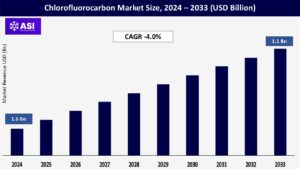
The global Chlorofluorocarbon (CFC) Market size was valued at approximately USD 1.6 billion in 2024 and is projected to decline to USD 1.1 billion by 2033, with a CAGR of -4.0% due to stringent environmental regulations and ongoing phase-outs under the Montreal Protocol.
CFCs, synthetic compounds containing carbon, chlorine, and fluorine, were historically used in refrigeration, air conditioning, foam blowing agents, aerosol propellants, and cleaning solvents. However, their ozone-depleting potential (ODP) has led to widespread restrictions and a declining global market.
Some areas, particularly in Africa, Asia, and Latin America, still use CFCs for outdated refrigeration and air conditioning systems in spite of the Montreal Protocol’s worldwide production ban.
Upgrading to current systems that use safer substitutes like HFCs or natural refrigerants is still too expensive in many low- and middle-income nations. Because of this reliance, there is still a need for CFCs to maintain and repair the infrastructure that already exists.
CFCs are still trafficked illegally or as reclaimed/recycled compounds because of their ongoing industrial importance, particularly in older equipment that cannot be modified. Such practice is concentrated in nations with laxer enforcement of environmental laws. Despite their restricted supply, reclaimed CFCs meet specific needs from industries where alternative technologies are either unavailable or prohibitively expensive.
The Montreal Protocol’s universal regulatory ban on the production and use of CFCs is the biggest barrier to the market. Due to the high ozone depletion potential (ODP) and global warming potential (GWP) of CFCs, this international pact, which has been ratified by more than 190 nations, requires their total phase-out. As a result, primary production has been eradicated worldwide, and legitimate trade and consumption have been severely curtailed.
Alternatives, including hydrochlorofluorocarbons (HCFCs), hydrofluorocarbons (HFCs), hydrofluoroolefins (HFOs), and natural refrigerants like carbon dioxide (CO₂) and ammonia, have become widely used as a result of technological breakthroughs. These substitutes lessen dependency on CFCs in all applications since they are more ecologically friendly and energy-efficient.
| Report Metric | Details |
|---|---|
| Segmentations | |
| By Product Type |
CFC-12 (Dichlorodifluoromethane) CFC-11 (Trichlorofluoromethane) CFC-113 (Trichlorotrifluoroethane) Others |
| By Application |
Refrigeration & Air Conditioning Foam Blowing Agents Aerosol Propellants Solvents and Degreasers |
| By End-User |
Industrial (Including Aerospace & Electronics) Commercial (HVAC, Refrigeration) Residential Automotive Others |
| Key Players |
|
| Geographies Covered | |
| North America |
U.S. |
| Europe |
U.K. |
| Asia Pacific |
China |
| Middle East & Africa |
Saudi Arabia |
| Latin America |
Brazil |
The Chlorofluorocarbon Market is segmented by Product Type (CFC-12 (Dichlorodifluoromethane), CFC-11 (Trichlorofluoromethane), CFC-113 (Trichlorotrifluoroethane), Others), By Application (Refrigeration & Air Conditioning, Foam Blowing Agents, Aerosol Propellants, Solvents and Degreasers), By End User (Industrial (Including Aerospace & Electronics), Commercial (HVAC, Refrigeration), Residential, Automotive, Others).
Each factor plays a crucial role in enhancing patient safety, increasing the adoption of self-administered anticoagulant therapies, and supporting the development of more convenient, prefilled drug delivery systems that streamline treatment in the management of thromboembolic and cardiovascular conditions.
Historically, the most widely used CFC, CFC-12, was integral to refrigeration and air-conditioning systems. Despite the production ban, it remains prevalent in older automobiles and commercial HVAC units, especially in developing nations where retrofitting is cost-prohibitive.
Once dominant in foam blowing and as a refrigerant, CFC-11 is now largely restricted but still found in legacy building insulation and commercial cooling systems. Illicit production has been reported in some regions due to its thermal insulation properties.
Primarily used as a solvent and precision cleaner in the electronics and aerospace sectors, CFC-113 is still legally permitted under essential-use exemptions in specific industrial applications. Demand is niche and highly regulated.
Includes CFC blends and less common variants used in scientific research, calibration gases, and experimental applications. These variants form a small yet persistent portion of the market, often traded through reclaimed or laboratory-grade channels.
The largest application segment is driven by the continued operation of older AC units and refrigerators, particularly in Southeast Asia, Africa, and Latin America. CFC-12 and CFC-11 are still required for system maintenance and refrigerant top-ups in aging infrastructure.
CFCs were once the standard for polyurethane and polystyrene foam production, especially in thermal insulation. Although officially banned, some illegal use persists in unregulated manufacturing or in older systems not yet upgraded.
Previously used in medical inhalers, deodorants, and spray paints, this segment has nearly disappeared due to the shift to hydrocarbons and compressed gas substitutes. Remaining demand is limited to black-market channels or legacy products.
Specialized sectors such as aerospace, defense, and high-end electronics still rely on CFCs like CFC-113 for precision cleaning due to their non-flammability and inertness. Usage remains minimal and often regulated under essential-use provisions.
Industries requiring high-precision, high-purity cleaning agents, such as aerospace assembly, satellite manufacturing, and military-grade electronics, form the largest end-use category. CFCs persist here due to technical compatibility and regulatory exemptions.
Includes supermarkets, restaurants, and commercial office spaces operating legacy chillers and cold storage units. Replacement costs often delay conversion, especially in mid-income countries.
Aging refrigerators and window AC units still operating in rural households or economically constrained regions continue to utilize CFC-based systems, particularly in India, Sub-Saharan Africa, and Southeast Asia.
Pre-2000 vehicles, particularly in the used-car markets of developing countries, still run CFC-12-based air-conditioning systems. The cost of retrofitting or replacing systems sustains residual demand.
Includes laboratory-grade applications, medical inhalers under exemption, and R&D use in instrumentation requiring specific properties of CFCs.
Asia-Pacific still has pockets of active CFC use despite international regulations, especially in rural or uncontrolled areas of Vietnam, Indonesia, the Philippines, and India. Sustained demand is a result of low-cost service procedures and aged refrigeration infrastructure.
As a result of nations investing in ecologically friendly disposal methods under global environmental agreements, the region is also emerging as a major center for the recovery and destruction of CFCs.resistance.
Strict adherence to the Montreal Protocol and sophisticated retrofit initiatives have virtually eliminated the use of CFCs in the general market in North America and Europe. Reclaimed refrigerants, essential-use exemptions in the aerospace and medical industries, and research and development labs make up the little remaining activity. These areas have some of the strongest enforcement systems in the world..
Heavily restricted, with fipronil’s usage in agriculture partially prohibited. Nonetheless, it is still of little use in veterinary and specialized applications.
Old refrigeration units and the legacy automobile industry, especially in rural regions, support demand in Brazil, Mexico, and Argentina. Informal sectors continue to use prohibited refrigerants even if regulatory enforcement has increased in major economies. The establishment of recovery and reclamation facilities for phased-out chemicals has advanced somewhat.
Industrial sectors in some nations, especially those engaged in manufacturing and petrochemicals, continue to demonstrate minimal usage of CFC, especially in older cooling systems, despite a major reduction in demand. In a number of Gulf and North African republics, the absence of centralized HVAC regulation has permitted low but consistent use to prevail.
Due to their high ozone-depleting potential, CFCs are banned or severely restricted under international environmental treaties.
Minimal legacy use exists in some developing countries and old systems, but globally, CFC use is being phased out.
Hydrofluorocarbons (HFCs), hydrochlorofluorocarbons (HCFCs), hydrofluoroolefins (HFOs), CO₂, and ammonia.
Refrigeration, air conditioning, aerosol, and foam manufacturing industries.
No. Production and trade are banned in most regions. Any remaining usage is heavily regulated and monitored.
1.1 Summary
1.2 Research methodology
2.1 Research Objectives
2.2 Market Definition
2.3 Limitations & Assumptions
2.4 Market Scope & Segmentation
2.5 Currency & Pricing Considered
3.1 Drivers
3.2 Geopolitical Impact
3.3 Human Factors
3.4 Technology Factors
4.1 Porters Five Forces Analysis
4.2 Value Chain Analysis
4.3 Average Pricing Analysis
4.4 M & A, Agreements & Collaboration Analysis
5.1 Chlorofluorocarbon Market, By Product Type
5.1.1 Introduction
5.1.2 Market Size & Forecast
5.2 Chlorofluorocarbon Market, By Application
5.3 Chlorofluorocarbon Market, By End-User
6.1 North America Chlorofluorocarbon Market , By Country
6.1.1 Chlorofluorocarbon Market, By Product Type
6.1.2 Chlorofluorocarbon Market, By Application
6.1.3 Chlorofluorocarbon Market, By End-User
6.2 U.S.
6.2.1 Chlorofluorocarbon Market, By Product Type
6.2.2 Chlorofluorocarbon Market, By Application
6.2.3 Chlorofluorocarbon Market, By End-User
6.3 Canada
7.1 U.K.
7.2 Germany
7.3 France
7.4 Spain
7.5 Italy
7.6 Russia
7.7 Nordic
7.8 Benelux
7.9 The Rest of Europe
8.1 China
8.2 South Korea
8.3 Japan
8.4 India
8.5 Australia
8.6 Taiwan
8.7 South East Asia
8.8 The Rest of Asia-Pacific
9.1 UAE
9.2 Turkey
9.3 Saudi Arabia
9.4 South Africa
9.5 Egypt
9.6 Nigeria
9.7 Rest of MEA
10.1 Brazil
10.2 Mexico
10.3 Argentina
10.4 Chile
10.5 Colombia
10.6 Rest of Latin America
11.1 Global Market Share (%) By Players
11.2 Market Ranking By Revenue for Players
11.3 Competitive Dashboard
11.4 Product Mapping