

Chlorine Market
Chlorine Market & Trends Analysis Report, By Derivative Type (EDC/PVC, Water Treatment Chemicals), By Application (Water Treatment, Pharmaceuticals and Chemicals, Pulp & Paper and Textiles) – Industry Analysis Report, Regional Outlook, Growth Potential, Price Trends, Competitive Market Share & Forecast, 2025–2033.

Historical Period: 2019-2024
Forecast Period: 2025-2033
Report Code :
CAGR: 4.6%
Last Updated : March 20, 2026
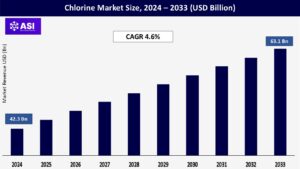
The global chlorine market size was valued at approximately USD 42.3 billion in 2024 and is projected to reach USD 63.1 billion by 2033, growing at a CAGR of 4.6% during the forecast period (2025–2033).
Chlorine is a highly reactive halogen element widely used in water disinfection, PVC production, and as a chemical intermediate in numerous industries. The increasing demand for potable water, urban sanitation, and chlorinated derivatives in industrial applications is driving market expansion globally.
Chlorine is most commonly used in wastewater treatment and municipal water supply disinfection. The need for chlorine-based water treatment chemicals is growing as a result of growing urban populations and rising water pollution levels, particularly in developing countries.
Chlorine use in municipal and industrial water treatment plants is increasing as a result of the World Health Organization’s (WHO) emphasis on safe water access.
For the production of polyvinyl chloride (PVC), which is used extensively in construction materials, doors, windows, electrical insulation, and pipes, chlorine is an essential raw element.
Long-term chlorine demand is being stimulated by the explosion in infrastructure construction, particularly in rising nations like Brazil, Indonesia, and India. Government spending on sanitary infrastructure and the growth of urban dwellings are also important factors.
Chlorine is essential for industrial and water treatment processes, but because of its corrosive and poisonous properties, it poses major health and environmental hazards. Environmental contamination, skin irritation, and respiratory issues can arise from prolonged or high levels of chlorine gas exposure.
As a result, strict regulations controlling the manufacture, handling, shipping, and emissions of chlorine have been put in place by regulatory bodies like the U.S. Environmental Protection Agency (EPA) and the European Chemicals Agency (under REACH). These rules may restrict market flexibility and raise compliance costs, particularly for small and mid-sized enterprises.
The main method of producing chlorine is the electrolysis of brine, which necessitates a significant amount of electrical energy. Production costs are therefore directly impacted by changes in the price of energy globally.
Chlorine’s market pricing and overall profitability are also impacted by the wide price variations of essential input materials like sodium chloride and the by product caustic soda. Pricing tactics are further complicated by the interconnectedness of the markets for caustic soda and chlorine, which exposes producers to operational and economic volatility.
| Report Metric | Details |
|---|---|
| Segmentations | |
| By Derivative Type |
EDC/PVC Water Treatment Chemicals |
| By Application |
Water Treatment Pharmaceuticals and Chemicals Pulp & Paper and Textiles |
| Key Players |
|
| Geographies Covered | |
| North America |
U.S. |
| Europe |
U.K. |
| Asia Pacific |
China |
| Middle East & Africa |
Saudi Arabia |
| Latin America |
Brazil |
The Chlorine Market is segmented by Derivative Type (EDC/PVC, Water Treatment Chemicals), by Application (Water Treatment, Pharmaceuticals and Chemicals, Pulp & Paper, and Textiles).
Each factor plays a crucial role in enhancing patient safety, increasing the adoption of self-administered anticoagulant therapies, and supporting the development of more convenient, prefilled drug delivery systems that streamline treatment in the management of thromboembolic and cardiovascular conditions.
EDC/PVC – Largest Segment (38.2% Market Share in 2024)
Ethylene dichloride (EDC) and its derivative, PVC, dominate the chlorine market. Their widespread use in construction, automotive, and packaging makes them the leading application sector. As developing countries ramp up housing and infrastructure, EDC/PVC consumption is set to rise consistently.
Water Treatment Chemicals – Fastest Growing Segment
Demand for chlorine in municipal and industrial water treatment is rapidly rising due to escalating freshwater demand, tightening environmental regulations, and increasing awareness about hygiene and sanitation.
Water Treatment – Leading Application
Because chlorine is necessary for disinfecting drinking water and treating industrial and municipal wastewater, water treatment continues to be the primary application segment for chlorine.
To guarantee access to potable water, municipalities in developing nations, especially those in Asia and Africa, are investing a lot more in chlorination infrastructure. Chlorine’s dominance in this industry is being further strengthened by regulatory requirements and growing awareness of waterborne illnesses.
Pharmaceuticals and Chemicals
In the manufacture of many active pharmaceutical ingredients (APIs), intermediates, and chemicals like hydrochloric acid and chlorinated solvents, chlorine is an essential chemical intermediary. Chlorine demand in this market is being sustained in part by the global expansion of pharmaceutical and specialty chemical manufacturing, particularly in China, India, and portions of Europe.
Pulp & Paper and Textiles
In the textile business, bleaching paper pulp and treating fabrics are two common uses for chlorine and its derivatives, especially chlorine dioxide. Because of cost-effectiveness and legacy infrastructure, the pulp and paper and textile industries continue to consume a significant amount of chlorine, despite environmental concerns and tighter rules urging a gradual shift toward chlorine-free operations.
Asia-Pacific leads the global chlorine market, accounting for over 38% of total revenue in 2024, with China and India as major contributors. Rapid urbanization, PVC demand, and investments in water infrastructure drive regional growth. The region is projected to register a CAGR of 5.3% during 2025–2033.
North America remains a strong market, led by the U.S., owing to robust demand from chemical and pharmaceutical sectors, and established water treatment infrastructure. Regulatory compliance and advanced production technology support stable chlorine consumption.
Europe’s chlorine market is driven by mature industrial sectors and strong environmental governance. Stringent REACH regulations encourage the use of chlorine in controlled and safe applications, especially in water treatment and pharmaceuticals.
Latin America shows moderate growth potential, led by Brazil and Mexico. Expanding urban populations and industrial investments are creating steady demand for chlorine-based products and water treatment systems.
The MEA market is expanding due to rising infrastructure development and clean water access programs in the GCC and African nations. Governments are increasingly investing in chlorine-based municipal treatment solutions.
The market size of Chlorine in 2024 was USD 42.3 billion.
The projected CAGR of the Chlorine market is 4.6%
Asia-Pacific, with a CAGR of 5.3%.
Water treatment, PVC production, pharmaceuticals, pulp & paper, and textiles.
Olin Corporation, Tata Chemicals, Occidental Petroleum, Westlake, and Hanwha Solutions.
1.1 Summary
1.2 Research methodology
2.1 Research Objectives
2.2 Market Definition
2.3 Limitations & Assumptions
2.4 Market Scope & Segmentation
2.5 Currency & Pricing Considered
3.1 Drivers
3.2 Geopolitical Impact
3.3 Human Factors
3.4 Technology Factors
4.1 Porters Five Forces Analysis
4.2 Value Chain Analysis
4.3 Average Pricing Analysis
4.4 M & A, Agreements & Collaboration Analysis
5.1 Chlorine Market, By Derivative Type
5.1.1 Introduction
5.1.2 Market Size & Forecast
5.2 Chlorine Market, By Application
6.1 North America Chlorine Market , By Country
6.1.1 Chlorine Market, By Derivative Type
6.1.2 Chlorine Market, By Application
6.2 U.S.
6.2.1 Chlorine Market, By Derivative Type
6.2.2 Chlorine Market, By Application
6.3 Canada
7.1 U.K.
7.2 Germany
7.3 France
7.4 Spain
7.5 Italy
7.6 Russia
7.7 Nordic
7.8 Benelux
7.9 The Rest of Europe
8.1 China
8.2 South Korea
8.3 Japan
8.4 India
8.5 Australia
8.6 Taiwan
8.7 South East Asia
8.8 The Rest of Asia-Pacific
9.1 UAE
9.2 Turkey
9.3 Saudi Arabia
9.4 South Africa
9.5 Egypt
9.6 Nigeria
9.7 Rest of MEA
10.1 Brazil
10.2 Mexico
10.3 Argentina
10.4 Chile
10.5 Colombia
10.6 Rest of Latin America
11.1 Global Market Share (%) By Players
11.2 Market Ranking By Revenue for Players
11.3 Competitive Dashboard
11.4 Product Mapping