

Cellulose Gel Market
Cellulose Gel Market & Trends Analysis Report, By Type (Powder, Granules), By Function (Stabilizer and Thickener, Substituting Fat), By Application (Food & Beverage, Pharmaceuticals, Personal Care, Industrial)– Industry Analysis Report, Regional Outlook, Growth Potential, Price Trends, Competitive Market Share & Forecast, 2025–2033.

Historical Period: 2019-2024
Forecast Period: 2025-2033
Report Code :
CAGR: 6.5%
Last Updated : March 20, 2026
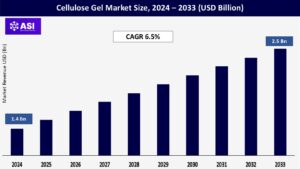
The global Cellulose Gel Market size was valued at approximately USD 1.4 billion in 2024 and is projected to reach USD 2.5 billion by 2033, growing at a CAGR of 6.5% during the forecast period.
Cellulose gel (microcrystalline cellulose) is a purified, partially depolymerized cellulose widely used as a functional ingredient in food, pharmaceuticals, cosmetics, and industrial formulations due to its water-binding, thickening, stabilizing, and fat-replacement properties.
Growth is driven by rising demand for low-fat and clean-label foods, increasing use in tablet formulations as a binder and disintegrant, and expanding applications in eco-friendly industrial products.
Cellulose gel is extensively used as a fat replacer, texture modifier, and stabilizer in dairy products, sauces, dressings, bakery items, and beverages. With consumer demand shifting toward healthier, reduced-fat products without compromising taste or mouthfeel, food manufacturers are increasingly incorporating cellulose gel.
Its clean-label image, derived from plant-based raw materials, aligns with global trends in natural and sustainable food ingredients. Growth in convenience and ready-to-eat foods across Asia-Pacific and Latin America is further supporting market expansion.
Cellulose gel is essential to the pharmaceutical industry as a binder, disintegrant, and stabilizer in the production of tablets and capsules. It allows regulated drug release, improves flow characteristics, and hardens tablets.
The need for cellulose gel in oral solid dosage forms is rising as a result of the market expansion for generic medications, rising nutraceutical intake, and aging demographic trends.
The manufacture of cellulose gel is largely dependent on cotton linters and wood pulp. The supply of forestry products, pulp pricing, and energy costs can all have a big impact on the economics of production.
Stricter environmental laws controlling forestry operations may also have an impact on the availability of raw materials, which could cause supply chain interruptions and increased manufacturing costs.
Cellulose gel must meet strict quality and safety requirements, such as those set forth by the European Pharmacopoeia (EP), Japanese Pharmacopoeia (JP), U.S. Food and Drug Administration (FDA), European Food Safety Authority (EFSA), and the United States Pharmacopeia (USP), even though it is generally recognized as safe (GRAS) for use in food and pharmaceutical applications.
Manufacturers find it more difficult to comply with these requirements, especially when they are entering or growing into several regional markets.
| Report Metric | Details |
|---|---|
| Segmentations | |
| By Type |
Powder Granules |
| By Function |
Stabilizer and Thickener Substituting Fat |
| By Application |
Food & Beverage Pharmaceuticals Personal Care Industrial |
| Key Players |
|
| Geographies Covered | |
| North America |
U.S. |
| Europe |
U.K. |
| Asia Pacific |
China |
| Middle East & Africa |
Saudi Arabia |
| Latin America |
Brazil |
The Cellulose Gel Market is segmented by Type (Powder, Granules), By Function (Stabilizer and Thickener, Substituting Fat, ), By Application (Food & Beverage, Pharmaceuticals, Personal Care, Industrial).
Each factor plays a crucial role in enhancing patient safety, increasing the adoption of self-administered anticoagulant therapies, and supporting the development of more convenient, prefilled drug delivery systems that streamline treatment in the management of thromboembolic and cardiovascular conditions.
(Dominant Segment) Powder
Because of its extended shelf life, simplicity of blending, and adaptability, powdered cellulose gel has the biggest market share. It is highly favored in the food business for producing smooth textures in applications related to dairy, baking, and beverages.
It is an essential component for maintaining regular tablet hardness, disintegration, and stability in pharmaceuticals due to its consistent particle size and dependable performance.
Granules
Granular cellulose gel is becoming more and more popular on the market because of its better flowability, uniform dispersion, and decreased dusting. It works especially well for industrial formulations, dietary supplements, and powdered cosmetics, where exact formulation performance and regulated handling are crucial.
Stabilizer and Thickener (Dominant Segment)
The food, beverage, and cosmetics sectors mostly employ cellulose gel as a thickening and stabilizer. In dairy products, sauces, and dressings, it improves viscosity, inhibits syneresis, and helps form stable emulsions. Manufacturers use it because of its consistent performance and capacity to preserve texture throughout processing and storage.
Substituting Fat
Cellulose gel works well as a fat substitute in low-fat dairy, baked goods, and confections, adding a creamy texture while cutting calories. This feature preserves flavor and sensory appeal while satisfying the growing consumer desire for healthier food options.
Food & Beverage (Largest Market)
The food and beverage industry represents the largest application segment, with key uses in dairy products (yogurts, ice creams), bakery fillings, sauces, and plant-based alternatives. Growing consumer interest in vegan, clean-label, and reduced-fat products is a significant driver of demand.
Pharmaceuticals
Extensively utilized in tablets, capsules, and oral suspensions as a binding agent, stabilizer, and dissolution enhancer, improving both product stability and bioavailability.
Personal Care
Functions as a stabilizer, texture enhancer, and thickening agent in creams, lotions, toothpaste, and cosmetic powders, supporting the development of premium and multifunctional formulations.
Industrial
Applied in paints, adhesives, filtration aids, and eco-friendly cleaning products, benefiting from increasing adoption of sustainable and high-performance materials.
Asia-Pacific dominates both production and consumption, led by China and India with robust food processing, pharmaceutical manufacturing, and cosmetics sectors. Rising disposable incomes, urbanization, and changing dietary patterns are accelerating demand, particularly in plant-based and fortified products.
A mature yet innovation-driven market, characterized by the adoption of clean-label food additives and the expansion of nutraceutical and dietary supplement applications. The U.S. remains the largest contributor, supported by advanced R&D capabilities and strong consumer awareness.
Stringent food safety standards and regulatory support for natural, clean-label ingredients make Europe a key growth region. Major markets such as Germany, France, and the UK are focusing on sustainable sourcing and premium-quality products.
Experiencing moderate but steady growth due to the expansion of processed food manufacturing, rising health consciousness, and increasing penetration of pharmaceuticals and personal care products.
The global Cellulose Gel market size was valued at USD 1.4 billion in 2024.
The global Cellulose Gel market is projected at a CAGR of Approximately 6.5%
Powder form in Food & Beverage applications
Asia-Pacific, driven by strong food, pharma, and cosmetics sectors
1.1 Summary
1.2 Research methodology
2.1 Research Objectives
2.2 Market Definition
2.3 Limitations & Assumptions
2.4 Market Scope & Segmentation
2.5 Currency & Pricing Considered
3.1 Drivers
3.2 Geopolitical Impact
3.3 Human Factors
3.4 Technology Factors
4.1 Porters Five Forces Analysis
4.2 Value Chain Analysis
4.3 Average Pricing Analysis
4.4 M & A, Agreements & Collaboration Analysis
5.1 Cellulose Gel Market, By Type
5.1.1 Introduction
5.1.2 Market Size & Forecast
5.2 Cellulose Gel Market, By Function
5.3 Cellulose Gel Market, By Application
6.1 North America Cellulose Gel Market , By Country
6.1.1 Cellulose Gel Market, By Type
6.1.2 Cellulose Gel Market, By Function
6.1.3 Cellulose Gel Market, By Application
6.2 U.S.
6.2.1 Cellulose Gel Market, By Type
6.2.2 Cellulose Gel Market, By Function
6.2.3 Cellulose Gel Market, By Application
6.3 Canada
7.1 U.K.
7.2 Germany
7.3 France
7.4 Spain
7.5 Italy
7.6 Russia
7.7 Nordic
7.8 Benelux
7.9 The Rest of Europe
8.1 China
8.2 South Korea
8.3 Japan
8.4 India
8.5 Australia
8.6 Taiwan
8.7 South East Asia
8.8 The Rest of Asia-Pacific
9.1 UAE
9.2 Turkey
9.3 Saudi Arabia
9.4 South Africa
9.5 Egypt
9.6 Nigeria
9.7 Rest of MEA
10.1 Brazil
10.2 Mexico
10.3 Argentina
10.4 Chile
10.5 Colombia
10.6 Rest of Latin America
11.1 Global Market Share (%) By Players
11.2 Market Ranking By Revenue for Players
11.3 Competitive Dashboard
11.4 Product Mapping