

Calcium Lactate Market
Calcium Lactate Market & Trends Analysis Report, By Grade (Powder, Granules), By Application (Beverages & Food, Pharmaceuticals, Nutraceuticals, Animal Feed) – Industry Analysis Report, Regional Outlook, Growth Potential, Price Trends, Competitive Market Share & Forecast, 2025–2033.

Historical Period: 2019-2024
Forecast Period: 2025-2033
Report Code :
CAGR: 5.6%
Last Updated : March 27, 2026
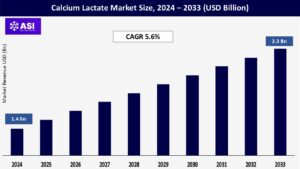
The global Calcium Lactate Market size was valued at approximately USD 1.4 billion in 2024 and is projected to reach USD 2.3 billion by 2033, growing at a CAGR of 5.6% during the forecast period.
Calcium lactate is a white crystalline salt produced by the reaction of lactic acid with calcium carbonate or calcium hydroxide. It is widely used as a calcium fortifier, food additive, acidity regulator, and in pharmaceutical preparations.
Growth is primarily driven by the rising demand for fortified foods and beverages, increased prevalence of calcium deficiency-related conditions, expanding nutraceutical consumption, and growing applications in food preservation and pharmaceutical excipients.
Because of its great stability in a variety of formulations, neutral taste, and high bioavailability, calcium lactate is becoming a more popular calcium source for food fortification. To alleviate calcium deficits, it is frequently added to dairy, confections, beverages, and baked goods.
Significant market demand is being driven by government-led micronutrient fortification initiatives and the global shift toward preventative healthcare. Rapid urbanization, changing dietary patterns, and increased consumption of packaged fortified foods are all contributing factors to the growing acceleration in emerging markets including Asia-Pacific and Latin America.
Calcium lactate is used in pharmaceuticals as a dietary supplement to prevent and treat hypocalcemia, osteoporosis, and other conditions affecting the bones. Because of its ability to bind and disintegrate, it is frequently utilized as an excipient in tablet formulations.
Demand is being driven, especially in North America and Europe, by the increased prevalence of bone health problems, aging populations, greater health consciousness, and the expanding use of over-the-counter nutritional supplements.
Lactic acid and calcium supplies are necessary for the synthesis of calcium lactate, and both are impacted by changes in the cost of chemical and agricultural feedstocks.
Weather, crop yields, and energy costs are just a few examples of the variables that can have a big impact on the cost of producing lactic acid and, consequently, on manufacturers’ overall profit margins.
Although calcium lactate is classified as generally recognized as safe (GRAS), producers are still subject to stringent purity, safety, and labeling requirements that are enforced by organizations like the Food Safety and Standards Authority of India (FSSAI), the European Food Safety Authority (EFSA), and the U.S. Food and Drug Administration (FDA).
For pharmaceutical-grade and infant nourishment applications, these compliance standards are very stringent, which frequently results in higher production costs, more paperwork, and lengthier product approval periods.
| Report Metric | Details |
|---|---|
| Segmentations | |
| By Grade |
Powder Granules |
| By Application |
Beverages & Food Pharmaceuticals Nutraceuticals Animal Feed |
| Key Players |
|
| Geographies Covered | |
| North America |
U.S. |
| Europe |
U.K. |
| Asia Pacific |
China |
| Middle East & Africa |
Saudi Arabia |
| Latin America |
Brazil |
The Calcium Lactate Market is segmented by Grade (Powder, Granules), By Application (Beverages & Food, Pharmaceuticals, Nutraceuticals, Animal Feed).
Each factor plays a crucial role in enhancing patient safety, increasing the adoption of self-administered anticoagulant therapies, and supporting the development of more convenient, prefilled drug delivery systems that streamline treatment in the management of thromboembolic and cardiovascular conditions.
(Dominant Segment) Powder
Because it is so simple to include into food, beverage, and pharmaceutical formulations, powdered calcium lactate has the biggest market share. Because of its superior stability, high solubility, and accurate dosing, it is the go-to option for nutritional supplement production and fortification projects.
Granules
Granular calcium lactate is becoming more and more popular, especially in applications that call for regulated dissolution rates, such as the creation of tablets and animal feed. It is becoming more and more appealing for industrial applications due to its improved flowability, decreased dusting, and simplicity of use in premixed formulations.
Beverages & Food (Dominant Segment)
For calcium fortification, calcium lactate is often used in dairy, confections, beverages, and baked goods. It is the perfect option for increasing nutritional value without compromising product quality because of its neutral flavor, high bioavailability, and stability. Segment expansion is being driven by supporting government policies and rising consumer demand for fortified packaged foods.
Pharmaceuticals
Calcium lactate is used as a dietary supplement in the pharmaceutical industry to treat and prevent hypocalcemia, osteoporosis, and other disorders affecting the bones. In tablet formulations, it also acts as an excipient, providing advantages for binding and disintegration.
Nutraceuticals
As calcium lactate is used more often in functional meals, nutritional supplements, and health beverages to promote bone strength and general wellness, the nutraceutical market is expanding steadily.
Animal Feed
Calcium lactate is used in animal feed to promote bone development, improve eggshell quality in poultry, and enhance overall livestock health. Its bioavailable calcium content supports optimal growth and productivity in farm animals.
Asia-Pacific dominates the global calcium lactate market in both production and consumption, supported by robust food processing, nutraceutical, and pharmaceutical industries.
China and India are the leading markets, driven by rising middle-class incomes, government-led fortification initiatives, and rapid expansion of the dairy and beverage sectors. Urbanization and changing dietary patterns further fuel demand for fortified foods and supplements in the region.
In North America, market growth is fueled by strong demand for fortified foods, high dietary supplement consumption, and a well-established pharmaceutical industry. The U.S. leads the regional market, supported by high consumer awareness of calcium’s health benefits and widespread availability of fortified and functional products.
The European market remains mature but stable, with demand sustained by strict nutritional labeling regulations and strong consumer preference for clean-label, fortified products.
Opportunities lie in premium fortified foods, sports nutrition, and functional beverages, particularly in markets such as Germany, France, and the U.K.
In Latin America and the Middle East, growing nutritional awareness, expanding healthcare infrastructure, and government initiatives to combat micronutrient deficiencies are driving adoption. However, the markets face challenges such as price sensitivity and comparatively lower consumer awareness than in developed regions.
The market size of Calcium Lactate in 2024 was USD 1.4 billion.
The projected CAGR of the Calcium Lactate market is 5.6%
Powder form in the Food & Beverages application
Asia-Pacific, driven by fortification programs and strong demand in food and pharma sectors
1.1 Summary
1.2 Research methodology
2.1 Research Objectives
2.2 Market Definition
2.3 Limitations & Assumptions
2.4 Market Scope & Segmentation
2.5 Currency & Pricing Considered
3.1 Drivers
3.2 Geopolitical Impact
3.3 Human Factors
3.4 Technology Factors
4.1 Porters Five Forces Analysis
4.2 Value Chain Analysis
4.3 Average Pricing Analysis
4.4 M & A, Agreements & Collaboration Analysis
5.1 Calcium Lactate Market, By Grade
5.1.1 Introduction
5.1.2 Market Size & Forecast
5.2 Calcium Lactate Market, By Application
6.1 North America Calcium Lactate Market , By Country
6.1.1 Calcium Lactate Market, By Grade
6.1.2 Calcium Lactate Market, By Application
6.2 U.S.
6.2.1 Calcium Lactate Market, By Grade
6.2.2 Calcium Lactate Market, By Application
6.3 Canada
7.1 U.K.
7.2 Germany
7.3 France
7.4 Spain
7.5 Italy
7.6 Russia
7.7 Nordic
7.8 Benelux
7.9 The Rest of Europe
8.1 China
8.2 South Korea
8.3 Japan
8.4 India
8.5 Australia
8.6 Taiwan
8.7 South East Asia
8.8 The Rest of Asia-Pacific
9.1 UAE
9.2 Turkey
9.3 Saudi Arabia
9.4 South Africa
9.5 Egypt
9.6 Nigeria
9.7 Rest of MEA
10.1 Brazil
10.2 Mexico
10.3 Argentina
10.4 Chile
10.5 Colombia
10.6 Rest of Latin America
11.1 Global Market Share (%) By Players
11.2 Market Ranking By Revenue for Players
11.3 Competitive Dashboard
11.4 Product Mapping