

Basalt Fiber Market
Basalt Fiber Market & Trends Analysis Report, By Form (Continuous Fiber of Basalt, Basalt Fiber Discrete), By Application (Building, Transportation & Automobiles, Wind Power, Defense & Aerospace, Marine and Others), By End User (Residential, Commercial, Industrial)– Industry Analysis Report, Regional Outlook, Growth Potential, Price Trends, Competitive Market Share & Forecast, 2025–2033.

Historical Period: 2019-2024
Forecast Period: 2025-2033
Report Code :
CAGR: 8.2%
Last Updated : March 27, 2026
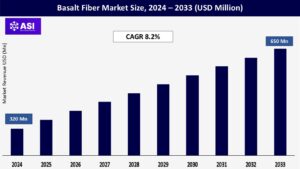
The global Basalt Fiber Market size was valued at approximately USD 320 million in 2024 and is projected to reach USD 650 million by 2033, growing at a CAGR of 8.2% during the forecast period.
Basalt fiber, derived from volcanic rock, is an advanced material known for its high strength, thermal stability, corrosion resistance, and eco-friendliness. It is increasingly replacing traditional fibers such as glass and carbon in applications spanning construction, automotive, aerospace, wind energy, and defense. Rising demand for lightweight, sustainable, and cost-efficient reinforcement materials is fueling global adoption.
Basalt fibers are being used more and more in sectors including wind energy, automotive, and aerospace to improve structural strength, lower emissions, and increase fuel efficiency.
The trend toward basalt-based composites as an alternative to conventional materials like steel and glass fibers is being accelerated by the increased focus on sustainability and performance.
Because of their exceptional thermal stability, long-term durability, and resistance to corrosion, basalt rebar, meshes, and composites are becoming increasingly popular in the construction sector.
In order to guarantee longevity and reduce lifecycle costs, basalt solutions are being used more and more in infrastructure projects, particularly in the areas of highways, bridges, and coastal structures.
High energy input and specialized equipment are required for the sophisticated melting and fiber-forming processes employed in the production of basalt fiber, which dramatically raises production costs.
Because of this, basalt fibers continue to be more costly than substitutes like glass fibers, which reduces their ability to compete in markets where consumers are price-conscious.
Despite the fact that basalt fibers have several material benefits, poor market awareness and the lack of standardized testing and certification procedures in some areas are preventing their widespread use. End users become uncertain as a result of this lack of standardization, which hinders wider market penetration.
| Report Metric | Details |
|---|---|
| Segmentations | |
| By Form |
Continuous Fiber of Basalt Basalt Fiber Discrete |
| By Application |
Building Transportation & Automobiles Wind Power Defense & Aerospace Marine and Others |
| By End-User |
Residential Commercial Industrial |
| Key Players |
|
| Geographies Covered | |
| North America |
U.S. |
| Europe |
U.K. |
| Asia Pacific |
China |
| Middle East & Africa |
Saudi Arabia |
| Latin America |
Brazil |
The Basalt Fiber Market is segmented by Form (Continuous Fiber of Basalt, Basalt Fiber Discrete), By Application (Building, Transportation & Automobiles, Wind Power, Defense & Aerospace, Marine and Others), By End User (Residential, Commercial, Industrial).
Each factor plays a crucial role in enhancing patient safety, increasing the adoption of self-administered anticoagulant therapies, and supporting the development of more convenient, prefilled drug delivery systems that streamline treatment in the management of thromboembolic and cardiovascular conditions.
Continuous Fiber of Basalt (Largest Section)
Because continuous basalt fiber is widely used in reinforcement composites in the automotive, aerospace, and construction industries, it commands the largest market share. It is the perfect substitute for conventional reinforcement materials due to its exceptional strength, resilience to heat and chemical stress, and longevity.
Basalt Fiber Discrete
In applications including fireproofing, thermal insulation, and concrete reinforcement, discrete basalt fiber is becoming more and more popular. Adoption is being fueled by its capacity to increase energy efficiency, fire safety, and crack resistance, especially in industrial and infrastructural applications.
Building (Largest Section)
With extensive use in rebars, meshes, sheets, and concrete reinforcement, construction is the major application field for basalt fibers. The material is ideal for bridges, highways, tunnels, and coastal infrastructure because of its resistance to corrosion, durability, and thermal stability.
Transportation & Automobiles
Manufacturers can lower car weight without sacrificing strength and safety by using basalt fibers in body panels, brake pads, and structural reinforcements. This backs the industry’s drive for reduced emissions and fuel efficiency.
Wind Power
Because of their high fatigue resistance, extended service life, and capacity to tolerate challenging operating circumstances, basalt fibers are being used more and more in the wind energy industry to manufacture turbine blades.
Defense & Aerospace
The lightweight and high-strength properties of basalt composites make them attractive for aircraft components, interior structures, and protective armor. Additionally, their ability to withstand heat improves performance in challenging settings.
Marine and Others
In applications where resistance to fire, heat stress, and saltwater corrosion is essential, such as shipbuilding, pipelines, and high-temperature machinery, basalt fibers are utilized. The expansion of this market is further aided by niche uses in industrial textiles and sports equipment.
Residential
In the residential sector, basalt fibers are used for DIY applications and housing construction, particularly in concrete reinforcement, insulation, and fireproofing solutions. Their durability and eco-friendly properties make them appealing for sustainable housing projects.
Commercial
The commercial segment covers infrastructure development, retail complexes, and facility construction, where basalt rebar, meshes, and composites enhance structural strength, longevity, and resistance to environmental stress.
Industrial (Largest Segment)
The industrial sector dominates the market, with applications in maintenance, repair, and operations (MRO), utilities, aerospace, automotive, wind energy, and broader manufacturing industries. Demand is driven by basalt’s lightweight, high-performance, and cost-saving benefits in critical operations and heavy-duty infrastructure.
Asia–Pacific leads the basalt fiber market, driven by large-scale infrastructure projects, wind energy expansion, and growing automotive production in countries such as China, India, and Japan. Rising government investments in renewable energy and sustainable construction further strengthen regional demand.
North America shows strong adoption of basalt fibers in aerospace, defense, and automotive industries, supported by the region’s emphasis on lightweight, fuel-efficient, and high-performance materials. The U.S. remains the largest contributor, with increasing interest in advanced composites.
Europe’s basalt fiber market is shaped by stringent sustainability regulations and a strong push for eco-friendly materials in construction, automotive, and renewable energy sectors. Countries like Germany, France, and the UK are key drivers due to their renewable initiatives and automotive innovation.
These regions are witnessing emerging demand fueled by urbanization, infrastructure development, and new wind energy installations. However, adoption is somewhat limited due to higher production costs and lower awareness compared to more developed markets. Long-term growth is expected as infrastructure investments rise.
The market size of Basalt Fiber market is USD 320 million.
The projected CAGR of Basalt Fiber market is 8.2%
The Continuous Basalt Fiber dominates the market.
The Asia–Pacific region shows the highest potential.
The leading companies are Yara International, Haifa Group, Sasol Chemicals, URALCHEM, GFS Chemicals.
1.1 Summary
1.2 Research methodology
2.1 Research Objectives
2.2 Market Definition
2.3 Limitations & Assumptions
2.4 Market Scope & Segmentation
2.5 Currency & Pricing Considered
3.1 Drivers
3.2 Geopolitical Impact
3.3 Human Factors
3.4 Technology Factors
4.1 Porters Five Forces Analysis
4.2 Value Chain Analysis
4.3 Average Pricing Analysis
4.4 M & A, Agreements & Collaboration Analysis
5.1 Basalt Fiber Market, By Form
5.1.1 Introduction
5.1.2 Market Size & Forecast
5.2 Basalt Fiber Market, By Application
5.3 Basalt Fiber Market, By End-User
6.1 North America Basalt Fiber Market , By Country
6.1.1 Basalt Fiber Market, By Form
6.1.2 Basalt Fiber Market, By Application
6.1.3 Basalt Fiber Market, By End-User
6.2 U.S.
6.2.1 Basalt Fiber Market, By Form
6.2.2 Basalt Fiber Market, By Application
6.2.3 Basalt Fiber Market, By End-User
6.3 Canada
7.1 U.K.
7.2 Germany
7.3 France
7.4 Spain
7.5 Italy
7.6 Russia
7.7 Nordic
7.8 Benelux
7.9 The Rest of Europe
8.1 China
8.2 South Korea
8.3 Japan
8.4 India
8.5 Australia
8.6 Taiwan
8.7 South East Asia
8.8 The Rest of Asia-Pacific
9.1 UAE
9.2 Turkey
9.3 Saudi Arabia
9.4 South Africa
9.5 Egypt
9.6 Nigeria
9.7 Rest of MEA
10.1 Brazil
10.2 Mexico
10.3 Argentina
10.4 Chile
10.5 Colombia
10.6 Rest of Latin America
11.1 Global Market Share (%) By Players
11.2 Market Ranking By Revenue for Players
11.3 Competitive Dashboard
11.4 Product Mapping