

Actuators Market
Actuators Market Size, Share & Trends Analysis Report By Type (Pneumatic Actuators,, Electrical Actuators) End-Use (Oil and Gas, Automotive, Electronics) Analysis Report, Regional Outlook, Growth Potential, Price Trends, Competitive Market Share & Forecast, 2025–2033.

Historical Period: 2019-2024
Forecast Period: 2025-2033
Report Code :
CAGR: 7.90%
Last Updated : August 31, 2026
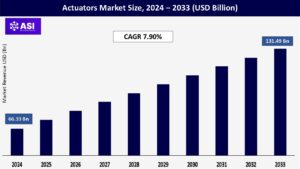
The Actuators Market size was valued at USD 66.33 billion in 2024 and is projected to reach a value from USD 71.57 billion in 2025 to USD 131.49 billion by 2033, registering a CAGR of 7.90% during the forecast period (2025-2033).
An actuator is a mechanical device responsible for converting energy into motion. With the help of input energy that is generated by electricity, air, or liquid, actuators apply a force to move an object. Types of actuators include hydraulic, pneumatic, electrical, thermal, and mechanical. Actuators make use of an energy source and a control signal.
Automation is becoming more prevalent due to advancements in robotics, A.I., and machine learning. The automotive, manufacturing, agricultural, food, transportation, and medical industries employ actuators to automate various systems and processes.
Actuators are a crucial component of all actuation systems. Through the projected period, the market expansion is anticipated to be driven by increased industrial automation. Another reason for the rise in industrial automation is the growing population. Another reason driving up demand for industrial automation is the expanding global population.
Manufacturers automated the process that led to the mass production of goods to meet the wants of the growing population. In addition, the growing employment of industrial robots in mechanized sectors is anticipated to accelerate market growth by reducing human error and speeding up production.
Actuators are employed in many aspects of an airplane, including the landing gear, flight controls, seats, doors, and more. As a result, the demand for aircraft will increase as new products become available. The demand for air travel has recently surged due to the enormous economic expansion in developing nations and growing economies like China, Africa, and India.
There is a need to expand the fleet of airplanes because of the increased air passenger traffic. This demand has caused a rise in commercial aircraft deliveries, which is expected to fuel the market’s expansion.
Due to the fluids they contain, hydraulic actuators are challenging to install. It has substantial installation costs, mainly when installed for industrial lines. The market’s expansion is anticipated to be hampered by this. The pneumatic and hydraulic actuation systems use air and a fluid medium, such as oil or water, respectively, to produce the desired output.
Oil or water leaks harm products, reduce their effectiveness and raise maintenance costs, which hurts the market. The many actuators used in a wide range of applications have problems. Efficiency is compromised in the case of hydraulic linear actuators due to fluid leakage, which causes problems with cleanliness.
As a result, the market share growth of actuators is hampered by key damage reasons such as continuous seal wear, improper assembly or maintenance, dangers related to steam valves, and decreased quality.
| Report Metric | Details |
|---|---|
| Segmentations | |
| By Type |
Pneumatic Acuators Electric Acuators |
| By End-Use Type |
Oil & Gas Automotive Aerospace & Defence Manufacturing |
| Key Players |
|
| Geographies Covered | |
| North America |
U.S. |
| Europe |
U.K. |
| Asia Pacific |
China |
| Middle East & Africa |
Saudi Arabia |
| Latin America |
Brazil |
The Electric Actuators segment is expected to witness a significant growth rate at a CAGR of 8.93% during the forecast period. Electric actuators are used extensively in automobile applications due to their high speed. At high speeds, electrical actuators provide increased control and acceleration.
The force used to provide thrust can be programmed without the use of compressed air or the associated infrastructure, and these actuators consume very little energy overall. are readily available and most widely used since they do not use oil-compressed air, which reduces the need for extra machinery.
These actuators are powered by electrical energy and use a powerful motor to convert the electrical energy into an actuating force. These actuators are preferred in electrically motorized equipment used for excavation and construction.
Pneumatic actuators segment dominated with a market share of over 32% in 2024, due to prevalent simplicity, cost-effectiveness, and wide installation across industrial automation, manufacturing, and process industries. They are driven by compressed air, which further ensures their durability in environments that require fast response times and constant performance.
The design of these actuators enables quick linear or rotary motion, making them suitable for repetitive tasks in assembly lines and automation systems. Pneumatic actuators are also preferred in environments with hazardous or explosive conditions, where electrical devices may create safety challenges.
The comprehensive market uptake of noise loggers among end-use industries is further driven by their minimal maintenance requirements and compatibility with harsh working conditions, which is integral to the segment being the key component in the market.
The automotive segment dominated with a market share of over 34% in 2024, due to the increasing demand for automation and enhanced vehicle functionality. owing to the rising demand for automation and enhanced functionality in vehicles.
The actuators help provide better comfort and amenities for the drivers in different automotive systems, such as power windows, adjustable seats, and climate control (HVAC) systems. The recent surge of the electric vehicles (EV) market and technological advantages in autonomy have even fast-tracked the integration of smart, high-precision actuators for enhanced control and ability.
The oil and gas sector is undergoing a remarkable change and the United States and on course to lead the global trade of oil and gas in the coming years. With the increase in research and development in the shale gas sector in the U.S., the demand for actuators is projected to witness considerable growth in the coming years.
Inter-governmental treaties such as the TAPI(Turkmenistan–Afghanistan–Pakistan–India) pipeline project, also known as the Trans-Afghanistan Pipeline, will carry 33 billion cubic meters of natural gas to the said countries, which will propel the demand for actuators that are used to control the flow processes in the oil and gas industry.
Furthermore, investments from countries like Saudi Arabia drive actuators’ market growth. For instance, Saudi Arabia’s Aramco plans to invest around USD 110 Billion in the Jafurah gas field.
The aerospace and defense sectors have also played a crucial role in driving the demand for high-performance actuators. With increasing investments in military modernization and commercial aircraft production, the market has seen a surge in demand for precision control systems.
Statistics Canada reported that the country’s aerospace product and parts manufacturing industry generated USD 21.2 Billion in revenue in 2021, underlining the sector’s significant contribution to the actuator market.
Aerospace & defense segment anticipated to witness remarkable growth owing to the growing aircraft deliveries. Moreover, rising adoption modern warfare technologies, increasing procurement of next generation weapons drive the growth of the market.
Manufacturing plays a crucial role in driving the demand for actuators as automation continues to evolve in production processes. In the oil and gas sector, the adoption of actuators enhances process control and safety, reflecting their importance in critical applications.
The Asia Pacific region has dominated the market with a 47.9 % share in 2024. The actuators market is continuously showing northward direction growth, thanks to the growing adoption of the product in China, India, South Korea, Japan, Taiwan, and the rest of the Asia Pacific region Industry in the Asia Pacific is continually upgrading its capabilities, necessitating machinery with new and novel actuators.
In order to gain a tactical advantage in the field of robotics and process automation, China and Japan are investing extensively in robotics and automation. In addition, in growing economies like India and China, the Internet of Things (IoT) has gotten a lot of attention. This includes the creation of smart cities and IoT-specific centers of excellence, all of which are expected to drive demand for actuators at the same time.
Europe is anticipated to exhibit a CAGR of 5.7% over the forecast period. In every industry, Europe tends to accept new and improved technologies. Due to numerous automotive sectors, the actuator market is vast and developed throughout Europe. In addition, Germany has the largest market share in Europe, followed by France.
Due to increased investment in the food and beverage and power generation industries, the actuator market in the European region is anticipated to expand at a modest rate during the projected period. Additionally, the market for actuators is expected to rise due to the region’s focus on electrifying automotive components and significant growth in the luxury car category.
The North America region dominated with a market share of over 42% in 2024, primarily due to its robust industrial base, including sectors like automation, aerospace, and automotive.
The United States and Canada are prominent contributors, with considerable demand for actuators in various sectors, including manufacturing, robotics, and defense. In the industrial automation industry, actuators are critical in controlling mechanical systems, which improves efficiency and reduces labor costs.
The aerospace industry also depends on actuators for aircraft control systems, while the automotive sector employs them in automobile control systems, electric vehicle systems, and in autonomous driving technology. The North America region retains its standing as the largest market and a key innovator of actuators across all industries, buoyed by ongoing technological developments.
The actuators market is expected to grow CAGR of 7.90 % from 2025 to 2033.
The current actuators market size is USD 66.33 Billions in 2024.
The Asia Pacific currently holds the largest market share of the actuators.
Top industry players in actuators market are Johnson Controls International plc, Assured Automation, Honeywell International Inc., Micromatic LLC, Cair Euromatic Automation Pvt Ltd, Cameron International Corporation, Festo AG and Co. KG, Rotork, Flowserve Corporation, General Electric, Schlumberger Limited, Emerson Electric Co., Auma Riester GmbH and Co.
1.1 Summary
1.2 Research methodology
2.1 Research Objectives
2.2 Market Definition
2.3 Limitations & Assumptions
2.4 Market Scope & Segmentation
2.5 Currency & Pricing Considered
3.1 Drivers
3.2 Geopolitical Impact
3.3 Human Factors
3.4 Technology Factors
4.1 Porters Five Forces Analysis
4.2 Value Chain Analysis
4.3 Average Pricing Analysis
4.4 M & A, Agreements & Collaboration Analysis
5.1 Actuators Market, By Type
5.1.1 Introduction
5.1.2 Market Size & Forecast
5.2 Actuators Market, By End-Use Type
6.1 North America Actuators Market, By Country
6.1.1 Actuators Market, By Type
6.1.2 Actuators Market, By End-Use Type
6.2.1 Actuators Market, By Type
6.2.2 Actuators Market, By End-Use Type
6.3 Canada
7.1 U.K.
7.2 Germany
7.3 France
7.4 Spain
7.5 Italy
7.6 Russia
7.7 Nordic
7.8 Benelux
7.9 The Rest of Europe
8.1 China
8.2 South Korea
8.3 Japan
8.4 India
8.5 Australia
8.6 Taiwan
8.7 South East Asia
8.8 The Rest of Asia-Pacific
9.1 UAE
9.2 Turkey
9.3 Saudi Arabia
9.4 South Africa
9.5 Egypt
9.6 Nigeria
9.7 Rest of MEA
10.1 Brazil
10.2 Mexico
10.3 Argentina
10.4 Chile
10.5 Colombia
10.6 Rest of Latin America
11.1 Global Market Share (%) By Players
11.2 Market Ranking By Revenue for Players
11.3 Competitive Dashboard
11.4 Product Mapping