

Aerosol Paint Market
Aerosol Paint Market Share & Trends Analysis Report, By Resin Type (Dominant acrylic, Alkyd, Epoxy, Others), By Application (Transportation & Automobiles, DIY & Home Decor), By End Use (Residential, Commercial, Industrial), By Channel of Distribution (Retail Offline, Online)– Industry Analysis Report, Regional Outlook, Growth Potential, Price Trends, Competitive Market Share & Forecast, 2025–2033.

Historical Period: 2019-2024
Forecast Period: 2025-2033
Report Code :
CAGR: 5.1%
Last Updated : March 27, 2026
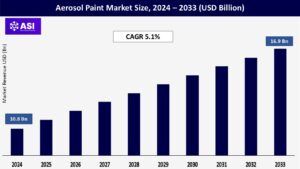
The global Aerosol Paint Market size was valued at ~USD 10.8 billion in 2024 and is projected to reach ~USD 16.9 billion by 2033, growing at a CAGR of ~5.1% during 2025–2033.
Aerosol paints (spray paints) offer convenience, portability, fast drying, and even coating, making them popular across automotive touch-ups, DIY/home décor, and industrial MRO (maintenance, repair & operations).
DIY projects are growing as a result of urban living, increased disposable incomes, and social media influence. Because of its convenience and adaptability, consumers are using aerosol paints more frequently as they work on minor décor tasks, upcycle furniture, and create creative crafts.
The automotive aftermarket is growing as a result of the expansion of the global automobile parc and the increased demand for used car restoration. Because of its affordability, convenience of use, and capacity to improve vehicle appearance, touch-up, detailing, and protection aerosol coatings are becoming more and more popular.
The market for aerosol paint is changing as a result of strict laws governing propellant use and VOC emissions in North America and Europe. Manufacturers are compelled to adopt water-based and environmentally friendly formulations due to compliance regulations, which also raise manufacturing costs and limit the use of some conventional chemistries.
Managing pressurized cans at the end of their useful lives presents many difficulties. Because aerosol containers need special handling to avoid risks, consumers and municipalities frequently struggle with safe disposal and recycling. This complicates garbage management systems and raises sustainability issues.
| Report Metric | Details |
|---|---|
| Segmentations | |
| By Resin Type |
Dominant acrylic Alkyd Epoxy Others |
| By Application |
Transportation & Automobiles DIY & Home Decor |
| By End Use |
Residential Commercial Industrial |
| By Channel of Distribution |
Retail Offline Online |
| Key Players |
|
| Geographies Covered | |
| North America |
U.S. |
| Europe |
U.K. |
| Asia Pacific |
China |
| Middle East & Africa |
Saudi Arabia |
| Latin America |
Brazil |
Aerosol Paint Market is segmented by Resin Type (Dominant acrylic, Alkyd, Epoxy, Others), By Application (Transportation & Automobiles, DIY & Home Decor), By End Use (Residential, Commercial, Industrial), By Channel of Distribution (Retail Offline, Online).
Each factor plays a crucial role in enhancing patient safety, increasing the adoption of self-administered anticoagulant therapies, and supporting the development of more convenient, prefilled drug delivery systems that streamline treatment in the management of thromboembolic and cardiovascular conditions.
Dominant acrylic
Aerosol paints based on acrylic have the biggest market share because of their exceptional color retention, UV resistance, and quick drying times. When aesthetics and usability are important, they are the go-to option for do-it-yourself décor, crafts, and automobile touch-up applications.
Alkyd
Alkyd resins are prized for their robust durability and excellent adherence, particularly on wood and metal surfaces. Because of their durability and resilience to weather, they are frequently utilized in protective coatings, industrial coatings, and outdoor furniture.
Epoxy
Epoxy-based aerosols provide excellent chemical resistance, hardness, and abrasion tolerance. Though a smaller segment, they are gaining traction in heavy-duty maintenance, marking, and industrial refurbishing applications.
Others (Polyurethane, Vinyl, Specialty Blends)
This segment includes polyurethane, vinyl, and tailored specialty blends. These resins are often used in clear coats, heat-resistant finishes, and performance-driven coatings designed for niche applications such as automotive refinishing, high-temperature machinery, and protective barriers.
Transportation & Automobiles (Largest)
Aerosol paints are most commonly used in the automotive industry. Body touch-ups, wheel and rim refinishing, underbody anti-rust coatings, and protective or ornamental treatments on accessories are some of its primary applications. The growing global vehicle parc, increased demand for used car restoration, and customer desire for simple maintenance solutions all contribute to growth.
DIY & Home Décor
Because of their simplicity and adaptability, aerosol paints are frequently used in creative and home remodeling tasks. Uses include interior accent projects, wall stenciling, creative crafts, furniture refurbishing, and appliance touch-ups. Use in this market is also being driven by social media trends and the expanding do-it-yourself mentality.
Residential
This group, which is driven by do-it-yourselfers and hobbyists, covers small-scale tasks like creative crafts, furniture restoration, appliance touch-ups, and home décor. Household adoption is being fueled by social media inspiration and growing urban lifestyles.
Commercial
Commercial covers the use of aerosol paints for facility maintenance, fast repairs, and aesthetic enhancements in retail, hotel, and institutional contexts. They are appealing for commercial maintenance requirements because to their simplicity of use and little downtime.
Industrial
include MRO (maintenance, repair, and operations) for infrastructure, utilities, and manufacturing facilities. Aerosol paints support efficiency in large-scale operations by being used for marking, corrosion prevention, equipment maintenance, and safety labeling.
Retail Offline (Dominant)
Aerosol paint is mostly sold through traditional retail channels like hardware stores, specialty paint stores, and big-box stores. For instant availability, product comparison, and in-store staff assistance, consumers prefer offline purchasing, especially for do-it-yourself and vehicle touch-up needs.
Online (Fastest Growing)
E-commerce platforms, such as third-party marketplaces and brand-owned direct-to-consumer channels, are expanding quickly. Adoption is being fueled by convenience, a greater selection of products, affordable prices, and doorstep delivery. Online sales growth is also being accelerated by social media-driven do-it-yourself trends and growing internet penetration.
APAC dominates the global aerosol paints market, supported by strong DIY uptake in advanced markets like Japan, South Korea, and Australia, alongside increasing small-job maintenance activities in Southeast Asia and India. A rapidly expanding automotive parc also fuels aftermarket demand for touch-up and protective coatings.
North America benefits from a mature DIY culture, widespread home improvement projects, and strong e-commerce penetration. However, stringent VOC regulations are shaping product innovation, driving demand for low-VOC and water-borne aerosol formulations.
The European market is influenced by high regulatory standards and a strong sustainability agenda. Manufacturers focus on premium finishes, eco-friendly formulations, and recyclability initiatives, with consumers showing strong preference for high-performance specialty coatings.
These emerging regions present growth opportunities driven by increasing urbanization, expanding vehicle ownership, and rising home improvement activities. However, market penetration is moderated by price sensitivity, limited awareness, and slower regulatory harmonization compared to developed markets.
The market was valued at USD 10.8 billion in 2024.
The market is projected to grow at a CAGR of 5.1% from 2025 to 2033.
Automotive & Transportation by application; Acrylic by resin; Gloss/Semi-gloss by finish; Offline retail by channel (with online growing fastest).
Rust-Oleum (RPM), Krylon (Sherwin-Williams), Nippon Paint, Asian Paints, Montana Colors, Kansai Paint, Samurai Paint, Bosny, and others.
DIY adoption, automotive refurbishment, specialty effects, and convenience of application.
1.1 Summary
1.2 Research methodology
2.1 Research Objectives
2.2 Market Definition
2.3 Limitations & Assumptions
2.4 Market Scope & Segmentation
2.5 Currency & Pricing Considered
3.1 Drivers
3.2 Geopolitical Impact
3.3 Human Factors
3.4 Technology Factors
4.1 Porters Five Forces Analysis
4.2 Value Chain Analysis
4.3 Average Pricing Analysis
4.4 M & A, Agreements & Collaboration Analysis
5.1 Aerosol Paint Market, By Resin Type
5.1.1 Introduction
5.1.2 Market Size & Forecast
5.2 Aerosol Paint Market, By Application
5.3 Aerosol Paint Market, By End Use
5.4 Aerosol Paint Market, By Channel of Distribution
6.1 North America Aerosol Paint Market, By Country
6.1.1 Aerosol Paint Market, By Resin Type
6.1.2 Aerosol Paint Market, By Application
6.1.3 Aerosol Paint Market, By End Use
6.1.4 Aerosol Paint Market, By Channel of Distribution
6.2 U.S.
6.2.1 Aerosol Paint Market, By Resin Type
6.2.2 Aerosol Paint Market, By Application
6.2.3 Aerosol Paint Market, By End Use
6.2.4 Aerosol Paint Market, By Channel of Distribution
6.3 Canada
7.1 U.K.
7.2 Germany
7.3 France
7.4 Spain
7.5 Italy
7.6 Russia
7.7 Nordic
7.8 Benelux
7.9 The Rest of Europe
8.1 China
8.2 South Korea
8.3 Japan
8.4 India
8.5 Australia
8.6 Taiwan
8.7 South East Asia
8.8 The Rest of Asia-Pacific
9.1 UAE
9.2 Turkey
9.3 Saudi Arabia
9.4 South Africa
9.5 Egypt
9.6 Nigeria
9.7 Rest of MEA
10.1 Brazil
10.2 Mexico
10.3 Argentina
10.4 Chile
10.5 Colombia
10.6 Rest of Latin America
11.1 Global Market Share (%) By Players
11.2 Market Ranking By Revenue for Players
11.3 Competitive Dashboard
11.4 Product Mapping