

Allergy Treatment Market
Allergy Treatment Market Share & Trends Analysis Report, By Treatment Type (Antihistamines, Corticosteroids, Leukotriene Receptor Antagonists, Immunotherapy, Decongestants, Others), By Allergy Type (Respiratory Allergies, Food Allergies, Skin Allergies, Drug Allergies, Insect Sting Allergies, Others), By Route of Administration (Oral, Nasal, Injection, Others), By End User (Hospitals, Clinics, Specialty Centers, Home Care), By Distribution Channel (Hospital Pharmacies, Retail Pharmacies, Online Pharmacies) Industry Analysis Report, Regional Outlook, Growth Potential, Price Trends, Competitive Market Share & Forecast, 2025–2033.

Historical Period: 2019-2024
Forecast Period: 2025-2033
Report Code :
CAGR: 6.20%
Last Updated : January 21, 2026
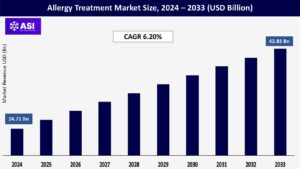
The global allergy treatment market size was valued at approximately USD 24.71 billion in 2024 and is projected to reach USD 42.83 billion by 2033, growing at a CAGR of 6.20% during the forecast period (2025–2033).
The Allergy Treatment Market refers to the segment of the pharmaceutical and healthcare industry dedicated to the development, production, and distribution of products and therapies aimed at managing and alleviating allergic conditions. Allergies occur when the immune system overreacts to substances such as pollen, dust mites, food, insect stings, or pet dander. Treatments in this market include antihistamines, corticosteroids, decongestants, leukotriene inhibitors, immunotherapy (such as allergy shots or sublingual tablets), and biologics targeting specific immune pathways. These therapies are used to reduce symptoms like sneezing, itching, runny nose, skin rashes, and asthma attacks. A key property of allergy treatments is their ability to modulate or suppress the immune system’s hypersensitive response, either by blocking histamine receptors or by gradually desensitizing the body to allergens. The market is driven by the rising prevalence of allergic diseases globally, increased awareness about allergy management, and advancements in targeted biologic therapies.
The increasing global incidence of allergic conditions such as asthma, allergic rhinitis, eczema, and food allergies is a major driver of the allergy treatment market. Urbanization, air pollution, climate change, and changing lifestyles have contributed to a significant rise in allergy cases, especially in children and the elderly.
According to organizations like the World Allergy Organization (WAO), hundreds of millions suffer from allergic rhinitis and asthma globally. This growing patient base has led to heightened demand for both over-the-counter (OTC) and prescription allergy treatments, pushing pharmaceutical companies to innovate and expand their allergy treatment portfolios.
The shift toward precision medicine has led to the development of targeted allergy therapies, including monoclonal antibodies like omalizumab (anti-IgE) and other biologics that provide more effective, long-term relief for severe allergic conditions such as chronic urticaria or asthma.
These advanced therapies offer benefits over traditional antihistamines by addressing the root cause of allergic reactions rather than just treating symptoms. Continued R&D in immunotherapy (such as sublingual tablets or allergy shots) is also fueling market growth, as these treatments aim to desensitize the immune system rather than simply suppress symptoms.
One major restraint in the allergy treatment market is the side effects and limited long-term efficacy of commonly used medications such as antihistamines, corticosteroids, and decongestants. While these treatments provide quick symptomatic relief, they often do not address the root cause of allergic conditions.
Long-term use of corticosteroids, for example, can lead to complications such as weight gain, high blood pressure, osteoporosis, and immune suppression. Similarly, sedative effects of first-generation antihistamines may reduce patient compliance. Moreover, many patients experience recurrence of symptoms after stopping treatment, highlighting the lack of a permanent cure.
These limitations can deter patients from continued use and prompt healthcare providers to be cautious, thereby slowing market expansion particularly in regions with limited access to advanced biologic therapies.
| Report Metric | Details |
|---|---|
| Segmentations | |
| By Treatment Type |
Antihistamines Corticosteroids Leukotriene Receptor Antagonists Immunotherapy Decongestants Others |
| By Allergy Type |
Respiratory Allergies Food Allergies Skin Allergies Drug Allergies Insect Sting Allergies Others |
| By Route of Administration |
Oral Nasal Injection Others |
| By End User |
Hospitals Clinics Specialty Centers Home Care |
| By Distribution Channel |
Hospital Pharmacies Retail Pharmacies Online Pharmacies |
| Key Players |
|
| Geographies Covered | |
| North America |
U.S. |
| Europe |
U.K. |
| Asia Pacific |
China |
| Middle East & Africa |
Saudi Arabia |
| Latin America |
Brazil |
The Allergy Treatment Market is segmented by Treatment Type, Allergy Type, Route of administration, Distribution Channels and End User.
Each factor plays a crucial role in enhancing patient quality of life, driving the adoption of targeted and personalized allergy treatments, and supporting the development of safer, more effective, and long-lasting therapeutic options for managing allergic rhinitis, asthma, eczema, and other hypersensitivity conditions.
The market includes various categories of medications that parallel immunoglobulin types in function, such as antihistamines, corticosteroids, decongestants, leukotriene receptor antagonists, and monoclonal antibodies (biologics like omalizumab targeting IgE), where IgE plays a particularly central role in allergic reactions.
Allergy treatments are categorized into over-the-counter (OTC) medications and prescription-based therapies, with growing adoption of immunotherapy options such as sublingual tablets (SLIT) and allergy shots (SCIT), which function similarly to intravenous and subcutaneous immunoglobulin treatments in administration and immune modulation.
The market serves a range of allergic conditions including allergic rhinitis, asthma, atopic dermatitis (eczema), urticaria, food allergies, and drug allergies—paralleling the use of immunoglobulins in autoimmune and inflammatory diseases.
Hospitals handle acute and severe allergic reactions requiring biologics or emergency interventions; clinics manage routine allergy care and immunotherapy; homecare settings are expanding, especially for SLIT and inhaler-based therapies; and other settings include allergy testing centers.
Allergy treatments are dispensed through hospital pharmacies for advanced or biologic-based therapies, retail pharmacies for OTC and general prescriptions, and increasingly through online pharmacies, which offer convenience and access to a wide range of allergy medications.
Each segment reflects the market’s growth potential, driven by rising allergic disease prevalence and a shift toward personalized and targeted therapies.
The market is the most developed and holds the largest share due to a high prevalence of allergic conditions such as asthma, allergic rhinitis, and food allergies.
The United States, in particular, benefits from advanced healthcare infrastructure, strong patient awareness, the availability of cutting-edge treatments like biologics, and favorable reimbursement systems, all of which contribute to widespread adoption of both over-the-counter and prescription allergy medications.
Follows closely behind, with countries like Germany, France, and the UK leading in allergy diagnostics and immunotherapy adoption. Universal healthcare systems, growing use of sublingual immunotherapy (SLIT), and increasing government support for allergy education have helped boost treatment access, although the market is somewhat limited by varying reimbursement policies and regulatory diversity across nations.
Region, the allergy treatment market is expanding rapidly, making it the fastest-growing globally. Urbanization, rising pollution levels, and changing lifestyles have contributed to a surge in allergy cases, particularly in countries like China, India, Japan, and South Korea.
Increasing healthcare spending, improved access to medical facilities, and a growing pharmaceutical industry support the market’s expansion, although challenges such as low rural awareness and limited access to biologic treatments remain.
Presents moderate growth potential, driven by rising urbanization, air pollution, and healthcare investment in countries such as Brazil, Mexico, and Argentina. However, disparities in healthcare infrastructure and access to advanced therapies limit widespread market penetration.
The allergy treatment market is gradually expanding, especially in GCC countries like Saudi Arabia and the UAE, where rising healthcare expenditure and the adoption of Western medical practices are boosting demand.
Nevertheless, large parts of the region face constraints such as limited allergy diagnostics, low awareness, and access to specialized treatments, particularly in rural and underdeveloped areas.
Overall, while developed regions dominate in terms of market size and advanced treatment availability, emerging regions are witnessing robust growth driven by demographic changes, rising allergic disease burden, and expanding healthcare infrastructure.
The allergy treatment market was valued at USD 24.71 billion in 2024.
The allergy treatment market is projected to grow at a CAGR of 6.20% from 2025 to 2033.
The Antihistamine hold the largest allergy treatment market share.
The North America region is expected to witness the highest growth rate.
Major players include Sanofi, GlaxoSmithKline plc (GSK) and Johnson & Johnson.
1.1 Summary
1.2 Research methodology
2.1 Research Objectives
2.2 Market Definition
2.3 Limitations & Assumptions
2.4 Market Scope & Segmentation
2.5 Currency & Pricing Considered
3.1 Drivers
3.2 Geopolitical Impact
3.3 Human Factors
3.4 Technology Factors
4.1 Porters Five Forces Analysis
4.2 Value Chain Analysis
4.3 Average Pricing Analysis
4.4 M & A, Agreements & Collaboration Analysis
5.1 Allergy Treatment Market, By Treatment Type
5.1.1 Introduction
5.1.2 Market Size & Forecast
5.2 Allergy Treatment Market, By Allergy Type
5.3 Allergy Treatment Market, By Route of Administration
5.4 Allergy Treatment Market, By End User
5.5 Allergy Treatment Market, By Distribution Channel
6.1 North America Allergy Treatment Market , By Country
6.1.1 Allergy Treatment Market, By Treatment Type
6.1.2 Allergy Treatment Market, By Allergy Type
6.1.3 Allergy Treatment Market, By Route of Administration
6.1.4 Allergy Treatment Market, By End User
6.1.5 Allergy Treatment Market, By Distribution Channel
6.2 U.S.
6.2.1 Allergy Treatment Market, By Treatment Type
6.2.2 Allergy Treatment Market, By Allergy Type
6.2.3 Allergy Treatment Market, By Route of Administration
6.2.4 Allergy Treatment Market, By End User
6.2.5 Allergy Treatment Market, By Distribution Channel
6.3 Canada
7.1 U.K.
7.2 Germany
7.3 France
7.4 Spain
7.5 Italy
7.6 Russia
7.7 Nordic
7.8 Benelux
7.9 The Rest of Europe
8.1 China
8.2 South Korea
8.3 Japan
8.4 India
8.5 Australia
8.6 Taiwan
8.7 South East Asia
8.8 The Rest of Asia-Pacific
9.1 UAE
9.2 Turkey
9.3 Saudi Arabia
9.4 South Africa
9.5 Egypt
9.6 Nigeria
9.7 Rest of MEA
10.1 Brazil
10.2 Mexico
10.3 Argentina
10.4 Chile
10.5 Colombia
10.6 Rest of Latin America
11.1 Global Market Share (%) By Players
11.2 Market Ranking By Revenue for Players
11.3 Competitive Dashboard
11.4 Product Mapping