

Alpha Emitter Market
Alpha Emitter Market Share & Trends Analysis Report, By Type of Radionuclide (Astatine (At-211). Radium (Ra-223), Lead (Pb-212), Bismuth (Bi-212), Actinium (Ac-225). Others), By Applications (Prostate Cancer, Bone Metastases, Ovarian Cancer, Pancreatic Cancer, Endocrine Tumours, Others) – Industry Analysis Report, Regional Outlook, Growth Potential, Price Trends, Competitive Market Share & Forecast, 2025–2033.

Historical Period: 2019-2024
Forecast Period: 2025-2033
Report Code :
CAGR: 9.10%
Last Updated : May 7, 2026
The global alpha emitter market size was valued at approximately USD 1.3 billion in 2024 and is projected to reach USD 2.9 billion by 2033, growing at a CAGR of 9.10% during the forecast period (2025–2033).
The alpha emitter market is the global industry focused on making and using special radioactive materials called alpha emitters. These materials give off alpha particles, tiny, heavy particles made of two protons and two neutrons as they break down. Alpha emitters are mainly used in a medical treatment called targeted alpha therapy (TAT), which is a type of cancer treatment. This therapy is powerful and focuses only on cancer cells, causing less harm to healthy parts of the body. Because alpha particles release a lot of energy but travel only a short distance in the body, they are very effective at killing cancer cells exactly where needed. Important alpha emitters include Actinium-225, Radium-223, and Astatine-211, each used for different medical or industrial purposes. These innovations are shaping the future of the alpha emitter industry.
The market for these materials is growing quickly, mainly because of the rising demand for personalized cancer treatments and progress in medical technology. More money is also being spent on research to develop better treatments using alpha emitters. This increase in investment is positively influencing the overall alpha emitter market size.
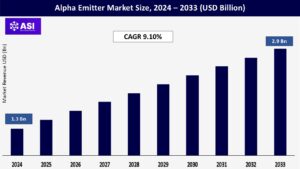
The alpha emitter market is growing because more people are looking for safer, more effective ways to treat cancer. Traditional treatments like chemotherapy and radiation often harm healthy cells along with cancer cells, which leads to difficult side effects.
Targeted alpha therapy (TAT), on the other hand, uses alpha-emitting substances that zero in on cancer cells, damaging only the bad ones while leaving healthy tissue mostly untouched. This makes it especially useful for treating tough or advanced cancers, like prostate cancer or certain blood cancers. As doctors and patients alike move toward treatments that are more personalized and less harmful, interest in alpha-based therapies is steadily increasing. This trend is playing a major role in the alpha emitter market growth.
The progress being made in nuclear medicine and cancer drug development. Advances in technology have made it easier to produce and use alpha emitters in hospitals and research labs. At the same time, governments and private companies are putting more money into developing new treatments that use these radioactive substances. Additionally, regulatory support and faster approval processes for novel radiopharmaceuticals have encouraged innovation and market expansion. These developments not only improve the availability of alpha-based treatments but also open new possibilities for treating various cancers, further fueling market growth.
One of the biggest challenges holding back the growth of the alpha emitter market is the limited availability and high cost of alpha-emitting isotopes. Producing these radioactive materials is complex and requires specialized facilities, equipment, and expertise, which are not widely available.
For example, isotopes like Actinium-225 and Astatine-211 are produced in only a few places around the world, and the process is time-consuming and expensive. Because of this, there’s often a shortage of supply, which makes it difficult for researchers and hospitals to access them consistently. This scarcity not only drives up costs but also slows down the development and wider use of targeted alpha therapies. Until production becomes more efficient and accessible, this supply issue will continue to be a major hurdle for the market.
| Report Metric | Details |
|---|---|
| Segmentations | |
| By Type of Radionuclide |
Astatine (At-211) Radium (Ra-223) Lead (Pb-212) Bismuth (Bi-212) Actinium (Ac-225) Others |
| By Application |
Prostate Cancer, Bone Metastases Ovarian Cancer Pancreatic Cancer Endocrine Tumors, Others |
| Key Players |
|
| Geographies Covered | |
| North America |
U.S. |
| Europe |
U.K. |
| Asia Pacific |
China |
| Middle East & Africa |
Saudi Arabia |
| Latin America |
Brazil |
The types of radionuclides include Actinium-225 (Ac-225) is one of the most promising. It’s being studied for use in several cancer treatments because of its strong radiation power and a half-life that makes it practical for medical use. Radium-223 (Ra-223) is already approved and widely used, especially in treating prostate cancer that has spread to the bones, making it a major player in the market. Its growing clinical adoption is contributing to the alpha emitter market size expansion.
Astatine-211 (At-211) is still in the experimental stage, but scientists are hopeful it could be useful for cancers like brain and ovarian cancer. Lead-212 (Pb-212) and Bismuth-212 (Bi-212) are also being explored, especially for treatments that need to be very targeted. There are also a few other isotopes being developed, but they’re still limited in use due to production or approval issues.
In terms of application, prostate cancer is currently the biggest area where alpha emitters are being used, mainly because of the success of Ra-223. Bone metastases, or cancer that has spread to the bones, is another major focus, as alpha emitters are very good at targeting these areas while protecting healthy bone.
Ovarian and pancreatic cancers are becoming more important areas as well, since they are hard to treat with traditional methods and researchers are seeing hopeful results from alpha therapy. Endocrine tumors, which include certain types of hormone-related cancers, are also being targeted with these treatments because the precision of alpha particles helps in reaching small or scattered tumors. Other cancers, like brain tumors or leukemia, are also being studied, showing that the potential for alpha therapy is still growing. Altogether, these segments highlight a fast-moving and hopeful future for alpha emitters in modern cancer care.
North America is holding largest market of the global alpha emitter market, due to its strong healthcare systems, substantial investment in cancer research, and the presence of major pharmaceutical companies and research institutions. The United States, in particular, has made significant strides with the clinical use of Radium-223 for prostate cancer and continues to fund the development of Actinium-225-based treatments. Supportive regulations and a growing number of clinical trials are also helping to accelerate market growth in the region. These factors are supporting a dominant alpha emitter market share for North America.
Europe is holding the second-largest market share. The region continues to expand its alpha emitter market share through ongoing research initiatives. Countries such as Germany, France, and the UK are key contributors, with strong involvement in nuclear medicine and radiopharmaceutical development. The region benefits from robust healthcare infrastructure, EU-backed research funding, and increasing public acceptance of advanced cancer therapies, all of which support the growing use of alpha emitters.
In the Asia-Pacific region, the market is expanding quickly, driven by a rise in cancer cases, better access to healthcare, and government support for nuclear medicine initiatives. Nations like Japan, China, and South Korea are actively producing medical isotopes and forming partnerships with international companies to improve treatment options. However, issues like uneven healthcare infrastructure and the high cost of alpha therapies remain challenges in some parts of the region.
Latin America is slowly embracing alpha emitter technology, with Brazil and Mexico leading regional efforts. The area is gradually improving its healthcare systems and showing increased interest in cutting-edge cancer treatments. Still, limited financial resources, slower regulatory processes, and unequal access to medical facilities are slowing down progress compared to more developed markets.
The Middle East and Africa currently hold the smallest share of the alpha emitter market, mostly due to restricted access to advanced medical technology and nuclear medicine. However, countries such as the UAE and South Africa are taking steps to upgrade their healthcare infrastructure and invest in cancer research. With growing awareness and international cooperation, this region may see more growth in the future, although likely at a slower rate.
The alpha emitter market was valued at USD 1.3 billion in 2024.
The alpha emitter market is projected to grow at a CAGR of 9.10% from 2025 to 2033.
The Astatine (At-211) hold the largest alpha emitter market share.
The North America, Europe region is expected to witness the highest growth rate.
Major players include Bayer AG, Telix Pharmaceuticals and Actinium Pharmaceuticals, Inc.
1.1 Summary
1.2 Research methodology
2.1 Particulate Adjuvants
2.2 Aluminum-Based Adjuvants
2.3 Toll- Like Receptor Agonists
3.1 Drivers
3.2 Geopolitical Impact
3.3 Human Factors
3.4 Technology Factors
4.1 Porters Five Forces Analysis
4.2 Value Chain Analysis
4.3 Average Pricing Analysis
4.4 M & A, Agreements & Collaboration Analysis
5.1 Alpha Emitter Market, Type of Radionuclide
5.1.1 Introduction
5.1.2 Market Size & Forecast
5.2 Alpha Emitter Market, By Application
6.1 North America Alpha Emitter Market, By Country
6.1.1 Alpha Emitter Market, Type of Radionuclide
6.1.2 Alpha Emitter Market, By Application
6.2 U.S.
6.2.1 Alpha Emitter Market, Type of Radionuclide
6.2.2 Alpha Emitter Market, By Application
6.3 Canada
7.1 U.K.
7.2 Germany
7.3 France
7.4 Spain
7.5 Italy
7.6 Russia
7.7 Nordic
7.8 Benelux
7.9 The Rest of Europe
8.1 China
8.2 South Korea
8.3 Japan
8.4 India
8.5 Australia
8.6 Taiwan
8.7 South East Asia
8.8 The Rest of Asia-Pacific
9.1 UAE
9.2 Turkey
9.3 Saudi Arabia
9.4 South Africa
9.5 Egypt
9.6 Nigeria
9.7 Rest of MEA
10.1 Brazil
10.2 Mexico
10.3 Argentina
10.4 Chile
10.5 Colombia
10.6 Rest of Latin America
11.1 Global Market Share (%) By Players
11.2 Market Ranking By Revenue for Players
11.3 Competitive Dashboard
11.4 Product Mapping