

Ammonium Bifluoride Market
Ammonium Bifluoride Market & Trends Analysis Report, By Grade (Technical Grade, Industrial Grade, Electronic Grade), By Application (Metal Surface Treatment, Glass Etching, Oil & Gas, Electronics Cleaning, Others), By End Use industry (Automotive, Construction, Electronics, Chemicals, Others)– Industry Analysis Report, Regional Outlook, Growth Potential, Price Trends, Competitive Market Share & Forecast, 2025–2033.

Historical Period: 2019-2024
Forecast Period: 2025-2033
Report Code :
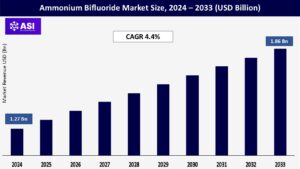
CAGR: 4.4%
Last Updated : March 27, 2026
The global ammonium bifluoride market size was valued at USD 1.27 billion in 2024 and is projected to reach USD 1.86 billion by 2033, growing at a CAGR of 4.4% during the forecast period.
Ammonium bifluoride (NH₄HF₂) is a highly reactive, caustic, and poisonous substance that is mostly utilized in electronics cleaning, glass etching, metal surface treatment, and oil well acidization. It is useful in a variety of industrial applications that call for the etching, derusting, or polishing of metal or silica-based surfaces due to its potent fluorinating and cleaning capabilities.
The global market is being driven by the expansion of the electronics sector, the growing need for effective metal treatment chemicals, and the growth of the building and automotive industries.
Ammonium bifluoride is essential for cleaning, descaling, and removing rust from titanium and stainless steel surfaces. The need for bifluoride-based surface treatment solutions is continuously increasing as industrial manufacturing, especially in emerging nations, and the automotive and aerospace industries use more lightweight metals.
In the semiconductor industry, silicon wafers and glass substrates are cleaned with high-purity ammonium bifluoride. Ultra-clean etching and processing chemicals are becoming increasingly in demand as a result of growing investments in microelectronics, solar cells, and 5G infrastructure, particularly in Asia-Pacific.
Because it can emit hydrofluoric acid (HF) when it comes into contact with moisture, ammonium bifluoride is extremely corrosive and dangerous to human health.
This raises operating expenses by requiring stringent safety precautions for handling, storage, and transportation. The compound’s hazardous nature also prevents small-scale users and establishments with inadequate safety infrastructure from adopting it.
Ammonium bifluoride and other fluorine-based chemicals are governed by strict environmental laws in places like the United States, the European Union, and several parts of Asia.
These frameworks require stringent waste management, safety, and emission control procedures. Manufacturers must pay more to comply with these rules, which lowers their profitability and prevents new competitors from entering the market.
| Report Metric | Details |
|---|---|
| Segmentations | |
| By Grade |
Technical Grade Industrial Grade Electronic Grade |
| By Application |
Metal Surface Treatment Glass Etching Oil & Gas Electronics Cleaning Others |
| By End-Use Industry |
Automotive Construction Electronics Chemicals Others |
| Key Players |
|
| Geographies Covered | |
| North America |
U.S. |
| Europe |
U.K. |
| Asia Pacific |
China |
| Middle East & Africa |
Saudi Arabia |
| Latin America |
Brazil |
The Ammonium Bifluoride Market is segmented by Grade (Technical Grade, Industrial Grade, Electronic Grade), By Application (Metal Surface Treatment, Glass Etching, Oil & Gas, Electronics Cleaning, Others), By End Use industry (Automotive, Construction, Electronics, Chemicals, Others).
Each factor plays a crucial role in enhancing patient safety, increasing the adoption of self-administered anticoagulant therapies, and supporting the development of more convenient, prefilled drug delivery systems that streamline treatment in the management of thromboembolic and cardiovascular conditions.
Technical Grade (48.6%)
Widely used in glass etching and general industrial cleaning, this grade dominates due to its low cost and widespread applicability.
Industrial Grade (33.4%)
Used in oil well acidizing, metal cleaning, and electroplating. Offers higher stability for aggressive industrial operations.
Electronic Grade (18.0%)
Highly pure grade for microelectronics, wafer processing, and high-end optics. Demand is growing with the electronics and semiconductor boom.
Metal Surface Treatment (39.8%)
Used for rust removal, stainless steel pickling, and titanium cleaning. Automotive and defense industries drive consistent demand.
Glass Etching (24.5%)
Enables decorative and functional etching in architectural and consumer glass products.
Oil & Gas (16.9%)
Used in acidizing to improve permeability in oil wells. Demand is regionally dependent on E&P activities.
Electronics Cleaning (10.6%)
Plays a role in high-precision wafer and circuit cleaning in chip fabrication.
Others (8.2%)
Includes detergents, industrial degreasers, and specialty chemical formulations.
Automotive (27.3%)
Used in pickling stainless steel exhaust systems and surface treatment of aluminum components.
Construction (23.9%)
Glass etching chemicals used in decorative panels, mirrors, and safety glass.
Electronics (19.5%)
Semiconductor processing, LED manufacturing, and PCB cleaning are key use cases.
Chemicals (15.4%)
Intermediate for fluorine-based compounds and catalysts.
Others (13.9%)
Covers oil & gas services, aerospace, and defense.
With more than 40% of the global share, it is the largest and fastest-growing area. dominated by South Korea, China, Japan, and India because of their robust metal production and electronics industries. Growth is also supported by government programs for semiconductor self-reliance.
The United States dominates the North American market, which is bolstered by modern electronics manufacturing, metal treatment, and oilfield services. Ammonium bifluoride is used in high-value, controlled industrial settings, which leads to specialized but lucrative applications, even as severe safety and environmental requirements prevent rapid expansion.
Europe’s top consumers are Germany, France, and Italy, especially in the automotive and specialty chemical industries. However, the European Union’s stringent environmental and worker safety requirements, which present difficulties for small and medium sized businesses (SMEs) operating in this sector, moderate the adoption rate.
Oilfield stimulation, consumer products manufacturing, and growing demand in the construction industry are the main drivers of market expansion in Latin America, with Brazil and Mexico leading the way. It is anticipated that growing industrial capacity and economic development will facilitate gradual adoption.
The construction boom in the Gulf Cooperation Council (GCC) countries and the growing use of ammonium bifluoride in oilfield applications in Egypt, the United Arab Emirates, and Nigeria are the main drivers of the Middle East and Africa region’s continuous expansion. In this area, investments in the energy sector and infrastructure development are major accelerators.
The market size of Ammonium Bifluoride market is USD 1.27 billion.
The projected CAGR of Ammonium Bifluoride market is 4.4%
Metal Surface Treatment.
Asia-Pacific, driven by semiconductors and construction.
Solvay, Honeywell, Morita Chemical, Stella Chemifa, American Elements.
1.1 Summary
1.2 Research methodology
2.1 Research Objectives
2.2 Market Definition
2.3 Limitations & Assumptions
2.4 Market Scope & Segmentation
2.5 Currency & Pricing Considered
3.1 Drivers
3.2 Geopolitical Impact
3.3 Human Factors
3.4 Technology Factors
4.1 Porters Five Forces Analysis
4.2 Value Chain Analysis
4.3 Average Pricing Analysis
4.4 M & A, Agreements & Collaboration Analysis
5.1 Ammonium Bifluoride Market, By Grade
5.1.1 Introduction
5.1.2 Market Size & Forecast
5.2 Ammonium Bifluoride Market, By Application
5.3 Ammonium Bifluoride Market, By End-Use Industry
6.1 North America Ammonium Bifluoride Market , By Country
6.1.1 Ammonium Bifluoride Market, By Grade
6.1.2 Ammonium Bifluoride Market, By Application
6.1.3 Ammonium Bifluoride Market, By End-Use Industry
6.2 U.S.
6.2.1 Ammonium Bifluoride Market, By Grade
6.2.2 Ammonium Bifluoride Market, By Application
6.2.3 Ammonium Bifluoride Market, By End-Use Industry
6.3 Canada
7.1 U.K.
7.2 Germany
7.3 France
7.4 Spain
7.5 Italy
7.6 Russia
7.7 Nordic
7.8 Benelux
7.9 The Rest of Europe
8.1 China
8.2 South Korea
8.3 Japan
8.4 India
8.5 Australia
8.6 Taiwan
8.7 South East Asia
8.8 The Rest of Asia-Pacific
9.1 UAE
9.2 Turkey
9.3 Saudi Arabia
9.4 South Africa
9.5 Egypt
9.6 Nigeria
9.7 Rest of MEA
10.1 Brazil
10.2 Mexico
10.3 Argentina
10.4 Chile
10.5 Colombia
10.6 Rest of Latin America
11.1 Global Market Share (%) By Players
11.2 Market Ranking By Revenue for Players
11.3 Competitive Dashboard
11.4 Product Mapping