

Anaesthesia Drugs Market
Anaesthesia Drugs Market Share & Trends Analysis Report, By Drug Type (General Anaesthesia Drugs, Local Anaesthesia Drugs), By Route of Administration (Intravenous, Inhalation, Topical, Others), By Application (Surgery, Pain Management, Others), By End User (Hospitals, Ambulatory Surgical Centers, Clinics, Others), By Distribution Channel (Hospital Pharmacies, Retail Pharmacies, Online Pharmacies) Industry Analysis Report, Regional Outlook, Growth Potential, Price Trends, Competitive Market Share & Forecast, 2025–2033.

Historical Period: 2019-2024
Forecast Period: 2025-2033
Report Code :
CAGR: 3.57%
Last Updated : December 15, 2025
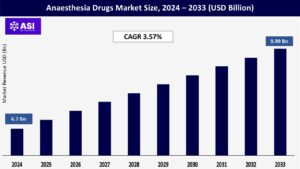
The global Anesthesia Drugs Market size was valued at approximately USD 6.7 billion in 2024 and is projected to reach USD 9.99 billion by 2033, growing at a CAGR of 3.57% during the forecast period (2025–2033).
The Anesthesia Drugs Market is the global business of making and supplying medicines that help reduce or block pain during surgeries and medical treatments. These drugs are very important in healthcare because they allow doctors to do procedures without causing pain to the patient.
There are three main types of Anesthesia drugs General anaesthetics make the patient fully unconscious, Local anaesthetics numb a small area of the body, Regional anaesthetics block pain in a larger part, like the lower body (for example, with spinal or epidural injections).
These drugs work by stopping pain signals from traveling through the nervous system to the brain. Good Anesthesia drugs should act fast, last the right amount of time, be safe, wear off easily, and have few side effects. Common general Anesthesia drugs include propofol, sevoflurane, and thiopental, while lidocaine and bupivacaine are often used as local anaesthetics.
These medicines are used in many areas like surgeries, dental treatments, tests, and emergency care. The market is growing because more surgeries are being done, new and better drugs are being developed, and there is a greater need for safer and more effective Anesthesia options.
One of the main reasons the Anesthesia drugs market is growing is because more people are having surgeries both planned (like knee replacements) and emergency ones (like after an accident). Many people today suffer from long-term health problems like heart disease, cancer, joint pain, and obesity, which often need surgery.
Also, as the population gets older, especially in countries like the U.S. and Japan, more people need operations, which increases the use of Anesthesia. Every surgery needs some kind of Anesthesia whether to make the whole body sleep or just to numb a part—so these drugs are always needed.
Plus, more small surgical centers and modern methods like minimally invasive surgeries are being used. These often require fast-acting Anesthesia so that patients can go home sooner, which adds to the demand.
Another reason this market is growing is because of improvements in how anesthesia drugs are made and given to patients. New types of anesthesia drugs are being developed that work faster, last longer, and cause fewer problems for patients.
For example, some new drugs stay in the body longer but are safer, and others can be breathed in, which gives doctors better control over how much the patient gets. New machines, like automatic drug pumps and computer-guided delivery systems, help doctors give the right amount safely and more accurately.
Also, companies are working to make anesthesia drugs with fewer side effects, like nausea or heart problems, which makes them more attractive for hospitals and doctors to use.
One significant challenge limiting the growth of the anesthesia drugs market is the potential side effects and health risks associated with anesthesia use. Although anesthesia is generally safe when administered correctly, it can still lead to serious complications, especially in patients with pre-existing health conditions such as heart disease, diabetes, obesity, or respiratory problems.
Common side effects include nausea, vomiting, dizziness, low blood pressure, chills, allergic reactions, and in rare cases, anesthesia awareness where a patient may become conscious during surgery. In older adults, there is also a higher risk of post-operative cognitive dysfunction or delirium, which can affect memory and thinking ability after surgery.
These risks make some patients and healthcare providers cautious about using certain anesthesia drugs, especially for elective or less urgent procedures. Additionally, legal and regulatory concerns arise when adverse events occur, leading to lawsuits or stricter rules on drug usage.
Healthcare providers must carefully evaluate a patient’s medical history and condition before choosing an anesthesia drug, which can complicate and slow down treatment planning. Because of these safety concerns, the adoption of certain anesthesia drugs may be limited, restraining the market’s overall growth, especially in regions with stricter healthcare regulations or limited access to skilled anesthesiologists.
| Report Metric | Details |
|---|---|
| Segmentations | |
| By Drug Type |
General Anesthesia Drugs Local Anesthesia Drugs |
| By Route of Administration |
Intravenous Inhalation Topical Others |
| By Application |
Surgery Pain Management Others |
| By End User |
Hospitals Ambulatory Surgical Centers Clinics Others |
| By Distribution Channel |
Hospital Pharmacies Retail Pharmacies Online Pharmacies |
| Key Players |
|
| Geographies Covered | |
| North America |
U.S. |
| Europe |
U.K. |
| Asia Pacific |
China |
| Middle East & Africa |
Saudi Arabia |
| Latin America |
Brazil |
The Anesthesia Drugs Market is segmented by Drug Type, Route of administration, Application, Distribution Channels and End User. Each factor plays a crucial role in improving patient safety, boosting the use of advanced anesthesia drugs, and encouraging the development of safer, faster-acting, and more efficient anesthesia options to support better outcomes in surgical and medical procedures.
General Anesthesia Drugs: These drugs induce a complete loss of consciousness and sensation throughout the body. They are commonly used during major surgeries and complex medical procedures. Examples include propofol, sevoflurane, and thiopental. This segment typically holds a significant market share due to the high volume of surgeries requiring general anesthesia.
Local Anesthesia Drugs: These drugs numb a specific area of the body without affecting consciousness. They are widely used in dental procedures, minor surgeries, and pain management. Lidocaine and bupivacaine are popular local anesthetics. This segment is growing steadily, especially with the rise of outpatient and minimally invasive procedures.
Intravenous (IV) administration allows rapid onset of anesthesia, making it preferred for both induction and maintenance of anesthesia during surgeries. Drugs like propofol are commonly given intravenously. This route is favored for precise control over anesthesia depth.
Inhalation Inhaled anesthetics, such as sevoflurane and isoflurane, are used primarily for maintaining anesthesia during longer procedures. They offer easy adjustment of anesthesia levels and quick recovery times. Topical
Topical anesthetics are applied directly to the skin or mucous membranes to numb the surface area.
They are used in minor procedures, dental treatments, and diagnostic tests like endoscopy. OthersThis includes epidural and spinal anesthesia, where drugs are injected near the spinal cord to block sensation in larger regions, mainly used in childbirth and lower body surgeries.
Surgery The largest application segment, encompassing general, orthopedic, cardiovascular, neurological, and cosmetic surgeries, among others. Anesthesia drugs are essential to ensure patient comfort and safety during these procedures.
Pain Management Local and regional anesthetics are widely used for managing acute and chronic pain conditions, including post-operative pain and cancer-related pain. Others This includes applications in dental procedures, diagnostic tests like colonoscopy and endoscopy, and emergency medicine.
Hospitals remain the largest end-user segment due to the volume and complexity of surgical procedures performed. They require a wide range of anesthesia drugs for different types of surgeries and patient needs.
Ambulatory Surgical Centers ASCs are growing rapidly as more minor and outpatient surgeries are performed outside hospitals. These centers prefer fast-acting anesthetics that allow quick patient recovery and discharge.
Clinics, including dental and specialty clinics, often use local anesthetics for minor procedures and pain control. Others This includes emergency care units, diagnostic centers, and long-term care facilities where anesthesia drugs are also utilized.
Hospital Pharmacies The primary source of anesthesia drugs within hospitals, supplying medications directly to operating rooms and surgical units. Retail Pharmacies Retail pharmacies provide anesthesia drugs mainly for outpatient use and for patients requiring pain management or minor procedures outside hospital settings.
Online Pharmacies Growing in popularity due to convenience and wider reach, online pharmacies facilitate easier access to anesthesia-related medications, especially for chronic pain management.
The North American anesthesia drugs market is one of the largest globally, driven by advanced healthcare infrastructure, high healthcare expenditure, and a high volume of surgical procedures.
The presence of leading pharmaceutical companies and continuous investment in research and development contribute to the availability of innovative and safer anesthesia drugs.
Additionally, increasing demand for outpatient surgeries and minimally invasive procedures supports market growth. However, the high cost of drugs and strict regulatory requirements can pose challenges.
In Europe, the anesthesia drugs market is mature, with significant demand fueled by a growing aging population requiring surgical interventions. The region places strong emphasis on patient safety and the adoption of advanced anesthetic techniques, supported by robust healthcare systems.
Expansion of ambulatory surgical centers and increasing healthcare funding in many European countries further bolster market growth. Nevertheless, disparities in healthcare access between Western and Eastern Europe and budget constraints in public health systems may affect market penetration in some areas.
The Asia Pacific region is experiencing rapid growth in the anesthesia drugs market due to its large and increasing population, rising incidence of chronic diseases, and expanding healthcare infrastructure.
Countries like India, China, and Japan are witnessing growth in surgical procedures and medical tourism, driving demand for modern anesthesia drugs.
Governments are investing heavily to improve healthcare access and quality, which is further supporting market expansion. However, challenges such as limited access in rural regions and varying regulatory frameworks remain.
In Latin America, the market is steadily growing as healthcare infrastructure modernizes and awareness about advanced surgical and pain management techniques rises.
The increasing number of surgical procedures and expanding pharmaceutical distribution networks are key drivers. Economic fluctuations and regulatory delays, however, present obstacles, and there is often unequal healthcare access between urban and rural populations that impacts overall growth.
The Middle East and Africa (MEA) region shows promising potential, primarily due to increasing healthcare investments and growing numbers of hospitals and surgical centers, especially in the Gulf Cooperation Council (GCC) countries.
Rising awareness of modern anesthesia drugs and expanding medical tourism contribute to market growth. Nonetheless, economic and political instability in certain areas, along with uneven healthcare infrastructure and workforce shortages, restrain the market’s full potential across this diverse region.
The market was valued at USD 6.7 billion in 2024.
The market is projected to grow at a CAGR of 3.57% from 2025 to 2033.
General Anesthesia Drugs hold the largest market share.
The North America region is expected to witness the highest growth rate.
Major players include Pfizer Inc., Baxter International Inc. and AbbVie Inc.
1.1 Summary
1.2 Research methodology
2.1 Research Objectives
2.2 Market Definition
2.3 Limitations & Assumptions
2.4 Market Scope & Segmentation
2.5 Currency & Pricing Considered
3.1 Drivers
3.2 Geopolitical Impact
3.3 Human Factors
3.4 Technology Factors
4.1 Porters Five Forces Analysis
4.2 Value Chain Analysis
4.3 Average Pricing Analysis
4.4 M & A, Agreements & Collaboration Analysis
5.1 Anaesthesia Drugs Market, By Drug Type
5.1.1 Introduction
5.1.2 Market Size & Forecast
5.2 Anaesthesia Drugs Market, By Route of Administration
5.3 Anaesthesia Drugs Market, By Application
5.4 Anaesthesia Drugs Market, By End User
5.5 Anaesthesia Drugs Market, By Distribution Channel
6.1 North America Anaesthesia Drugs Market , By Country
6.1.1 Anaesthesia Drugs Market, By Drug Type
6.1.2 Anaesthesia Drugs Market, By Route of Administration
6.1.3 Anaesthesia Drugs Market, By Application
6.1.4 Anaesthesia Drugs Market, By End User
6.1.5 Anaesthesia Drugs Market, By Distribution Channel
6.2 U.S.
6.2.1 Anaesthesia Drugs Market, By Drug Type
6.2.2 Anaesthesia Drugs Market, By Route of Administration
6.2.3 Anaesthesia Drugs Market, By Application
6.2.4 Anaesthesia Drugs Market, By End User
6.2.5 Anaesthesia Drugs Market, By Distribution Channel
6.3 Canada
7.1 U.K.
7.2 Germany
7.3 France
7.4 Spain
7.5 Italy
7.6 Russia
7.7 Nordic
7.8 Benelux
7.9 The Rest of Europe
8.1 China
8.2 South Korea
8.3 Japan
8.4 India
8.5 Australia
8.6 Taiwan
8.7 South East Asia
8.8 The Rest of Asia-Pacific
9.1 UAE
9.2 Turkey
9.3 Saudi Arabia
9.4 South Africa
9.5 Egypt
9.6 Nigeria
9.7 Rest of MEA
10.1 Brazil
10.2 Mexico
10.3 Argentina
10.4 Chile
10.5 Colombia
10.6 Rest of Latin America
11.1 Global Market Share (%) By Players
11.2 Market Ranking By Revenue for Players
11.3 Competitive Dashboard
11.4 Product Mapping