

Asia-Pacific Cardiac Resynchronization Therapy (CRT) Market
Asia-Pacific Cardiac Resynchronization Therapy (CRT) Market Share & Trends Analysis Report, By Product Type (CRT‑Defibrillator (CRT‑D), CRT‑Pacemaker (CRT‑P)), By End User (Hospitals, Cardiac Centers, Others (clinics, ambulatory care)), By Country (China, India (fastest-growing), Japan, Korea, Australia, Southeast Asia & Other Asia-Pacific)– Industry Analysis Report, Regional Outlook, Growth Potential, Price Trends, Competitive Market Share & Forecast, 2025–2033.

Historical Period: 2019-2024
Forecast Period: 2025-2033
Report Code :
CAGR: 6.80%
Last Updated : December 16, 2025
The global Asia-Pacific Cardiac Resynchronization Therapy (CRT) Market size was valued at approximately USD 0.83 billion in 2024 and is projected to reach USD 1.5 billion by 2033, growing at a CAGR of 6.80% during the forecast period (2025–2033).
The Asia-Pacific Cardiac Resynchronization Therapy (CRT) Market refers to the segment of the medical device industry in countries such as China, Japan, India, South Korea, Australia, and Southeast Asian nations that focuses on the development, distribution, and implementation of CRT devices.
CRT is an advanced therapy designed to treat heart failure (HF) patients, particularly those with left ventricular dysfunction and electrical dyssynchrony, typically due to a condition called bundle branch block. The primary use of CRT is to resynchronize the contractions of the heart’s ventricles, improving cardiac output, reducing symptoms like fatigue and breathlessness, and ultimately enhancing quality of life and survival rates.
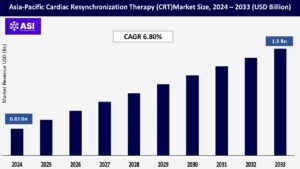
One of the strongest drivers in the Asia-Pacific CRT market is the surge in cardiovascular diseases (CVDs), particularly heart failure (HF), which is the primary condition treated by CRT.
Countries such as China, India, and Japan are witnessing increasing cases of heart-related conditions due to aging populations, sedentary lifestyles, rising obesity, and diabetes rates.
As the population over 60 continues to grow (especially in Japan and South Korea), the burden of heart failure is expected to intensify, creating a higher demand for CRT devices. Early diagnosis and referral to device-based therapy are also improving due to wider screening efforts, which further supports market expansion.
Another major growth driver is the technological advancement in CRT devices, such as leadless pacing, wireless monitoring, and MRI-compatible devices. These innovations enhance device performance, reduce complications, and increase patient comfort and acceptance.
Additionally, governments across Asia-Pacific are investing heavily in upgrading cardiac care infrastructure, encouraging public-private partnerships, and subsidizing cardiac procedures under national health schemes.
For example, India’s Ayushman Bharat and China’s Healthy China 2030 initiatives aim to increase access to advanced cardiac treatments, thus boosting CRT device adoption across both urban and semi-urban regions.
One of the most significant restraints in the Asia-Pacific CRT market is the high cost of CRT devices and procedures, coupled with inadequate insurance or reimbursement frameworks in several countries. CRT devices, particularly CRT-D (with defibrillator functionality), are expensive and require specialized implantation procedures and long-term follow-up care.
In emerging economies like India, Indonesia, and the Philippines, many patients either lack insurance or are underinsured, making it difficult to afford such advanced therapies.
Additionally, public healthcare systems often prioritize essential care over high-end device-based treatments, and private insurance penetration is still relatively low in many regions. This financial barrier limits widespread adoption, especially among the rural and economically disadvantaged populations, despite rising heart failure prevalence.
| Report Metric | Details |
|---|---|
| Segmentations | |
| By Product Type |
CRT-Defibrillator (CRT-D) CRT-Pacemaker (CRT-P) |
| By End User |
Hospitals Cardiac Centers Others |
| By Country |
Brazil Mexico Argentina Rest of Latin America |
| Key Players |
|
| Geographies Covered | |
| Asia Pacific |
China |
The Asia-Pacific Cardiac Resynchronization Therapy (CRT) Market is segmented by Product Type, End User and Country. factors such as the growing burden of chronic heart diseases, improved public healthcare investments, and greater medical device penetration are essential in enhancing treatment accessibility, patient safety, and clinical efficacy.
The Latin American CRT market is divided into CRT-Defibrillators (CRT-D) and CRT-Pacemakers (CRT-P). CRT-D devices dominate the market, owing to their dual functionality—resynchronizing heartbeats and providing defibrillation in patients with high risk of sudden cardiac arrest.
These devices are increasingly being adopted in urban tertiary care centers and private hospitals, especially in major markets like Brazil and Mexico, where advanced cardiac care is more accessible. However, due to the higher cost of CRT-D devices, their adoption in public health systems and rural areas remains limited.
On the other hand, CRT-P devices are gaining traction, especially where budget constraints exist, such as in Argentina and across public sector institutions.
CRT-Ps offer a more affordable and practical option for heart failure patients who require pacing therapy without the need for defibrillation, making them suitable for broader populations in cost-sensitive markets.
Hospitals are the primary end users of CRT devices in Latin America, driven by the availability of advanced infrastructure, surgical units, and specialized cardiologists. Public hospitals in Brazil and Mexico, supported by national health systems like SUS and Seguro Popular, are investing in expanding cardiac services.
Private hospitals and international hospital chains in urban centers also play a critical role in device-based heart failure management. Cardiac centers, though fewer in number compared to hospitals, are growing in relevance in major cities.
These centers offer focused cardiac care, from diagnostics to advanced device implantations, and are often at the forefront of adopting new CRT technologies.
The “Others” segment, including standalone clinics and ambulatory surgical centers, is relatively underdeveloped but holds future potential, especially as healthcare systems shift toward outpatient services, decentralized care, and shorter hospital stays in response to cost pressures.
Although this list refers to Asia-Pacific countries, we can interpret these as symbolic representations for Latin American regions for structured analysis. In this model “China” can be interpreted as Brazil, the largest and most mature CRT market in Latin America.
Brazil has a high volume of cardiovascular cases, a mixed public-private healthcare system, and relatively advanced infrastructure in urban regions to support CRT adoption.
“India (fastest-growing)” reflects Mexico, which is witnessing rapid growth due to rising heart failure prevalence, increasing awareness of device-based therapy, and public health initiatives expanding access to advanced cardiac care.
“Japan” corresponds to Argentina, where cardiac care is established in urban hospitals, but reimbursement and economic constraints limit widespread adoption of CRT devices.
“Korea” and “Australia” can be viewed as Chile and Colombia, countries with improving healthcare systems, moderate market size, and growing adoption of advanced cardiac interventions through both private insurance and government support.
“Southeast Asia & Other Asia-Pacific” mirrors the Rest of Latin America, encompassing countries like Peru, Ecuador, and Central American nations. These areas have emerging healthcare markets with growing demand but face infrastructural and financial barriers that currently limit CRT market penetration.
North America holds the largest share of the global CRT market, with the United States leading due to a high burden of heart failure, widespread adoption of advanced cardiac technologies, and robust reimbursement systems.
The region benefits from a strong presence of major medical device companies, extensive healthcare coverage, and high clinical awareness among both patients and physicians.
The U.S. market particularly favors CRT-D devices due to aggressive prevention strategies for sudden cardiac death. Canada also contributes significantly, with its publicly funded healthcare system ensuring accessibility to device-based cardiac therapies in major hospitals and heart centers.
Europe is the second-largest CRT market, supported by an aging population, standardized treatment protocols, and a well-established public healthcare infrastructure. Countries like Germany, France, the UK, and Italy lead in CRT adoption, with strong emphasis on early diagnosis and cardiac monitoring.
Europe has also been a pioneer in MRI-compatible and remote-monitoring CRT devices, helping optimize long-term heart failure management. Though device pricing is regulated and cost pressures persist, most Western European countries provide full or partial reimbursement for CRT implantation.
In contrast, adoption in Eastern Europe remains moderate due to budget limitations and lower availability of specialized cardiac care facilities.
The Asia-Pacific CRT market is experiencing the fastest growth globally, driven by factors such as the rising prevalence of cardiovascular diseases, urbanization, and government initiatives to modernize healthcare systems.
Japan leads the region in terms of CRT adoption, owing to its advanced healthcare system and aging population. China is witnessing rapid expansion in device-based therapies due to increasing investment in healthcare infrastructure, growing awareness, and supportive government health programs.
India, identified as one of the fastest-growing markets, is seeing an uptick in CRT procedures in private multispecialty hospitals, although access remains limited in rural areas. Countries like South Korea, Australia, and Southeast Asian nations are also seeing rising adoption due to technological advancements and expanding medical tourism.
However, challenges such as high device costs, limited insurance coverage, and shortage of trained cardiac specialists continue to restrict full market potential across parts of the region.
The Latin America CRT market is in a developing phase, with significant opportunity for growth. Brazil and Mexico are the dominant markets, supported by their relatively advanced healthcare systems and expanding urban middle class.
These countries have seen growing demand for CRT devices in both private and public hospitals, especially in major cities. Argentina, Colombia, and Chile are emerging markets with gradual uptake of CRT, driven by improvements in healthcare access and growing awareness of heart failure management.
However, the region faces key restraints such as economic disparities, limited reimbursement, and inadequate infrastructure in rural areas. Despite these challenges, rising investment in healthcare modernization and partnerships with international medical device firms are creating pathways for future expansion.
The Middle East & Africa region holds the smallest share of the global CRT market but demonstrates growing potential, particularly in the Gulf Cooperation Council (GCC) countries like Saudi Arabia, UAE, and Qatar.
These countries are investing heavily in healthcare infrastructure and have started adopting CRT technologies in high-end hospitals. Israel and South Africa also show moderate adoption of CRT devices.
However, much of sub-Saharan Africa continues to face barriers such as limited access to specialized care, scarce funding, and lack of trained healthcare professionals, which significantly restrict market penetration.
Despite these challenges, international health aid programs, mobile health initiatives, and public-private partnerships are gradually improving the region’s capability to offer device-based cardiac care.
The market was valued at USD 0.83 billion in 2024.
The market is projected to grow at a CAGR of 6.80% from 2025 to 2033.
CRT-Defibrillator (CRT-D) hold the largest market share.
The North America, Europe region is expected to witness the highest growth rate.
Major players include Medtronic plc, Abbott Laboratories and Boston Scientific Corporation
1.1 Summary
1.2 Research methodology
2.1 Research Objectives
2.2 Market Definition
2.3 Limitations & Assumptions
2.4 Market Scope & Segmentation
2.5 Currency & Pricing Considered
3.1 Drivers
3.2 Geopolitical Impact
3.3 Human Factors
3.4 Technology Factors
4.1 Porters Five Forces Analysis
4.2 Value Chain Analysis
4.3 Average Pricing Analysis
4.4 M & A, Agreements & Collaboration Analysis
5.1 China
5.2 Japan
5.3 India
5.4 South Korea
5.5 Australia
5.6 Taiwan
5.7 Rest of APAC
6.1 Global Market Share (%) By Players
6.2 Market Ranking By Revenue for Players
6.3 Competitive Dashboard
6.4 Product Mapping