

ATV and UTV Market
ATV and UTV Market Size, Share & Trends Analysis Report By Vehicle Type (ATV, UTV), By Displacement (Less than 400cc, 400 – 800cc), By Fuel Type (Gasoline Powered, Diesel-powered), By Applications (Utility, Sports), Analysis Report, Regional Outlook, Growth Potential, Price Trends, Competitive Market Share & Forecast, 2025–2033.

Historical Period: 2019-2024
Forecast Period: 2025-2033
Report Code :
CAGR: 6.80%
Last Updated : December 16, 2025
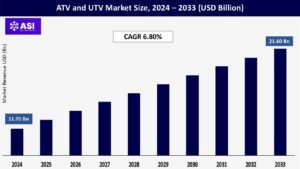
The global ATV and UTV market size was valued at USD 11.95 billion in 2024 and is expected to reach from USD 12.76 billion in 2025 to USD 21.60 billion by 2033, growing at a CAGR of 6.80% during the forecast period (2025–2033).
A vehicle is considered an all-terrain vehicle (ATV) if it has handlebars and is fitted with four low-pressure tires. ATVs are used in the military, forestry, agriculture, sports, and other industries and are renowned for their maneuverability and off-road capabilities.
These require training and are handled very differently. These are typically used off-road, but only a few places allow them to be driven on public roads. These have grown in popularity over the past few years because they make it possible to reach remote locations and offer a practical means of transporting supplies and equipment.
A vehicle called a utility terrain vehicle (UTV) is made to carry out tasks more effectively than a general-purpose vehicle. Other names for this vehicle include multi-purpose off-highway utility vehicle (MOHUV) and recreational off-highway (ROV).
ATV and UTV trails and related activities are now very popular with tourists for recreational purposes. To draw and keep tourists, many tourism councils are introducing ATV and UTV-related activities by constructing tracks for these vehicles.
For instance, the adventure event promoter ATV Circuit opened an ATV track in Noida (India) in May 2018. With a 1.5 km track, ATV Circuit offers an entirely off-road experience for customized 4×4 all-terrain vehicles with engines between 80 and 350 ccs.
The main objective was to track an increase in the number of people interested in extreme sports. Additionally, several nations host annual championships, rapidly gaining popularity because anyone operating an ATV can compete in the race. As a result, these adventure sports’ popularity is rising, attracting tourists, and stimulating the market for ATVs and UTVs.
ATV and UTV use were formerly prohibited on roads due to safety concerns. However, government authorities have recently established new bills and ordinances allowing the use of ATVs and UTVs on public roads.
For instance, the government of Newfoundland and Labrador announced a new off-road vehicle act and rules in May 2022 to enhance safety for all off-road vehicle users, and the act and regulations are anticipated to go into effect on May 19, 2022. Therefore, government support to allow ATV and UTV on roadways is anticipated to boost the growth of the market.
Driving an ATV or UTV in a wildlife area can have several detrimental effects on the landscape, including noise pollution, vegetation damage, increased runoff, soil erosion, and deteriorated water quality. ATV and UTV use is prohibited in many nations because it damages the terrain, endangering wildlife habitats and other areas.
ATVs also damage plants and young saplings when they stray off trails, reducing forest floor cover. Nearby trees are harmed due to exposed and damaged roots caused by soil erosion. A few rules have been added to the area to manage unmanaged ATV and UTV use and support wildlife recovery management strategies.
As a result, ATVs and UTVs are prohibited in wildlife areas because they harm the health of the grasslands and wildlife habitats, which is expected to slow the expansion of the global market.
| Report Metric | Details |
|---|---|
| Segmentations | |
| By Vehicle Type |
ATV UTV |
| By Displacement |
Less than 400cc 400 – 800cc |
| By Fuel Type |
Gasoline Powered Diesel-powered |
| By Applications |
Utility Sports |
| Key Players |
|
| Geographies Covered | |
| North America |
U.S. |
| Europe |
U.K. |
| Asia Pacific |
China |
| Middle East & Africa |
Saudi Arabia |
| Latin America |
Brazil |
UTV segment is the highest contributor to the market and is expected to grow at a CAGR of 6.5% during the forecast period. Off-road vehicles, called utility vehicles, are made to carry out tasks more effectively than passenger cars.
They are mainly employed to transport supplies and machinery between areas inaccessible to trucks. These vehicles are used for various tasks, including farming, material handling, hunting, and mountaineering. The main factor fueling the market’s expansion is the growing use of UTVs for utility purposes like forestry, agriculture, and goods transportation.
All-terrain vehicles (ATVs), which can be driven with handlebars and have low tire pressure, are also known as quads, quad bikes, and others. ATVs are designed to carry a maximum of two people, but some companies have introduced models that can accommodate four people.
One of the main factors propelling the growth of ATVs is the rising popularity of off-road sports activities and ATV competitions, like the GNCC Amateur Competition.
The 400-800cc segment owns the highest market share and is expected to grow at a CAGR of 6.1% during the forecast period. Due to excellent fuel efficiency, the vehicles within this segment are primarily used for hunting, mountaineering, and other outdoor activities.
Demand for 400-800 cc ATVs and UTVs is rising as they become more widely used in utility, search, and rescue operations. Market participants are also launching related products to meet rising consumer demand, helping the 400-888cc segment grow even faster.
ATVs and UTVs with engines larger than 800cc are considered. These vehicles are primarily used in industries like agriculture and material handling. Due to an increase in off-trailing events, it is anticipated that the more than 800 cc segment of the global market will experience significant growth.
Off-road competitions use ATVs and UTVs with larger displacement engines to produce more torque and gain a competitive edge.
The gasoline-powered segment is the highest contributor to the market and is expected to grow at a CAGR of 6.4% during the forecast period. This segment includes ATVs and UTVs that run on gasoline.
A large percentage of ATVs and UTVs are powered by gasoline, combined with oil in a precise ratio to protect engine components and provide rapid acceleration.
The growth of gasoline-powered ATVs and UTVs are boosted by introducing a new line of vehicles with improved engines, improved performance, and added safety features.
This segment examines ATVs and UTVs that have diesel-powered engines. Heavy-duty ATVs and UTVs typically have diesel engines for powerful towing and material handling applications. ATV and UTV manufacturing companies are introducing new lines of these vehicles for improved load carrying and towing capacity.
The growth of the diesel-powered segment is also fueled by the introduction of a new line of ATV and UTV vehicles by top manufacturers with improved towing and load-carrying capacity.
The sports segment owns the highest market share and is expected to grow at a CAGR of 6.2% during the forecast period. Races, timed events, and competitive riding all use these vehicles. They typically have a single rear axle and a single suspension designed to be powerful and light to rule the racetrack.
The main driver of the growth of the sports segment is a significant increase in demand for ATVs in sports applications due to an increase in international sport racing competitions. Due to the increasing availability of groomed trails for riding side-by-side vehicles, consumers are also purchasing these vehicles to race on specific side-by-side vehicle trails.
Youth athletes also participate in international ATV and UTV sporting events like the Grand National Cross Country (GNCC) and UTV World Championship, propelling the market’s expansion.
The utility segment includes ATVs and UTVs used for various purposes, including transportation, carrying objects, farming, etc. They are primarily employed to transport supplies and machinery between areas inaccessible to trucks.
Utility ATVs and UTVs are frequently operated in agricultural and livestock management applications. The utility segment of the global market is expanding due to the increased use of these vehicles for forestry, agriculture, and goods transportation. Additionally, the expanding use of these vehicles for fishing, hunting, and forest travel fuels the market expansion.
Asia-Pacific is expected to grow at a CAGR of 7.8% during the forecast period. The increased demand for power sports recreational activities in many countries, including China, Australia, and India, is the main factor driving the ATV and UTV market growth in the Asia-Pacific region.
Launching new ATV and UTV models and introducing new ATV and UTV models in line with defense applications contribute to the market’s expansion in the Asia-Pacific region.
Additionally, the addition of ATV and UTV riding circuits is anticipated to boost this area’s global market. In addition, rising leisure spending, particularly in developing nations like China and India, is expected to support market expansion in the Asia-Pacific region.
LAMEA’s ATV and UTV market includes Latin America, the Middle East, and Africa. The market in the region is anticipated to grow due to the significant demand for ATVs for industrial, agricultural, and tourism-related uses in nations like Brazil, the UAE, and others.
The market is anticipated to grow due to rising tourism, enormous ATV demand for recreational purposes, and rising consumer awareness of off-roading sports and events.
ATV and UTV racing championships like the Mega ATV Championship are held in LAMEA, which helps in the regional market growth. The industry in LAMEA is projected to expand rapidly due to favorable government laws allowing their use on highways.
North America is the most significant shareholder in the global ATV and UTV market and is expected to grow at a CAGR of 5.7% during the forecast period.
The main factors anticipated to increase demand for ATVs and UTVs in North America are the high demand for ATVs, high disposable income of individuals, the scope for new and advanced technologies, developed economy, and government regulations regarding ATV designs.
The introduction of new models of these vehicles by significant players and racing championships held by top ATV and UTV clubs contribute to the expansion of the market share in the area. Additionally, it is anticipated that North America’s market will grow due to government regulations supporting these vehicles’ use on public roads.
The market is expected to grow CAGR of 6.80% from 2025 to 2033.
The current market size is USD 11.95 Billions in 2024.
North America currently holds the largest market shares.
Top prominent players in global market are BRP INC, CFMOTO, Deere & Company, HISUN, Honda Motor Co Ltd, Kawasaki Heavy Industries Ltd. (Kawasaki Motors Corp., U.S.A.), Kubota Corporation, Kwang Yang Motor Co., Ltd, Polaris Industries Inc, Suzuki Motor Corporation, Textron Inc. (Arctic Cat), Yamaha Motor Co Ltd, etc.
1.1 Summary
1.2 Research methodology
2.1 Research Objectives
2.2 Market Definition
2.3 Limitations & Assumptions
2.4 Market Scope & Segmentation
2.5 Currency & Pricing Considered
3.1 Drivers
3.2 Geopolitical Impact
3.3 Human Factors
3.4 Technology Factors
4.1 Porters Five Forces Analysis
4.2 Value Chain Analysis
4.3 Average Pricing Analysis
4.4 M & A, Agreements & Collaboration Analysis
5.1 ATV and UTV Market, By Vehicle Type
5.1.1 Introduction
5.1.2 Market Size & Forecast
5.2 ATV and UTV Market, By Displacement
5.3 ATV and UTV Market, By Fuel Type
5.4 ATV and UTV Market, By Applications
6.1 North America ATV and UTV Market, By Country
6.1.1 ATV and UTV Market, By Vehicle Type
6.1.2 ATV and UTV Market, By Displacement
6.1.3 ATV and UTV Market, By Fuel Type
6.1.4 ATV and UTV Market, By Applications
6.2 U.S.
6.2.1 ATV and UTV Market, By Vehicle Type
6.2.2 ATV and UTV Market, By Displacement
6.2.3 ATV and UTV Market, By Fuel Type
6.2.4 ATV and UTV Market, By Applications
6.3 Canada
7.1 U.K.
7.2 Germany
7.3 France
7.4 Spain
7.5 Italy
7.6 Russia
7.7 Nordic
7.8 Benelux
7.9 The Rest of Europe
8.1 China
8.2 South Korea
8.3 Japan
8.4 India
8.5 Australia
8.6 Taiwan
8.7 South East Asia
8.8 The Rest of Asia-Pacific
9.1 UAE
9.2 Turkey
9.3 Saudi Arabia
9.4 South Africa
9.5 Egypt
9.6 Nigeria
9.7 Rest of MEA
10.1 Brazil
10.2 Mexico
10.3 Argentina
10.4 Chile
10.5 Colombia
10.6 Rest of Latin America
11.1 Global Market Share (%) By Players
11.2 Market Ranking By Revenue for Players
11.3 Competitive Dashboard
11.4 Product Mapping