

Automotive Human Machine Interface (HMI) Market
Automotive Human Machine Interface (HMI) Market Size, Share & Industry Analysis, By Product Type (Instrument Cluster, Infotainment, Head-Up Display, Touchscreen Display) By Interface Type (Visual, Acoustic, Haptic), By Access Type (Standard HMI, Connected HMI), Industry Analysis Report, Regional Outlook, Growth Potential, Price Trends, Competitive Market Share & Forecast, 2025–2033.

Historical Period: 2019-2024
Forecast Period: 2025-2033
Report Code :
CAGR: 12.4%
Last Updated : March 7, 2026
The global automotive HMI system market size was valued at USD 26.13 billion in 2024 and is projected to reach from USD 29.37 billion in 2025 to USD 74.83 billion by 2033, growing at a CAGR of 12.4% during the forecast period (2025-2033).
The automotive industry is witnessing a paradigm shift towards electric and autonomous vehicles, which offer various benefits. Therefore, their adoption is increasing worldwide. These vehicles require advanced HMI systems, anticipated to drive global market growth.
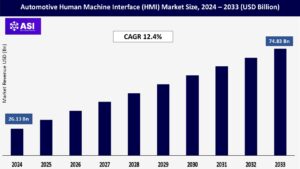
The automotive industry is undergoing a substantial transformation towards electric and autonomous vehicles, which have numerous advantages like lower emissions, greater fuel efficiency, improved performance, and reduced maintenance expenses.
These cars necessitate advanced HMI systems due to their involvement in various kinds of contact and communication among the driver, the vehicle, and the environment.
McKinsey & Company predicts that by 2030, approximately 12 percent of newly purchased passenger cars will be equipped with L3+ autonomous technology, and by 2035, over 37 percent will have sophisticated AD technologies.
A significant obstacle the automotive HMI market encounters is the excessive expense and complex nature of designing and incorporating HMI systems into automobiles.
To operate efficiently, the HMI system requires a range of hardware and software components, including sensors, cameras, microphones, displays, CPUs, memory, operating systems, and applications. These components contribute to the vehicle’s cost and weight while increasing power consumption and heat generation.
Additionally, the HMI system must function with several vehicle platforms, adhere to multiple standards and protocols, and guarantee compatibility with other devices and systems, such as smartphones, smartwatches, and cloud services.
The aspects above contribute to the complexity and arduousness of creating and implementing HMI systems in automobiles. They also provide testing, validation, and certification obstacles.
Furthermore, businesses requiring multiple items to be transported in a single delivery may create many conflicts due to the limited payload capacity of autonomous vehicles; this can lead to increased operational complexity and costs through multiple trips or deliveries.
Therefore, while autonomous last-mile delivery proves suitable for specific applications, its payload limitations present a significant obstacle to wider acceptance. This necessitates the development of innovative solutions that address these constraints and expand the market’s possibilities.
| Report Metric | Details |
|---|---|
| Segmentations | |
| By Product Type |
Instrument Cluster Infotainment Head-Up Display Touchscreen Display |
| By Interface Type |
Visual Acoustic Haptic |
| By Access Type |
Standard HMI Connected HMI |
| Key Players |
|
| Geographies Covered | |
| North America |
U.S. |
| Europe |
U.K. |
| Asia Pacific |
China |
| Middle East & Africa |
Saudi Arabia |
| Latin America |
Brazil |
Instrument Cluster acquired the 27% market share. Particularly in mid-range to luxury cars, the instrument cluster has changed from analog dials to entirely digital and changeable screens. These clusters offer real-time vehicle information, including advanced driver-assistance system (ADAS) alarms, speed, fuel, and navigational cues.
Innovation is being fueled by the growing need for improved graphics and personalized user experiences. In order to provide unified control and display, OEMs are combining infotainment systems with instrument clusters.
For bright displays, OLED and TFT LCD technologies are being used more and more. Additionally, theme-based visual modes (such as Eco and Sport) are being used by automakers. Infotainment systems with 25% market shares, which integrate audio, video, connectivity, navigation, and app integration, form the foundation of the automotive HMI experience.
Customer expectations for a smartphone-like interface in cars are what are driving the demand. Voice assistants, cloud-based apps, Android Auto, and Apple CarPlay are now supported by systems. After a purchase, functionality is improved by OTA (Over-The-Air) updates.
In order to facilitate upgrades and third-party app integration, infotainment platforms are increasingly being constructed on top of scalable platforms like Android Automotive OS.
To help drivers stay focused on the road, HUDs project important driving information, such as speed, navigation, and warnings, onto the windshield or a combiner. Thanks to improved technology and falling costs, HUDs, which were previously only found in luxury models, are now becoming more common in mid-segment automobiles.
Emerging HUDs based on augmented reality (AR) superimpose hazard alerts and contextual navigation information directly onto the driver’s field of vision. The demand for non-distracting data visualization tools like HUDs is being driven by the rise of ADAS and EVs.
In contemporary automobiles, touchscreen displays have supplanted physical buttons and dials for navigation, media, climate control, and other functions. Because of its durability and responsiveness, capacitive multi-touch technology is widely used.
Large portrait or landscape screens, some of which are larger than 15 inches, are now found in center stacks. Drivers can customize their interface layout with touchscreens, which also provide cleaner interiors. To improve usability, haptic feedback and anti-glare coatings are being incorporated.
With the most 42% market share, head-up displays, and digital instrument clusters, visual interfaces predominate in the HMI landscape. High-resolution screens positioned throughout the center console, dashboard, and even side mirrors are used by these interfaces to display information.
Vibrant, adaptable layouts with dynamic animations and data visualizations are offered by OLED and TFT displays. These systems can display multimedia content, ADAS alerts, energy consumption (in EVs), and real-time navigation as vehicle software advances. Ambient lighting, themes, and transitions all improve the user experience.
Acoustic interfaces hold the 31% market of the global market. Due to the incorporation of AI-powered voice assistants such as Apple Siri, Google Assistant, Amazon Alexa Auto, and proprietary in-car systems, acoustic interfaces are quickly gaining traction.
Key features like navigation, climate control, phone calls, and entertainment can all be operated hands-free thanks to these interfaces. Natural language commands are supported by the most recent systems, which enhances usability and lowers the learning curve.
Vehicles can comprehend complex, contextual requests (like “find the nearest EV charging station”) thanks to cloud-based natural language processing models. Haptic interfaces hold the 27% markets shares, providing a tangible reaction to user interaction by simulating touch or resistance through tactile feedback.
These are built into buttons, seats, steering wheels, and touchscreens to confirm or warn drivers without the need for visual input. Modern minimalist dashboards are more intuitive thanks to capacitive touch surfaces that simulate traditional button presses and provide haptic feedback.
Haptic steering wheels, which warn drivers when lane departure or autonomous mode changes occur, are a feature of luxury cars. Haptic feedback improves touchscreen usability and lowers the possibility of driving-related input errors in infotainment systems.
Conventional analog or digital instrument clusters and basic infotainment features like radio, Bluetooth, and limited navigation are examples of standard HMI systems. These systems, which are mostly found in entry-level and low-cost cars, put practicality and cost-effectiveness ahead of innovation.
Usually small, displays offer little personalization or interaction. Physical buttons or simple touch interfaces are frequently used to operate controls. These systems fulfill the fundamental function of simply communicating information such as fuel, speed, and audio settings.
The next development in vehicle-user interaction is represented by connected HMIs, which combine telematics, cloud services, and V2X (vehicle-to-everything) communication.
These systems provide real-time traffic and navigation, app-level services like streaming and vehicle diagnostics, and OTA (over-the-air) software updates. The HMI can modify controls, layouts, and content according to driver preferences and behavior thanks to AI-powered personalization.
Connected HMIs frequently have voice assistants, cloud-based infotainment, and remote control through smartphone apps. In EVs and autonomous vehicles, where software-defined functions predominate, this interface type is essential.
A rise in the production and sales of automobiles in countries, such as India, Japan, China, and South Korea will help the Asia Pacific dominate the market over the forecast period. Additionally, increasing demand for electric and connected vehicles from countries such as China and Japan is further expected to drive market growth in the region and is expected to maintain its position in the market.
Automotive HMI needs seamless connectivity and efficient management of EV-specific features. Therefore, the adoption of automotive HMI in this region is driven by the growing popularity of EVs and connected cars.
The most important 32% markets for automotive HMI in Europe. Europe’s market is also anticipated to show lucrative growth over the forecast period. Government authorities in the region have stepped up their vehicle evaluation policies, requiring manufacturers to produce vehicles that meet government safety standards.
Sensor-based technology is gaining momentum in the automotive sector to meet the government’s safety regulations. Therefore, demand for Advanced Driver Assistance Systems (ADAS) is expected to increase the adoption of automotive HMI systems during the forecast period.
North America acquired the 38% market share of the global market. Moreover, customers across the region are increasingly demanding feature-loaded vehicles that give them more control.
Additionally, infotainment systems have witnessed drastic changes over time, with automotive companies increasingly providing large touch panels in vehicles, primarily cars, enabling users to interact with the vehicles more efficiently. Companies, such as Tesla, General Motors, and Ford Motor Company, are providing these features to attract customers
The current market size is USD 26.13 Billions in 2025.
The HMI Market is growing at a CAGR of 12.4% during forecasting period 2025-2033.
Asia Pacific region held the highest share in 2024.
Instrument Cluster and Infotainment Systems hold the largest shares.
Faurecia, Garmin, Harman, LG Electronics, Mazda Motor Corporation, Unity Technologies.
1.1 Summary
1.2 Research methodology
2.1 Research Objectives
2.2 Market Definition
2.3 Limitations & Assumptions
2.4 Market Scope & Segmentation
2.5 Currency & Pricing Considered
3.1 Drivers
3.2 Geopolitical Impact
3.3 Human Factors
3.4 Technology Factors
4.1 Porters Five Forces Analysis
4.2 Value Chain Analysis
4.3 Average Pricing Analysis
4.4 M & A, Agreements & Collaboration Analysis
5.1 Automotive Human Machine Interface (HMI) Market, By Product Type
5.1.1 Introduction
5.1.2 Market Size & Forecast
5.2 Automotive Human Machine Interface (HMI) Market, By Interface Type
5.3 Automotive Human Machine Interface (HMI) Market, By Access Type
6.1 North America Automotive Human Machine Interface (HMI) Market , By Country
6.1.1 Automotive Human Machine Interface (HMI) Market, By Product Type
6.1.2 Automotive Human Machine Interface (HMI) Market, By Interface Type
6.1.3 Automotive Human Machine Interface (HMI) Market, By Access Type
6.2 U.S.
6.2.1 Automotive Human Machine Interface (HMI) Market, By Product Type
6.2.2 Automotive Human Machine Interface (HMI) Market, By Interface Type
6.2.3 Automotive Human Machine Interface (HMI) Market, By Access Type
6.3 Canada
7.1 U.K.
7.2 Germany
7.3 France
7.4 Spain
7.5 Italy
7.6 Russia
7.7 Nordic
7.8 Benelux
7.9 The Rest of Europe
8.1 China
8.2 South Korea
8.3 Japan
8.4 India
8.5 Australia
8.6 Taiwan
8.7 South East Asia
8.8 The Rest of Asia-Pacific
9.1 UAE
9.2 Turkey
9.3 Saudi Arabia
9.4 South Africa
9.5 Egypt
9.6 Nigeria
9.7 Rest of MEA
10.1 Brazil
10.2 Mexico
10.3 Argentina
10.4 Chile
10.5 Colombia
10.6 Rest of Latin America
11.1 Global Market Share (%) By Players
11.2 Market Ranking By Revenue for Players
11.3 Competitive Dashboard
11.4 Product Mapping