

Automotive Oxygen Sensor And Dynamic Sensor Market
Automotive Oxygen Sensor And Dynamic Sensor Market Size, Share & Trends Analysis Report By Type (Oxygen Sensors, Dynamic Sensors), By Distribution Channel (OEM, Aftermarket), By Vehicle Type (Passenger Cars, Commercial Vehicles), Analysis Report, Regional Outlook, Growth Potential, Price Trends, Competitive Market Share & Forecast, 2025–2033.

Historical Period: 2019-2024
Forecast Period: 2025-2033
Report Code :
CAGR: 5.4%
Last Updated : February 5, 2026
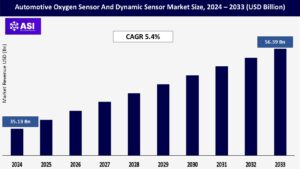
The global automotive oxygen sensor and dynamic sensor market size was valued at USD 35.13 billion in 2024 and is expected to grow from USD 37.02 billion in 2025 to reach USD 56.39 billion by 2033, growing at a CAGR of 5.4% during the forecast period (2025-2033).
Automotive oxygen sensors, often known as lambda sensors, are instruments that gauge the amount of oxygen present in exhaust gases. Because improper fuel burning can harm the exhaust system’s internal components and affect the cars’ overall performance, the oxygen sensor significantly impacts the exhaust system’s lifespan.
Governments worldwide are implementing stricter emission regulations to combat air pollution and mitigate the impact of climate change. These regulations mandate that vehicles meet specific emission standards, driving the demand for automotive oxygen sensors.
Oxygen sensors play a crucial role in ensuring optimal engine performance and reducing harmful emissions by monitoring the oxygen content in the exhaust gas and providing feedback to the engine control unit (ECU). As emission norms become more stringent, the demand for accurate and reliable oxygen sensors is expected to increase significantly.
The automotive industry is witnessing a shift towards advanced engine technologies, such as turbocharging, direct injection, and hybrid powertrains. These technologies improve engine efficiency and performance, but also require precise control of air-fuel mixtures.
Oxygen sensors are essential for this precise control as they provide real-time data on the oxygen content in the exhaust gas, enabling the ECU to adjust the fuel injection and ignition timing accordingly.
Incorporating a higher number of sensors and other electronic components increases the complexity of aftermarket repair and maintenance, as there is a lack of skill and expertise to repair these new systems.
In conjunction with price increases, this growing complexity of automotive systems is restricting the global market for automotive oxygen and dynamic sensors. Another major factor restraining the market is the replacement.
As most of the sensors are in intricate places in vehicles, it is difficult to repair or replace these sensors easily without disturbing other components. For instance, an automotive oxygen sensor in the powertrain system and the exhaust has varying operating temperature ranges. Therefore, in case of damage, replacement is a big issue.
| Report Metric | Details |
|---|---|
| Segmentations | |
| By Type |
Oxygen Sensors Dynamic Sensors |
| By Distribution Type |
OEM Aftermarket |
| By Vehicle Type |
Passenger Cars Commercial vehicles |
| Key Players |
|
| Geographies Covered | |
| North America |
U.S. |
| Europe |
U.K. |
| Asia Pacific |
China |
| Middle East & Africa |
Saudi Arabia |
| Latin America |
Brazil |
The oxygen sensors are further segmented into zirconia oxygen sensors, wideband zirconia, and titania sensors. The dynamic sensors are further segmented into mass airflow sensor, camshaft/crankshaft position sensor, pressure sensor, exhaust temperature sensor, engine oil level, oil pressure, intake air temperature sensor, and other dynamic sensors.
The dynamic sensors segment accounted for the largest market share and is estimated to grow at a CAGR of 5.5% during the forecast period. Within the dynamic sensors segment, the camshaft/crankshaft position sensor accounted for the largest market share and is predicted to expand at a CAGR of 4.7% during the forecast period.
The Camshaft Position Sensor detects camshaft rotation and is mounted near the cylinder head so that the sensor is opposite to the timing rotor attached to the engine camshaft. The engine control can pinpoint the precise location of the crankshaft drive thanks to the camshaft sensor.
Among other things, the ignition point and injection point must be calculated using this information. The fuel injection and ignition timing for an automobile can be determined using these parameters to be as inexpensive as possible.
The OEM distribution channel segment accounted for the largest market share and is estimated to grow at a CAGR of 4% during the forecasted period. Automotive OEMs are facing the challenge of reducing CO2 emissions.
Besides emission reduction measures such as hybridization and using all-electric powertrains, engine downsizing has gained momentum and has proved to be the most cost-efficient method to reduce emissions.
Engine downsizing has led to high-temperature generation, which has resulted in OEMs’ adoption of oxygen and engine dynamic sensors to increase the lifetime of vehicles. The increase in luxury and sports car sales has also resulted in OEMs’ high adoption of oxygen and dynamic sensors.
The aftermarket segment is the second largest. The aftermarket demand is primarily driven by an increase in the automobile’s lifetime. In the past, the average lifespan of a car was around eight years.
An average car is expected to last about 12 years or 200,000 miles. In 2024, the average vehicle age in the United States was 11.9 years. In the European Union, it was 11.5 years; in Japan, it was 13.3 years.
The passenger cars segment accounted for the largest market share and is estimated to grow at a CAGR of 4.7% during the forecasted period. The passenger cars segment has seen an increase in used car sales. In some regions, such as the United States and India, used car sales exceeded new passenger car sales in 2024.
This has led to high demand for aftermarket passenger car oxygen and dynamic sensors. Furthermore, there has been an increase in luxury and sports car sales worldwide.
The commercial vehicle segment is the second largest. The commercial vehicle segment has also seen a rise in rental service providers, especially in developing regions, which is expected to drive the demand for commercial vehicles’ oxygen and dynamic sensors.
As these vehicles have a longer life than passenger vehicles and are exposed to extreme terrains and weather conditions, they have a higher chance of sensor failure. This is expected to drive the demand for the aftermarket commercial vehicle segment during the forecasted period.
The expansion of the industrial sector in emerging markets and the development of commercial operations in logistics during the forecasted period are expected to drive market growth.
The Asia Pacific growing region with a cagr of 6.2%. The Asia Pacific is the second largest region. It is estimated to reach an expected value of USD 16 billion by 2030, growing at a CAGR of 6.2% during the forecast period. According to the UN’s Comtrade database, China is among the world’s largest car parts suppliers, exporting motor vehicle parts and accessories worth USD 34.8 billion in 2018.
In 2019, after implementing China 6 emission standards, Harbin Dongan Auto Engine Co. Ltd quickly took over the market with its product first-mover advantages, with full-year sales of 108,500 China 6 engines, accounting for 43.96% of the total sales.
Europe accounted for the largest market share and is estimated to grow at a CAGR of 4.9% during the forecasted period. The rising demand for electric vehicles poses a significant threat to the automotive oxygen and dynamic sensors market.
This is because the growing EV sales may bring down the sales of internal combustion engines in the long term. Increasing requirements for regular maintenance and the need for upgraded accessories and automotive components to enhance vehicle performance are likely to fuel the adoption of sensors and other auto components in the region.
North America has a substantial automotive industry with significant vehicle production and sales volumes. Major automotive manufacturers operate extensive production facilities in the region, creating a robust demand for automotive components, including oxygen sensors.
The high turnover of vehicles, including both new sales and the replacement market, further boosts demand. North American consumers have a strong preference for vehicles that offer advanced features, including enhanced fuel efficiency and lower emissions. This consumer trend drives the adoption of vehicles equipped with advanced oxygen sensors, contributing to market growth.
The automotive oxygen sensor and dynamic sensor market is expected to grow CAGR of 5.4% from 2025 to 2033.
The current automotive oxygen sensor and dynamic sensor market size is USD 35.13 Billions in 2024.
Europe currently holds the largest market share of automotive oxygen sensor and dynamic sensor.
The dynamic sensors segment accounted for the largest market share and is estimated to grow at a CAGR of 5.5% during the forecast period.
Some of the key players operating in the market are Delphi Technologies, Continental AG ORAFOL, HEXIS, Hella, KYB Corporation.
1.1 Summary
1.2 Research methodology
2.1 Research Objectives
2.2 Market Definition
2.3 Limitations & Assumptions
2.4 Market Scope & Segmentation
2.5 Currency & Pricing Considered
3.1 Drivers
3.2 Geopolitical Impact
3.3 Human Factors
3.4 Technology Factors
4.1 Porters Five Forces Analysis
4.2 Value Chain Analysis
4.3 Average Pricing Analysis
4.4 M & A, Agreements & Collaboration Analysis
5.1 Automotive Oxygen Sensor And Dynamic Sensor Market, By Type
5.1.1 Introduction
5.1.2 Market Size & Forecast
5.2 Automotive Oxygen Sensor And Dynamic Sensor Market, By Distribution Type
5.3 Automotive Oxygen Sensor And Dynamic Sensor Market, By Vehicle Type
6.1 North America Automotive Oxygen Sensor And Dynamic Sensor Market , By Country
6.1.1 Automotive Oxygen Sensor And Dynamic Sensor Market, By Type
6.1.2 Automotive Oxygen Sensor And Dynamic Sensor Market, By Distribution Type
6.1.3 Automotive Oxygen Sensor And Dynamic Sensor Market, By Vehicle Type
6.2 U.S.
6.2.1 Automotive Oxygen Sensor And Dynamic Sensor Market, By Type
6.2.2 Automotive Oxygen Sensor And Dynamic Sensor Market, By Distribution Type
6.2.3 Automotive Oxygen Sensor And Dynamic Sensor Market, By Vehicle Type
6.3 Canada
7.1 U.K.
7.2 Germany
7.3 France
7.4 Spain
7.5 Italy
7.6 Russia
7.7 Nordic
7.8 Benelux
7.9 The Rest of Europe
8.1 China
8.2 South Korea
8.3 Japan
8.4 India
8.5 Australia
8.6 Taiwan
8.7 South East Asia
8.8 The Rest of Asia-Pacific
9.1 UAE
9.2 Turkey
9.3 Saudi Arabia
9.4 South Africa
9.5 Egypt
9.6 Nigeria
9.7 Rest of MEA
10.1 Brazil
10.2 Mexico
10.3 Argentina
10.4 Chile
10.5 Colombia
10.6 Rest of Latin America
11.1 Global Market Share (%) By Players
11.2 Market Ranking By Revenue for Players
11.3 Competitive Dashboard
11.4 Product Mapping