

Automotive Steering Motor Market
Automotive Steering Motor Market Size, Share & Industry Analysis, By Technology (HPS, EHPS, EPS), By Vehicle Type (Passenger Car, Light Commercial Vehicle, and Electric Vehicle), Pinion (Single, Dual), Industry Analysis Report, Regional Outlook, Growth Potential, Price Trends, Competitive Market Share & Forecast, 2025–2033.

Historical Period: 2019-2024
Forecast Period: 2025-2033
Report Code :
CAGR: 4.5%
Last Updated : February 5, 2026
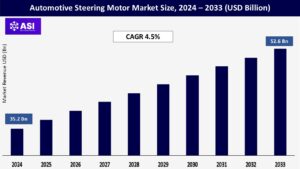
The global automotive steering motors market size was valued at USD 35.2 billion in 2024 and is expected to grow from USD 36.8 billion in 2025 to reach USD 52.6 billion by 2033, growing at a CAGR of 4.5% over the forecast period (2025-33).
An important factor driving the global market for automotive steering motors is the growing ubiquity of electric power steering (EPS) systems in automobiles. Compared to conventional hydraulic systems, EPS systems have several benefits, including better fuel economy, better vehicle control, and less maintenance needs
Governments throughout the world are enforcing stricter fuel efficiency standards, which are having an increasing impact on the global automobile steering motor market. These rules encourage automakers to develop innovative steering systems in an effort to lower carbon emissions and increase overall vehicle economy.
Since electric power steering (EPS) motors are more efficient than conventional hydraulic systems, they have become increasingly popular. Unlike hydraulic systems, which continuously use engine power, EPS systems only run when steering input is needed, which helps reduce fuel use.
Automakers are being forced to implement advanced steering systems by regulations like the Euro 6 emissions standards in Europe and the Corporate Average Fuel Economy (CAFE) standards in the United States. These standards impose strict limits on vehicle emissions, encouraging the use of lightweight materials and efficient components like EPS motors.
The shift towards electric and hybrid vehicles further underscores the importance of steering motor efficiency, as electric vehicles (EVs) rely heavily on energy-saving technologies to extend their range.
The lack of electrically assisted power steering systems specifically designed for mining and construction equipment is a major barrier to the market expansion for automobile steering motors.
These specific machines require significant steering forces, usually between 50kN and 100kN, which are difficult for electric motor-based systems to efficiently provide.
As a result, most mining and construction equipment still uses mechanical or hydraulic steering systems. Unfortunately, as compared to electric power steering systems, these alternatives are more complex, less efficient, and more prone to malfunctions.
Electrically assisted hydraulic systems aid in lowering engine load, which lowers the vehicle’s fuel needs and increases fuel economy. For mining and construction equipment, there are no electrically assisted steering methods available. 50kN to 100kN of force is needed to turn mining or construction equipment.
With an electric motor, it is difficult to achieve these forces. Since any development in electric steering mechanisms of mining and construction equipment will unleash a massive demand for automotive steering system OEMs, this is holding back the automotive steering industry.
| Report Metric | Details |
|---|---|
| Segmentations | |
| By Technology Type |
HPS EHPS EPS |
| By Vehicle Type |
Passenger Cars Light Commercial Vehicles Electric Vehicles |
| By Pinion Type |
Single Dual |
| Key Players |
|
| Geographies Covered | |
| North America |
U.S. |
| Europe |
U.K. |
| Asia Pacific |
China |
| Middle East & Africa |
Saudi Arabia |
| Latin America |
Brazil |
Electric power steering (EPS) is the dominant category, revolutionizing driving with its creative approach. In addition to improving mobility, EPS makes a substantial contribution to environmental sustainability by using an electric motor to assist with steering.
This is accomplished by lowering emissions and fuel use, which aligns with international initiatives to fight climate change and advance greener modes of transportation. In addition to being better for the environment, EPS has many advantages over manual and hydraulic steering systems.
One of its most notable qualities is its capacity to provide increased fuel efficiency, which is essential in the modern automotive environment where sustainability and efficiency are valued highly. EPS functions at lower noise levels, improving occupants’ overall comfort and driving experience.
Hydraulic power steering motors, while being a traditional choice, continue to hold relevance in the market, particularly for larger vehicles such as heavy-duty trucks and commercial vehicles, where robust steering support is crucial.
Despite the rise of electric systems, the reliability and cost-effectiveness of hydraulic power steering systems maintain their demand in certain vehicle segments.
However, technological advancements and the shift towards electric and hybrid vehicles might limit the growth of hydraulic steering motors, as manufacturers explore more sustainable and efficient alternatives.
The electro-hydraulic power steering motors segment represents a hybrid solution, combining elements of both electric and hydraulic systems. These motors offer the benefits of reduced energy consumption and enhanced steering feel, making them a preferred choice for high-performance and premium vehicles.
By providing a balance between the efficiency of electric systems and the traditional steering feel of hydraulic systems, electro-hydraulic motors cater to specific market demands, ensuring their continued relevance and growth potential within the automotive steering motors market.
Passenger cars represent the largest segment, with a significant share of the market. The increasing consumer demand for comfort, safety, and performance in passenger cars drives the adoption of advanced steering motors, particularly electric power steering systems, which offer precise control and energy efficiency.
As urbanization and rising disposable incomes boost the sales of passenger vehicles, the demand for high-quality steering motors is expected to witness substantial growth.
Commercial vehicles, including trucks, buses, and other utility vehicles, rely heavily on effective steering systems to ensure operational efficiency and safety. The steering motors used in these vehicles need to deliver robust performance to handle heavier loads and frequent usage.
Although hydraulic power steering systems have traditionally been predominant in this segment, there is a growing trend towards adopting electro-hydraulic and electric steering systems to enhance fuel efficiency and reduce maintenance costs. The shift towards advanced steering technologies in commercial vehicles is expected to contribute significantly to the market’s expansion.
The electric vehicles (EVs) segment is poised for rapid growth within the automotive steering motors market, driven by the global transition towards sustainable and eco-friendly transportation solutions.
EVs typically utilize electric power steering systems, which are better suited for integration with electric drivetrains. As governments and consumers increasingly embrace EVs, the demand for steering motors that are compatible with these vehicles is likely to surge.
Furthermore, advancements in autonomous and connected vehicle technologies are influencing the development of steering systems that offer precise control, further boosting the demand for high-performance steering motors in the EV segment.
Single-pinion systems are widely used in passenger cars due to their cost-effectiveness and relatively simple design. These systems typically include a single rack-and-pinion mechanism that translates the rotational motion of the steering wheel into lateral motion to steer the vehicle.
They are particularly suitable for light vehicles where high torque is not required. Single-pinion EPS (Electric Power Steering) systems are compact, lightweight, and efficient, making them ideal for fuel-efficient and entry-level vehicles.
However, they may lack the performance and responsiveness required in larger or high-performance vehicles. The dual-pinion segment is estimated to lead the market by providing better fuel economy and steering feel.
Dual pinion provides additional design flexibility to locate the motor and controller and assists the mechanism opposite the driver’s side, reducing risks of leg injury in case of a collision. In addition, the increasing penetration of C and D vehicle segments is expected to drive the growth of the dual-pinion segment.
Asia Pacific holds the largest share, 38% of the global market. The region is expected to witness a high growth rate as the adoption of EPS systems and steer-by-wire technology will increase.
The National Electric Mobility Mission Plan, which lays out a roadmap for the development of electric vehicles; the National Mission on Transformative Mobility and Battery Storage, which focuses on establishing a local ecosystem for battery manufacturing; and the Faster Adoption and Manufacturing of Hybrid and Electric Vehicles scheme are just a few of the initiatives the government has launched to support this goal.
Europe has a 26% share of the market. European automotive steering motors market share is expected to expand substantially during the forecast period. This can be attributed to the high demand for electric and autonomous vehicles, the presence of major automotive manufacturers and suppliers, and the supportive government policies and initiatives for low-emission and fuel-efficient vehicles.
Germany, France, and the U.K. are the key markets in this region, as they have a well-developed automotive industry and infrastructure and a high consumer preference for advanced and comfortable vehicles.
North America holds the second-largest 23% share in the global market. In North America, the focus on electric vehicles and autonomous driving solutions drives the demand for sophisticated steering systems.
Similarly, Europe is witnessing a transition towards greener transportation solutions, with a substantial push towards electric vehicles and stringent emission norms. These factors collectively contribute to the growth of the automotive steering motors market in these regions, with steady demand for innovative and efficient steering solutions.
MEA has acquired the 7% only share of the global market. According to an industrial report, Saudi Arabia has around 8 million passenger cars on the road and at least 650,000 new vehicles every year; it is one of the biggest automotive markets in the Middle East.
Such an enormous vehicle fleet demands increasingly more automotive fuel tanks for the market. With Saudi Arabia’s automotive industry on an upward trend, especially through the sales of passenger cars, the demand for efficient fuel storage solutions is also rising.
The current size of the automotive steering motors market 35.2 Billions in 2024.
The global automotive steering motors market is expected to have a CAGR is 4.5% from 2025 to 2033.
The Asia Pacific currently holds the largest automotive steering motors market share.
The global automotive steering motors market key players include Nidec Corporation, Robert Bosch GmbH, ZF Friedrichshafen AG, Denso Corporation, Nexteer Automotive, Continental AG, JSW Group, Hitachi Automotive Systems, Ltd., Magna International Inc., Aisin Seiki Co., Ltd.
1.1 Summary
1.2 Research methodology
2.1 Research Objectives
2.2 Market Definition
2.3 Limitations & Assumptions
2.4 Market Scope & Segmentation
2.5 Currency & Pricing Considered
3.1 Drivers
3.2 Geopolitical Impact
3.3 Human Factors
3.4 Technology Factors
4.1 Porters Five Forces Analysis
4.2 Value Chain Analysis
4.3 Average Pricing Analysis
4.4 M & A, Agreements & Collaboration Analysis
5.1 Automotive Steering Motor Market, By Technology Type
5.1.1 Introduction
5.1.2 Market Size & Forecast
5.2 Automotive Steering Motor Market, By Vehicle Type
5.3 Automotive Steering Motor Market, By Pinion Type
6.1 North America Automotive Steering Motor Market , By Country
6.1.1 Automotive Steering Motor Market, By Technology Type
6.1.2 Automotive Steering Motor Market, By Vehicle Type
6.1.3 Automotive Steering Motor Market, By Pinion Type
6.2 U.S.
6.2.1 Automotive Steering Motor Market, By Technology Type
6.2.2 Automotive Steering Motor Market, By Vehicle Type
6.2.3 Automotive Steering Motor Market, By Pinion Type
6.3 Canada
7.1 U.K.
7.2 Germany
7.3 France
7.4 Spain
7.5 Italy
7.6 Russia
7.7 Nordic
7.8 Benelux
7.9 The Rest of Europe
8.1 China
8.2 South Korea
8.3 Japan
8.4 India
8.5 Australia
8.6 Taiwan
8.7 South East Asia
8.8 The Rest of Asia-Pacific
9.1 UAE
9.2 Turkey
9.3 Saudi Arabia
9.4 South Africa
9.5 Egypt
9.6 Nigeria
9.7 Rest of MEA
10.1 Brazil
10.2 Mexico
10.3 Argentina
10.4 Chile
10.5 Colombia
10.6 Rest of Latin America
11.1 Global Market Share (%) By Players
11.2 Market Ranking By Revenue for Players
11.3 Competitive Dashboard
11.4 Product Mapping