

Bovine Serum Market
Bovine Serum Market Size, Market Share & Trends Analysis Report By Product Type (Charcoal Stripped, Exosome Depleted, Stem Cell), By Application (Drug Discovery, Cell Culture Media, In-Vitro Fertilization), By End-User (Pharmaceuticals, Biotechnology) and By Region (North America, Europe, Asia-Pacific, Middle East and Africa, LATAM) – Industry Analysis Report, Regional Outlook, Growth Potential, Price Trends, Competitive Market Share & Forecast, 2024–2033

Historical Period: 2019-2024
Forecast Period: 2025-2033
Report Code : ASIFBR1005
CAGR: 10.24%
Last Updated : August 13, 2026
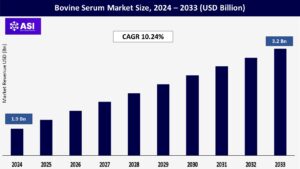
The Bovine Serum Market size is projected to grow from USD 1.9 Billion in 2025 to USD 3.2 billion by 2033, exhibiting a compound annual growth rate (CAGR) of 10.24 % during the forecast period (2025-2033) Bovine serum Derived from cow blood, bovine serum is an essential ingredient of many industrial and scientific operations, especially cell culture.
It offers the vital nutrients, hormones, and growth factors required for in vitro cell development and proliferation. Typically, to produce bovine serum, blood must be drawn from killed calves, and the serum must be separated from the cellular components using techniques like centrifugation.
Because it has a high concentration of proteins and growth factors that promote cell growth, fetal bovine serum (FBS) is one of the forms of bovine serum that is utilized in cell culture the most. It is extensively used in biotechnology, pharmaceutical development, vaccine manufacturing, and biomedical research.
The demand for bovine serum is influenced by the ongoing increase in the worldwide market for biopharmaceuticals and vaccinations. Serum plays a crucial role in the cell culture procedure that produces vaccinations.
Numerous vaccinations, such as those against the flu, measles, mumps, rubella, and polio, are made by cell culture methods that need the use of cow serum as a growth medium in order to cultivate the virus or the viral components that are utilized to make vaccine formulations.
The synthesis of therapeutic proteins, such as hormones, cytokines, growth factors, and monoclonal antibodies, also uses bovine serum. The demand for bovine serum is influenced by the usage of these proteins in a variety of therapeutic applications, such as the treatment of autoimmune illnesses, metabolic disorders, and cancer.
The production of therapeutic proteins, such as growth factors, hormones, cytokines, and monoclonal antibodies, also uses bovine serum. The market for bovine serum is impacted by the usage of these proteins in a variety of medical applications, such as the treatment of autoimmune illnesses, metabolic diseases, and cancer.
Developments in immunology, genetics, and biotechnology are propelling the creation of innovative vaccines and treatments with improved safety and efficacy profiles. Businesses engaged in the study, creation, and marketing of novel technologies, such as CRISPR-based gene editing, mRNA vaccines, and cell and gene therapies, have opportunities.
There is an increasing tendency in cell culture medium creation and adoption of synthetic or animal component-free alternatives due to concerns about animal-derived goods like bovine serum. This change is slow, though, and bovine serum is still the major ingredient in a lot of applications.
The market for non-animal substitutes has grown as worries about animal welfare and the moral ramifications of utilizing products generated from animals have grown. Businesses that use non-animal component substitutes can attract customers who care about ethics and raise their status in the CSR arena.
Modern tissue engineering, computational modelling, and cell culture methods have made it possible to create complex non-animal substitutes that more closely resemble human biology than conventional animal models.
Businesses can use these scientific developments to create cutting-edge, non-animal testing platforms and highly predictive research instruments. Non-animal substitutes reduce the time, expense, and ethical issues related to animal experimentation by providing an economical and effective alternative to conventional animal testing techniques.
Businesses that switch to non-animal testing techniques can save money, save the time it takes to develop new products, and increase the output of their research.
The development of non-animal alternatives is being driven by rising consumer awareness and demand for cruelty-free and sustainable products across a variety of industries, such as household goods, cosmetics, and personal care.
Businesses that offer items that have been tested without using animals can stand out from the competition and draw in customers who care about the environment and morality. In an effort to reduce animal suffering and enhance the predictability and reliability of test results, regulatory bodies are pushing more and more for the use of non-animal alternatives in research and product testing.
Businesses that use non-animal testing methods have the opportunity to both acquire competitive advantages and comply with regulatory requirements.
There are certain religious and cultural groups forbid using goods made from cows due to dietary constraints. Demand and market growth may be impacted by cultural and religious factors that restrict the market penetration and acceptability of bovine serum-based products in particular areas or demographic groups.
Such as the Hindus hold that cows are sacred animals, and many of them forbid eating meat or goods made from cows. This religious conviction can affect dietary decisions and cause some people, especially devoted Hindus, to be reluctant or refuse to utilize goods obtained from cows, such as bovine serum.
In Judaism, dietary laws known as kashrut prohibit the consumption of certain animals, including cows, and their by-products, such as beef and dairy, when not prepared according to kosher standards. Halal, or Islamic, dietary standards specify what constitutes acceptable food and drink, with limits on the consumption of pig and it by products.
Buddhist teachings place a strong emphasis on compassion and doing no harm to living things, even though they do not have the same severe dietary prohibitions as some other religions.
Beliefs and customs about animal care in a given culture, as well as dietary choices, might impact perceptions of goods obtained from cows. Indigenous societies, for instance, might not accept the use of bovine serum in scientific or industrial applications because of long-standing norms and beliefs against the usage of animal products.
Prohibitions based on religion or culture can give rise to discrete market sectors, each with their own tastes and buying habits. In order to effectively reach and engage varied consumer groups, businesses operating in culturally diverse markets may need to take these elements into account when establishing marketing strategies, product formulations, and distribution routes.
Businesses can improve their competitiveness in the bovine serum market by streamlining processes, cutting costs, and implementing vertical integration and supply chain optimization. Through complete supply chain management, which includes sourcing raw materials, production, and distribution, businesses may minimize risks related to external suppliers and guarantee product quality, consistency, and dependability.
Companies may guarantee a steady and dependable supply of high-quality raw materials while reducing costs and reducing supply chain risks by optimizing the sourcing of raw materials, such as bovine blood. Simplifying production procedures, like serum fractionation, processing, and blood collection, can cut lead times, increase output efficiency, and improve the uniformity and quality of the final product.
Inventory carrying costs can be reduced while maintaining product availability to satisfy customer demand by putting effective inventory management techniques, such as demand forecasting, safety stock optimization, and just-in-time inventory replenishment, into practice.
Delivery times may be shortened, transportation costs can be decreased, and customer service can be raised by optimizing logistics and distribution networks. For the purpose of optimizing sourcing, procurement, and supplier performance, it is possible to strengthen supply chain resilience, promote information sharing, and propel continuous improvement programs by cultivating strong connections with suppliers and promoting collaboration.
By using strict quality control procedures throughout the production process from procuring raw materials to distributing finished goods it enables businesses to guarantee product quality, consistency, and regulatory compliance.
By doing away with middle-man markups, cutting transaction costs, and maximizing resource use through economies of scale and scope, vertical integration can result in cost reductions. By providing vertically integrated solutions that give clients end-to-end capabilities, such as bespoke formulas, packaging alternatives, and value-added services, businesses may set themselves apart in the market.
Market penetration with customized serum products offers several strategic advantages for companies in the bovine serum market. Determine the target market categories that have different needs, preferences, and demands for items containing serum.
Divide the market into segments according to variables including geographic locations, application areas (like cell culture, diagnostics, and vaccine production), and industry verticals (like pharmaceuticals, biotechnology, and research institutions).
Create specialized serum goods that are suited to the unique needs of your target market. To meet a variety of application demands and preferences, provide a range of customization alternatives, such as serum formulations with varying nutrient compositions, growth factors, endotoxin levels, and performance characteristics.
Work closely with clients to jointly design bespoke serum products that meet their particular needs in terms of performance, preferences, and specifications. Participate in prototype testing, validation, and iterative feedback loops to make sure customized goods meet or surpass customer expectations.
Offer value-added services to improve customer experience and go hand in hand with personalized serum goods. To assist clients in maximizing the value of tailored serum solutions, optimizing product usage, and troubleshooting problems, provide technical support, advisory services, and training programs.
| Report Metric | Details |
|---|---|
| Segmentations | |
| By Product Type |
Charcoal Stripped Exosome Depleted Stem Cell |
| By Application |
Drug Discovery Cell Culture Media In-Vitro Fertilization |
| By End Users |
Pharmaceutical Biotechnology |
| Key Players |
Hyclone Laboratories Inc. Lanzhou Minhai Biotechnology Co., Ltd. Moregate BioTech Gemini Bio-Products Lampire Biological Laboratories Tissue Culture Biologicals Rocky Mountain Biologicals PAN-Biotech GmbH Bovogen Biologicals Pty Ltd. Biowest SAS Biological Industries Israel Beit Haemek Ltd. |
| Geographies Covered | |
| North America |
U.S. |
| Europe |
U.K. |
| Asia Pacific |
China |
| Middle East & Africa |
Saudi Arabia |
| Latin America |
Brazil |
The global bovine serum market has grown continuously as the increasing meat exclusive and Non vegetarian food eaters. This market is segmented based on product type includes Charcoal Stripped, Exosome Depleted and Stem Cell.
The bovine serum market is segmented based on product type, with charcoal stripped serum, exosome depleted serum, and stem cell serum playing significant roles in various scientific applications.
Charcoal stripped serum is widely utilized in hormone-sensitive cell culture studies, particularly in endocrinology and reproductive biology, where hormone removal is necessary to study cellular responses. This segment accounts for approximately 25% of the market share, driven by its extensive use in hormone-related research.
Exosome depleted serum is crucial for advanced cell therapy, regenerative medicine, and exosome research, ensuring minimal interference in extracellular vesicle studies. This type of serum is particularly valuable in understanding cell communication and disease mechanisms.
Stem cell serum, on the other hand, is specifically formulated for stem cell culture applications, providing essential growth factors to support optimal stem cell proliferation.
Based on application, the market is segmented into drug discovery, cell culture media, and in-vitro fertilization (IVF) being the primary areas of use.
Drug discovery relies heavily on bovine serum for preclinical research, where it is used to test drug efficacy and toxicity. Pharmaceutical and biotechnology companies utilize it across various stages of drug development, making it a vital component in biopharmaceutical advancements.
Cell culture media is the most dominant segment, accounting for 38.3% of the market share, as it is widely used in biotechnology, pharmaceuticals, and academic research institutions. Bovine serum provides essential nutrients that support cell proliferation, making it indispensable for biological research and industrial-scale cell culture production.
In-vitro fertilization (IVF) is another key application, where bovine serum is used in assisted reproductive technologies to enhance embryo development and fertilization procedures.
In North America with a noteworthy 40.1 % market share, it has emerged as the leading area in the global bovine serum market. The growing amount of money that the government spends on research and development (R&D) projects is the cause of this expansion. Particularly the United States is well known for having one of the world’s strongest R&D ecosystems.
Regional expansion is attributed to the establishment of major organizations in the market and their continuous efforts to produce highly effective serum for research purposes. Moreover, the region has a high concentration of cattle rearing, which adds to the abundance of fetal bovine serum which is made from the carcasses of dead cows in slaughterhouses.
The bovine serum market was valued at USD 1.9 billion in 2025.
The market is projected to grow at a CAGR of 10.24% from 2024 to 2029.
North America holds the largest share, accounting for 40.1% of the global bovine serum market.
The market is projected to reach USD 3.2 billion by 2033.