

Breakfast Drink Market
Global Breakfast Drink Market Size, Market Share & Trends Analysis Report, By Product (Nutrition Shakes, Smoothie Mixes, Ready-to-Drink Beverages, Others), By Flavor (Banana, Strawberry, Coffee, Chocolate, Others), By Offer Type (Gluten-Free, Lactose-Free, High Protein, High Fiber, Others), By Distribution Channel (Online, Offline), By Region (North America, Europe, Asia-Pacific, Middle East and Africa, Latin America) – Industry Analysis Report, Regional Outlook, Growth Potential, Price Trends, Competitive Market Share & Forecast, 2025–2033

Historical Period: 2019-2024
Forecast Period: 2025-2033
Report Code : ASIFBR1017
CAGR: 6.4%
Last Updated : August 14, 2026
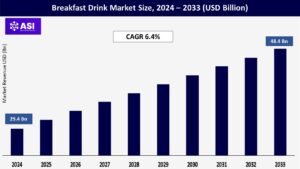
The global Breakfast Drink Market size was valued at approximately USD 29.4 billion in 2024 and is projected to reach USD 48.4 billion by 2033, growing at a CAGR of 6.4% during the forecast period (2025–2032).
Breakfast drinks, including RTD beverages, powdered mixes, and liquid concentrates, are favored for their ease of consumption and health benefits. Rising awareness of functional ingredients, such as protein, fiber, and vitamins, is further fueling market expansion.
Additionally, sustainability trends and innovative flavors are shaping consumer preferences, making breakfast drinks a staple in modern diets.
One of the most influential factors propelling the breakfast drink market is the growing consumer focus on health and wellness. Across the globe, individuals are becoming more conscious of their dietary habits and are actively seeking food and beverage options that support healthier lifestyles. Breakfast drinks are enriched with protein, fiber, vitamins, and minerals.
Consumers are majorly looking for drinks that support health goals such as weight management, digestive health, muscle building, and immune support. As a result, breakfast drinks fortified with functional ingredients like probiotics, collagen, plant-based proteins, and adaptogens are gaining widespread popularity.
Brands are responding by innovating with nutrient-dense, clean-label offerings that cater to consumers avoiding added sugars, artificial ingredients, and allergens.
This shift toward functional and clean-label nutrition is especially pronounced among Millennials and Gen Z populations, who prioritize holistic wellness and transparency in food labeling. The rise in plant-based and vegan diets is also contributing to the growth of dairy-free and soy-, oat-, or almond-based breakfast drinks.
In today’s fast-paced world, many consumers face time constraints in the morning, leading to a decline in traditional sit-down breakfasts. This shift in lifestyle behavior has significantly boosted the appeal of ready-to-drink (RTD) breakfast beverages, which offer a portable and time-efficient alternative without compromising on nutrition.
Working professionals, students, and busy parents are key consumer groups driving this trend. The convenience factor—being able to consume a complete or partial meal in liquid form while commuting or multitasking—has positioned breakfast drinks as a practical solution for modern life.
Moreover, the growing urban population, coupled with the rise of dual-income households, further supports the demand for quick, nutritious breakfast solutions.
To cater to this audience, manufacturers are focusing on packaging innovations such as resealable bottles, shelf-stable formulations, and single-serve formats that enhance usability and portability.
One of the key challenges limiting the growth of the breakfast drink market is the perception among certain consumer groups that these products are overly processed.
Despite growing demand for convenient and functional beverages, many health-conscious consumers remain skeptical of ingredients such as artificial sweeteners, preservatives, colorants, and thickeners that are sometimes used in ready-to-drink formulations.
According to a 2023 survey by the International Food Information Council (IFIC), approximately 61% of consumers globally reported that they prefer products with “recognizable” and “natural” ingredients, and nearly 49% avoid food and beverages they perceive as “heavily processed.”
This sentiment is particularly strong among Gen Z and Millennial consumers who closely scrutinize ingredient labels and are increasingly turning toward clean-label and minimally processed alternatives.
This skepticism can reduce brand loyalty and lead to hesitancy in trial and repeat purchases, particularly in regions where the organic and whole-food movement is gaining momentum. Consequently, manufacturers must work harder to gain trust through transparent labeling, simplified ingredient lists, and clearer communication around the nutritional benefits and sourcing of their products.
Another significant barrier to market expansion is the relatively high price point of premium breakfast drinks. These beverages, especially those fortified with functional ingredients like probiotics, plant-based proteins, adaptogens, and vitamins, often come with a price tag that is substantially higher than traditional breakfast foods such as cereals, oatmeal, or bread.
In price-sensitive markets such as parts of Asia, Africa, and Latin America, the average cost of a single-serve breakfast drink—ranging from $2 to $4—can be prohibitive for daily consumption by the middle and lower-income population segments.
Even in developed markets like the United States and Europe, inflationary pressures on food and beverage categories have led to increased price comparisons, pushing some consumers to substitute with more affordable alternatives.
This pricing disparity poses a challenge for brands attempting to scale in mass markets and calls for innovative solutions such as economy-sized packaging, subscription discounts, or region-specific pricing models to improve affordability.
| Report Metric | Details |
|---|---|
| Segmentations | |
| By Product |
Nutrition Shakes Smoothie Mixes Ready-to-Drink Beverages Others |
| By Flavor |
Banana Strawberry Coffee Chocolate Others |
| By Offer Type |
Gluten-Free Lactose-Free High Protein High Fiber Others |
| By Distribution Channel |
Online Offline |
| Key Players |
Kellogg Quaker Oats General Mills MOMA Sanitarium Arla Foods Nosh Drinks Whole Foods Market SmithKline Beecham |
| Geographies Covered | |
| North America |
U.S. |
| Europe |
U.K. |
| Asia Pacific |
China |
| Middle East & Africa |
Saudi Arabia |
| Latin America |
Brazil |
The breakfast drink market is segmented into Nutrition Shakes, Smoothie Mixes, and Ready-to-Drink (RTD) Beverages. Nutrition Shakes dominated the product segment, accounting for approximately 40.3% of the global market share in 2024.
These products are designed to provide a complete, balanced nutritional profile. Breakfast drink often enriched with protein, fiber, vitamins, and minerals. Their appeal lies in their convenience and functionality, especially among busy professionals, students, and fitness-conscious consumers.
Brands such as Ensure, Boost, and Huel have been key players in this segment. Smoothie Mixes are gaining steady traction, particularly in North America and Europe, where consumers are seeking more personalized, fresh, and natural breakfast options.
These products allow users to blend drinks at home with added fruits or superfoods. The segment is projected to grow at a CAGR of 6.1% from 2025 to 2033, supported by rising demand for clean-label and organic products. Ready-to-Drink Beverages (RTDs) are the fastest-growing segment, expected to expand at a CAGR of 8.4% during the forecast period.
RTDs combine convenience with health benefits, appealing to on-the-go consumers. Innovations in shelf-stable packaging, flavor variety, and nutritional fortification are fueling this rapid growth. Key players include Nestlé (Carnation Breakfast Essentials), Kellogg’s, and Suja.
The flavor segment is a crucial differentiator in consumer choice, and the market is segmented into Banana, Strawberry, and Coffee, among others. Banana remains the leading flavor, favored for its naturally sweet taste, creamy texture, and high potassium content. It accounted for around 29.7% of flavored breakfast drink consumption in 2024.
It is especially popular in family and children’s products. Strawberry follows closely, appreciated for its fruity and refreshing profile. It performs well in both nutrition shakes and smoothie blends and appeals across all age groups.
Coffee-flavored breakfast drinks are seeing rising demand, especially in urban centers and among millennials and Gen Z consumers seeking both nutrition and a caffeine boost. The market for coffee-flavored breakfast beverages is projected to grow at 7.6% CAGR, driven by innovations such as cold brew protein drinks and oat-based coffee blends.
The offer type segment reflects growing consumer interest in health and wellness, food intolerances, and dietary personalization. Gluten-Free+ breakfast drinks lead this category, driven by the rise in gluten sensitivities, celiac disease, and the general preference for gluten-free lifestyles.
In 2024, gluten-free options made up nearly 33.5% of product launches in the functional drink category, as reported by Mintel. High Protein offerings are growing rapidly, supported by the fitness boom and consumer desire for sustained energy and satiety.
These drinks often include whey or plant-based proteins like soy, pea, or rice. According to a 2023 Innova report, “high-protein” was the most commonly used health claim in new RTD breakfast beverages launched globally.
Lactose-Free products are expanding their footprint due to increasing awareness of lactose intolerance, which affects around 68% of the global population, according to the National Institutes of Health. This segment is especially strong in Asia-Pacific and Latin America, where dairy-free alternatives such as almond, oat, and coconut milk bases are commonly used.
The breakfast drink market is distributed through both Online and Offline channels, each serving distinct customer bases. Online Retail has emerged as the dominant distribution channel, accounting for over 51.8% of global sales in 2024. The surge is driven by the convenience of home delivery, access to a wider range of brands, and the popularity of subscription services.
Platforms like Amazon, iHerb, and brand-specific DTC (direct-to-consumer) websites have contributed to this growth, along with influencer marketing and wellness-focused social media campaigns.
Offline Retail — including supermarkets, hypermarkets, pharmacies, and specialty health food stores — continues to hold a significant share, particularly in regions with limited internet access or where consumers prefer to inspect products physically. This channel is vital in emerging markets such as parts of Africa, Southeast Asia, and rural Latin America.
The global breakfast drink market demonstrates diverse regional dynamics, driven by variations in lifestyle, income levels, dietary preferences, and health awareness.
North America and Europe lead in terms of market maturity, while Asia-Pacific emerges as the most promising growth region. Latin America and the Middle East & Africa show gradual but steady development, driven by urbanization and evolving consumer preferences.
North America held the largest market share of 34.9% in 2023, making it a key region in the global breakfast drink market. The United States leads regional demand, supported by a health-conscious consumer base, high disposable incomes, and a well-established culture of functional food consumption.
The rising popularity of protein-rich, low-sugar, and plant-based breakfast drinks aligns with dietary trends such as keto, veganism, and intermittent fasting. Major brands such as Ensure (Abbott), Premier Protein, and Orgain dominate the shelves, while emerging DTC brands are gaining traction via online subscriptions and influencer marketing.
According to the International Food Information Council (IFIC), 72% of U.S. consumers reported actively seeking functional food or beverages in 2023, boosting the market for fortified breakfast drinks.
Asia-Pacific is the fastest-growing regional market, projected to expand at a CAGR of 8.5% from 2024 to 2033, driven by rapid urbanization, rising middle-class populations, and changing dietary habits. Countries such as China, India, Japan, and South Korea are seeing increasing adoption of convenient breakfast alternatives due to fast-paced lifestyles.
Dairy alternatives and lactose-free drinks are highly favored, especially in East Asia, where lactose intolerance is prevalent among up to 90% of the adult population. In India, the breakfast drink category is benefiting from the boom in on-the-go health drinks like Horlicks Protein+, Nestlé Nesvita, and Amul’s high-protein milk drinks.
Europe accounts for 28.2% of the global breakfast drink market, with countries like the United Kingdom, Germany, France, and the Netherlands at the forefront in terms of product innovation, sustainability practices, and clean-label preferences.
Consumers in Europe demonstrate a strong preference for organic, non-GMO, and locally sourced ingredients. The growing number of vegan and flexitarian consumers is boosting demand for oat-based, almond, and soy-based breakfast drinks.
Regulatory support, including EFSA-approved health claims and sustainability labeling requirements, is helping build consumer trust and brand transparency. Brands such as Alpro (Danone), Oatly, and Huel are particularly successful, offering a wide range of breakfast beverages designed for health-conscious consumers.
Latin America accounts xx% of the global breakfast drink market in 2023, with Brazil emerging as a regional leader in health-oriented food and beverage consumption. Rising awareness about nutrition and obesity is pushing demand for fortified and low-calorie options.
Local and regional brands are introducing protein-enriched, vitamin-fortified RTD drinks catering to both urban millennials and working-class families. Most of the Brazilian consumers prioritize functional benefits in food and beverages, a trend contributing to the market’s expansion.
The Middle East & Africa is experiencing steady growth amid increasing urbanization and westernization of diets. UAE, Saudi Arabia, and South Africa are growing demand for wellness-focused beverages and fortified drinks.
Cultural shifts and rising female workforce participation are increasing demand for convenient, nutritious options suitable for busy lifestyles. Though infrastructure and affordability remain challenges, investment in retail modernization and health awareness campaigns are helping open up new markets.
The market was valued at USD 29.4 billion in 2024.
The market is projected to grow at a CAGR of 6.4% from 2025 to 2033.
Nutrition Shakes lead the market due to their balanced nutritional profile.
Asia-Pacific is the fastest-growing region, driven by urbanization and changing consumer preferences.
Major players include Kellogg, Quaker Oats, General Mills, MOMA, and Sanitarium.
1.1 Summary
1.2 Research methodology
2.1 Research Objectives
2.2 Market Definition
2.3 Limitations & Assumptions
2.4 Market Scope & Segmentation
2.5 Currency & Pricing Considered
3.1 Drivers
3.2 Geopolitical Impact
3.3 Human Factors
3.4 Technology Factors
4.1 Porters Five Forces Analysis
4.2 Value Chain Analysis
4.3 Average Pricing Analysis
4.4 M & A, Agreements & Collaboration Analysis
5.1 Global Breakfast Drink Market, By Product
5.1.1 Introduction
5.1.2 Market Size & Forecast
5.2 Global Breakfast Drink Market, By Flavor
5.3 Global Breakfast Drink Market, By Offer Type
5.4 Global Breakfast Drink Market, By Distribution Channel
6.1 North America Breakfast Drink Market, By Country
6.1.1 Breakfast Drink Market, By Product
6.1.2 Breakfast Drink Market, By Flavor
6.1.3 Breakfast Drink Market, By Offer Type
6.1.4 Breakfast Drink Market, By Distribution Channel
6.2 U.S.
6.2.1 Breakfast Drink Market, By Product
6.2.2 Breakfast Drink Market, By Flavor
6.2.3 Breakfast Drink Market, By Offer Type
6.2.4 Breakfast Drink Market, By Distribution Channel
6.3 Canada
7.1 U.K.
7.2 Germany
7.3 France
7.4 Spain
7.5 Italy
7.6 Russia
7.7 Nordic
7.8 Benelux
7.9 The Rest of Europe
8.1 China
8.2 South Korea
8.3 Japan
8.4 India
8.5 Australia
8.6 Taiwan
8.7 South East Asia
8.8 The Rest of Asia-Pacific
9.1 UAE
9.2 Turkey
9.3 Saudi Arabia
9.4 South Africa
9.5 Egypt
9.6 Nigeria
9.7 Rest of MEA
10.1 Brazil
10.2 Mexico
10.3 Argentina
10.4 Chile
10.5 Colombia
10.6 Rest of Latin America
11.1 Global Market Share (%) By Players
11.2 Market Ranking By Revenue for Players
11.3 Competitive Dashboard
11.4 Product Mapping