

Breast Implants Market
Breast Implants Market Share and Trend Analysis, By Technology (Silicone Gel Implants, Saline-Filled Implants, Structured Saline Alternatives), By Application (Cosmetic Augmentation, Reconstructive Surgery, Revision Procedures), By End User (Hospitals, ASCs, Specialty Plastic Surgery Clinics) – Industry Analysis Report, Regional Outlook, Growth Potential, Price Trends, Competitive Market Share & Forecast, 2026–2033

Historical Period: 2019-2024
Forecast Period: 2025-2033
Report Code :
CAGR: 6.9%
Last Updated : August 4, 2025
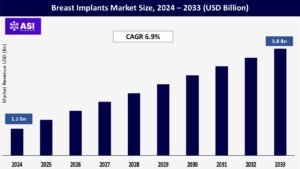
The global Breast Implants Market was valued at USD 1.2 billion in 2024 and is projected to reach USD 3.8 billion by 2033, expanding at a compound annual growth rate CAGR of 6.9% during the forecast period (2025 – 2033).
Breast implants are surgical prostheses to augment breast size for aesthetic purposes or to restore breast form after mastectomy (in many instances, for breast cancer), trauma, or congenital defects. These devices use silicone gel or saline (sterile sodium chloride solution) as the main filling substances, appealing to both aesthetic desires and necessary clinical reconstructive purposes. The market essentially has two different functions: cosmetic enhancement, driven by individual desire for improved physique, and reconstruction medically, a process typically resulting from the treatment of breast cancer and other physical injury. Pacing the market are a combination of forces such as growing social tolerance for cosmetic surgery, widespread documentation of breast cancer incidence rates increasing globally that requires reconstructive intervention, and ongoing technological development in implant technology providing enhanced safety and aesthetic results.
Innovations revolve around materials, texture of the surface, and shape to offer a more natural feel, minimize risk of complications, and deliver higher patient satisfaction. Yet, the industry has strong headwinds to contend with. Continuous regulatory oversight worldwide, especially in relation to long-term safety information and post-market monitoring, places stringent demands on producers. In addition, some ongoing issues with possible health hazards of implants, including capsular contracture (scar tissue thickening), rupture, and some unusual but severe conditions like Breast Implant-Associated Anaplastic Large Cell Lymphoma (BIA-ALCL) caused by some textured implants, engender apprehension among surgeons and patients. These considerations of safety and the intricate regulation regime function as key restraints to market growth even in the presence of underlying growth drivers.
The escalating global prevalence of breast cancer remains a primary driver for breast implant demand, particularly in reconstructive applications. As the most commonly diagnosed cancer worldwide, breast cancer necessitates mastectomies as a core treatment approach. This drives substantial demand for breast reconstruction, with a significant proportion of patients in developed regions opting for implant-based restoration. Legislative mandates in key markets ensure insurance coverage for post-mastectomy reconstruction, removing financial barriers and enhancing patient access. Simultaneously, targeted awareness campaigns by medical professionals and advocacy groups highlight the profound psychological and emotional benefits of reconstructive surgery, positioning it as integral to comprehensive cancer recovery.
Emerging economies are now mirroring these trends as healthcare infrastructure expands. Improved access to diagnostic services enables earlier breast cancer detection across Asia-Pacific and Latin America, creating growing pools of reconstruction candidates. Rising cancer screening rates and increasing patient education further normalize implant-based restoration in these regions. While cultural acceptance varies, the fundamental link between breast cancer treatment and reconstructive demand persists globally. This clinical necessity, supported by evolving healthcare policies and societal recognition of patients’ holistic recovery needs, continues to propel the reconstructive segment of the breast implant market forward despite broader industry challenges.
The normalization of cosmetic breast augmentation is fundamentally driven by profound cultural and technological shifts. Social media platforms relentlessly expose diverse beauty ideals, while celebrities and influencers openly discuss their elective procedures, significantly reducing societal stigma, particularly among younger demographics. This visibility transforms breast augmentation from a taboo into a mainstream consideration for personal enhancement. Concurrently, medical tourism thrives as patients seek affordable options abroad, leveraging substantial cost differentials in destinations known for high-quality, lower-cost surgical care.
Technological innovation remains pivotal, with advanced implant designs offering improved safety profiles, more natural aesthetics, and greater durability, directly addressing historical patient concerns. These developments foster greater confidence in choosing augmentation. Furthermore, rising economic prosperity in developing nations expands the consumer base, as growing middle classes allocate discretionary income towards aesthetic procedures. The convergence of heightened social acceptance, accessible international options, continuous product improvements, and expanding economic capability sustains robust demand within the cosmetic segment, positioning it as a cornerstone of the global breast implants market.
Safety issues related to implants pose a major hindrance to market expansion. Increased recognition of rare but serious illnesses, such as Breast Implant-Associated Anaplastic Large Cell Lymphoma (BIA-ALCL) that is mainly associated with textured devices, and the wider range of systemic symptoms known as Breast Implant Illness (BII) continues to influence clinician and patient confidence. Such highly publicized risks have provoked significant regulatory responses globally. Regulators have retaliated with tough requirements, including long-term safety data of unprecedented scope and rigorous post-market surveillance for every new and established product.
Regulating compliance requires heavy investment by manufacturers, driving costs up and timelines out for product development and market introduction. At the same time, chronic legal battles and high-profile trials involving purported implant complications create a culture of caution. This union of drivers – increased safety rhetoric, increased regulatory scrutiny, and continued legal examination – adds to caution among prospective patients. A quantifiable percentage of qualified patients delay or forego augmentation or reconstruction surgeries because of unresolved safety attitudes. In the face of offsetting clinical developments, these deeply entrenched issues and the changing, stringent regulatory environment serve as immense brakes, curbing total growth potential for the breast implants business.
| Report Metric | Details |
|---|---|
| By Technology |
Silicone Gel Implants Saline-Filled Implants Structured Saline Alternatives
|
| By Application |
Cosmetic Augmentation Reconstructive Surgery Revision Procedures
|
| By End-User |
Hospitals Ambulatory Surgical Centers (ASCs) Specialty Plastic Surgery Clinics
|
| Key Players |
|
| North America |
U.S. |
| Europe |
U.K. |
| Asia Pacific |
China |
| Middle East & Africa |
Saudi Arabia |
| Latin America |
Brazil |
The market of breast implants segments most importantly by core technology and filling material, influencing patient preference and surgical results. The most prominent category is silicone gel implants, which are preferred for their very natural feel and contour that very closely approaches breast tissue. They are preferred because they have the cohesive gel structure, which ensures preservation of its shape with movement and positional changes and provides optimal aesthetic outcomes. Conversely, saline-filled implants appeal to a specific segment valuing safety and simplicity in procedure; their main benefit is the body’s harmless absorption of saline solution upon rupture, along with a lesser need for incision at implantation. Saline devices are, however, greatly restricted by the high degree of visible rippling beneath the skin and a less natural, at times fluid-like sensation, especially in patients with little natural breast tissue cover.
An emerging category is the structured saline alternatives, designed with nested chamber or baffle systems aimed to leverage saline’s intrinsic safety profile together with greater stability and more natural appearance by eliminating the traditional rippling effect. Ongoing innovations aim towards better biocompatibility and complication avoidance, most notably through advanced surface implant technologies such as unique micropatterning intended to reduce negative immune reactions and virulent scar tissue formation (capsular contracture). This continuing technological progress directly confronts chronic clinical issues while continually broadening viable patient candidates and procedural confidence. The interaction of material science and surface engineering continues as key to market progress.
Application segmentation yields unique demand drivers among cosmetic, reconstructive, and revision procedures. Cosmetic augmentation represents the largest segment, driven by discretionary patient decisions based on individual aesthetic wishes and changing cultural standards of beauty. This is a mirror of the normalization of enhancement techniques as optional investments in personal image. On the other hand, reconstructive surgery sees more robust momentum growth tied to increasing breast cancer incidence requiring post-mastectomy restoration. More supportive insurance structures acknowledging reconstruction as integral to wholistic recovery also drive this segment.
Revision procedures are a persistent demand driver, largely based on the limited functional lifetime of implants requiring exchange, in addition to corrective actions for medical complications such as capsular contracture or rupture, and aesthetic taste evolution. This segment reflects both the clinical need and quest for improved outcomes and maintains stable demand regardless of market trends elsewhere. Every application route has distinct motivational systems – cosmetic led by desire, reconstruction by medical need and mental repair, and revision by upkeep, correction, or enhancement – all contributing to the market’s complex growth path and patient interaction patterns.
End-user segmentation identifies where treatments are conducted, mirroring cost profiles, complexity, and patient routes. Hospitals have a dominant role, especially for intricate reconstructive procedures that require multidisciplinary facilities, prolonged care pathways, and co-morbidity management commonly found in cancer patients. Their unified infrastructure facilitates extensive surgical planning, in-patient rehabilitation, and systematic post-operative management required in high-risk interventions. Ambulatory Surgical Centers (ASCs) are the most rapidly expanding environment, particularly for cosmetic enhancement. Their appeal resides in substantial cost savings, efficient scheduling, dedicated elective-only environments, and less hospital-acquired infection exposure, all of which fit exceptionally well with outpatient procedural requirements.
They enable more rapid patient throughput and stable pricing. Specialty plastic surgery centers represent an important third segment, based on intensive surgeon skill, highly individualized consultation experiences to establish trust, and single-focused follow-up care relationships that engender long-term loyalty in patients. These clinics would tend to target high-volume cosmetic practices and discerning patients that require a boutique, aesthetic environment with ongoing surgeon interaction. Setting selection has a profound impact on access to procedures, cost, availability of clinical resources, and the overall continuum of patient experience and outcomes.
North America continues as the leading regional market, fueled by a well-documented high incidence of breast cancer that requires widespread reconstructive procedures. Strong insurance requirements, especially under post-mastectomy reconstruction access legislation, decrease financial hurdles among patients by a considerable amount. Highly developed healthcare infrastructure, which facilitates sophisticated procedures and full aftercare, benefits the area. Cultural acceptance of aesthetic enhancement combined with widespread surgeon experience and well-developed patient education initiatives maintains high procedural volumes. The United States produces the vast majority of regional revenue, indicative of its established medical device market and advanced adoption rates for both cosmetic and reconstructive uses.
Europe is a significant, highly controlled market with stringent safety regulations covering implant production and clinical applications. The European Union’s Medical Device Regulation (EU MDR) mandates tough pre-market and post-market surveillance standards, providing high safety levels but also elevating manufacturers’ compliance burdens. Demand is supported by high incidence of breast cancer and robust universal healthcare systems in countries such as Germany and France, which support wide access to reconstructive surgery as part of high-quality cancer treatment. Whereas cosmetic enhancement is ongoing, the area shows a clear focus on medically indicated reconstruction, aided by patient rights guidelines and well-established clinical pathways prioritizing overall recovery.
The Asia-Pacific region is showing the most significant market growth, driven by factors that are converging: increasing disposable incomes allowing for discretionary cosmetic treatments, emerging medical tourism destinations providing cost-effective services, and expanding breast cancer awareness and reconstruction demand. South Korea and Thailand, among others, receive large volumes of international patients who come to access high-end aesthetic surgery at cheaper prices. At the same time, enhanced domestic healthcare infrastructure and increasing rates of cancer screening in densely populated countries like India and China are broadening the base of reconstruction candidates. Public health efforts and private investment are actively treating previously unserved segments, driving market penetration.
The LAMEA market offers a heterogeneous but consistently changing breast implants market, with unique growth patterns in its sub-regions. In Latin America, Brazil and Mexico lead the pace largely based on intense cultural focus on body image and aesthetics, creating a high demand for cosmetic augmentation procedures, often with support from growing private healthcare networks targeting an increasingly prosperous middle class. The Middle East, especially Gulf countries such as the UAE, uses state-of-the-art medical tourism facilities and considerable disposable incomes to draw national and international patients in pursuit of superior cosmetic surgery. South Africa stands out as an important African hub, driven by the expansion of private healthcare. Though education about reconstructive procedures following mastectomy is slowly increasing, the area as a whole is confronted with issues such as uneven access to healthcare and incoherent reimbursement systems, tempering more harmonized growth despite inherent possibility in focused urban areas and medical tourism markets.
The global breast Implants market was valued at USD 1.2 billion in 2024.
The breast implants market is projected to grow at a CAGR of 6.9 % from 2025 to 2033.
Major players include AbbVie (Allergan), Johnson & Johnson (Mentor), Sientra, Establishment Labs, GC Aesthetics, POLYTECH Health & Aesthetics, Groupe Sebbin, Ideal Implant
The Silicone hold the largest market share of breast implants.
The Asia-Pacific region is expected to witness the highest growth rate.
1.1 Summary
1.2 Research methodology
2.1 Research Objectives
2.2 Market Definition
2.3 Limitations & Assumptions
2.4 Market Scope & Segmentation
2.5 Currency & Pricing Considered
3.1 Drivers
3.2 Geopolitical Impact
3.3 Human Factors
3.4 Technology Factors
4.1 Porters Five Forces Analysis
4.2 Value Chain Analysis
4.3 Average Pricing Analysis
4.4 M & A, Agreements & Collaboration Analysis
5.1 Breast Implants Market , By Technology
5.1.1 Introduction
5.1.2 Market Size & Forecast
5.2 Breast Implants Market , By Application
5.3 Breast Implants Market , By End User
6.1 North America Breast Implants Market , By Country
6.1.1 Breast Implants Market , By Technology
6.1.2 Breast Implants Market , By Application
6.1.3 Breast Implants Market , By End User
6.2 U.S.
6.2.1 Breast Implants Market , By Technology
6.2.2 Breast Implants Market , By Application
6.2.3 Breast Implants Market , By End User
6.3 Canada
7.1 U.K.
7.2 Germany
7.3 France
7.4 Spain
7.5 Italy
7.6 Russia
7.7 Nordic
7.8 Benelux
7.9 The Rest of Europe
8.1 China
8.2 South Korea
8.3 Japan
8.4 India
8.5 Australia
8.6 Taiwan
8.7 South East Asia
8.8 The Rest of Asia-Pacific
9.1 UAE
9.2 Turkey
9.3 Saudi Arabia
9.4 South Africa
9.5 Egypt
9.6 Nigeria
9.7 Rest of MEA
10.1 Brazil
10.2 Mexico
10.3 Argentina
10.4 Chile
10.5 Colombia
10.6 Rest of Latin America
11.1 Global Market Share (%) By Players
11.2 Market Ranking By Revenue for Players
11.3 Competitive Dashboard
11.4 Product Mapping