

Calcium Nitrate Market
Calcium Nitrate Market & Trends Analysis Report, By Form (Liquid Calcium Nitrate, Calcium Nitrate Granular, Calcium Nitrate Crystalline), By Application (Fertilizers, Manufacturing of Concrete, Treatment of Wastewater, Others & Explosives), By End User (Farming, Industrial & Chemical, Other people)– Industry Analysis Report, Regional Outlook, Growth Potential, Price Trends, Competitive Market Share & Forecast, 2025–2033.

Historical Period: 2019-2024
Forecast Period: 2025-2033
Report Code :
CAGR: 4.9%
Last Updated : March 20, 2026
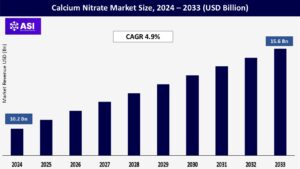
The global Calcium Nitrate Market size was valued at approximately USD 10.2 billion in 2024 and is projected to reach USD 15.6 billion by 2033, growing at a CAGR of 4.9% during the forecast period (2025–2033).
The inorganic substance calcium nitrate (Ca(NO₃)₂) is mostly utilized in cold packs, fertilizers, pyrotechnics and explosives, and concrete admixtures. It is useful in both industrial and agricultural settings due to its high solubility, hygroscopic character, and potential for calcium enrichment.
The demand for increased agricultural production, the growing usage of fertilizers high in calcium, and the expansion of infrastructural development are driving the market. However, market expansion may be constrained by regional environmental legislation and shifting raw material costs.
Because it provides both calcium and nitrate nitrogen, which are both necessary for root growth and fruit quality, calcium nitrate is a common nitrogenous fertilizer.
In greenhouse farming, hydroponics, and horticulture, it is especially useful. Calcium-rich fertilizers are becoming more and more in demand as worries about soil health and nutrient inadequacies grow, particularly in the Asia-Pacific and Latin America.
Calcium nitrate serves as a key ingredient in concrete admixtures, accelerating setting time, especially in cold climates. Rapid construction growth across India, China, the UAE, and Southeast Asia, coupled with a rising focus on durable, high-strength concrete, is fuelling demand from the construction sector.
Calcium nitrate manufacturing is largely dependent on raw materials, including ammonia, nitric acid, and limestone, all of which are impacted by supply-demand dynamics, global energy prices, and geopolitical events.
For example, the cost of producing ammonia is directly impacted by changes in natural gas prices, while the availability of limestone may be impacted by mining or logistical problems. Particularly for small to mid-sized producers, these input cost variations undermine manufacturer margins, threaten pricing stability, and generate supply-side uncertainty.
Concerns about soil acidification, groundwater contamination, and surface water body eutrophication have been raised by the widespread use of nitrogen-based fertilizers, such as calcium nitrate.
Consequently, regulatory organizations such as the U.S. Environmental Protection Agency (EPA) and the European Chemicals Agency (ECHA) are implementing more stringent guidelines regarding fertilizer mixing, runoff control, and nitrate application.
If not combined with sustainable agricultural methods, this could restrict the amount of calcium nitrate used in agriculture in highly regulated markets like the EU and North America. Furthermore, complying with regulations frequently results in increased operating expenses, which discourages new competitors and complicates global trade.
| Report Metric | Details |
|---|---|
| Segmentations | |
| By Form |
Liquid Calcium Nitrate Calcium Nitrate Granular Calcium Nitrate Crystalline |
| By Application |
Fertilizers Manufacturing of Concrete Treatment of Wastewater Others & Explosives |
| By End-User |
Farming Industrial & Chemical Other people |
| Key Players |
|
| Geographies Covered | |
| North America |
U.S. |
| Europe |
U.K. |
| Asia Pacific |
China |
| Middle East & Africa |
Saudi Arabia |
| Latin America |
Brazil |
The Calcium Nitrate Market is segmented by Form (Liquid Calcium Nitrate, Calcium Nitrate Granular, Calcium Nitrate Crystalline), By Application (Fertilizers, Manufacturing of Concrete, Treatment of Wastewater, Others & Explosives), By End User (Farming, Industrial & Chemical, Other people).
Each factor plays a crucial role in enhancing patient safety, increasing the adoption of self-administered anticoagulant therapies, and supporting the development of more convenient, prefilled drug delivery systems that streamline treatment in the management of thromboembolic and cardiovascular conditions.
In hydroponic farming, greenhouses, and fertigation systems, where accurate and uniform nutrient distribution is essential, liquid calcium nitrate is widely utilized.
The liquid form improves crop nutrient uptake efficiency and minimizes nutrient loss because it dissolves readily and works with automated watering systems. Additionally, wastewater treatment plants use liquid calcium nitrate to prevent sulfides and manage odors.
Because they are simple to handle, carry, and use in the field, granules are the favored method in traditional agriculture. These are frequently utilized in open-field farming for vegetables, corn, and sugarcane.
Granular forms provide slow-release and economical nutrient delivery, making them especially well-suited for broadcasting and side-dressing during the planting and growing stages.
Because of its exceptional purity and solubility, crystalline calcium nitrate is perfect for specialized uses in pyrotechnics, chemical synthesis, laboratories, and explosives manufacturing. Additionally, it is utilized in particular industrial formulations that call for regulated reactivity and a constant chemical makeup.
With more than half of the market, this is the most popular application segment. Calcium nitrate supplies both calcium and nitrate nitrogen, which are essential for the synthesis of chlorophyll and the strength of plant cell walls.
Fruit firmness, shelf life, and disease resistance are all improved by its use. It works especially well on high-value crops, including potatoes, berries, citrus fruits, tomatoes, and lettuce.
Calcium nitrate is utilized in the construction sector as an anti-freeze and set accelerator, particularly for concrete applications in cold areas. In precast elements and infrastructure projects exposed to high temperatures, it improves early strength development, shortens setting times, and helps avoid cracking.
In industrial and municipal wastewater systems, calcium nitrate is used to stop hydrogen sulfide gas from forming, which can lead to corrosion and stench. By providing a readily assimilated nitrogen source, it also facilitates biological denitrification. It is becoming more popular in the fields of sludge stabilization, food and beverage waste treatment, and urban sanitation.
Calcium nitrate is utilized in cold pack applications, pyrotechnics, and emulsion explosives because of its oxidizing qualities. It improves blast efficiency and mining and quarrying safety in the explosives industry. It is also used in experimental research and specialized synthesis by specialty chemical firms.
Commercial farms, horticultural growers, and fertilizer distribution networks are all included in agriculture, which continues to be the largest end-user segment. In order to treat calcium insufficiency, boost crop output, and facilitate precision farming techniques, calcium nitrate is essential. Africa, Latin America, and the Asia-Pacific have particularly high demand.
includes companies that create chemicals, explosives, and wastewater treatment facilities. For usage in controlled detonation compositions, oxidation reactions, and sulfide suppression, these users require high-performance, stable-grade calcium nitrate.
R&D labs, cold pack makers, and fireworks companies fall under this group. It represents a steady demand from specialized applications that need high-purity nitrate compounds, notwithstanding its niche size.
The largest and fastest-growing region is driven by expanding agriculture, urbanization, and infrastructure development in India, China, Vietnam, and Indonesia. Strong government subsidies and initiatives for modern irrigation and crop enhancement boost demand.
Significant demand from the fertilizer and construction industries in the U.S. and Canada. Widespread adoption of precision farming techniques is further accelerating usage.
Regulatory scrutiny on nitrates is high, but there is steady demand in horticulture, wastewater treatment, and specialty chemicals, especially in Germany, the Netherlands, and Spain.
The growth of commercial agriculture and sugarcane cultivation in Brazil and Argentina is supporting market expansion, alongside urban infrastructure investments.
Construction booms in the UAE, Saudi Arabia, and Egypt, combined with food security concerns, are increasing demand for calcium nitrate across the agricultural and concrete sectors.
The market size of Calcium Nitrate market is USD 10.2 billion.
The projected CAGR of Calcium Nitrate market is 4.9%
Fertilizers, due to extensive agricultural use.
Asia-Pacific, led by India and China.
Yara International, Haifa Group, Sasol Chemicals, URALCHEM, GFS Chemicals.
1.1 Summary
1.2 Research methodology
2.1 Research Objectives
2.2 Market Definition
2.3 Limitations & Assumptions
2.4 Market Scope & Segmentation
2.5 Currency & Pricing Considered
3.1 Drivers
3.2 Geopolitical Impact
3.3 Human Factors
3.4 Technology Factors
4.1 Porters Five Forces Analysis
4.2 Value Chain Analysis
4.3 Average Pricing Analysis
4.4 M & A, Agreements & Collaboration Analysis
5.1 Calcium Nitrate Market, By Form
5.1.1 Introduction
5.1.2 Market Size & Forecast
5.2 Calcium Nitrate Market, By Application
5.3 Calcium Nitrate Market, By End-User
6.1 North America Calcium Nitrate Market , By Country
6.1.1 Calcium Nitrate Market, By Form
6.1.2 Calcium Nitrate Market, By Application
6.1.3 Calcium Nitrate Market, By End-User
6.2 U.S.
6.2.1 Calcium Nitrate Market, By Form
6.2.2 Calcium Nitrate Market, By Application
6.2.3 Calcium Nitrate Market, By End-User
6.3 Canada
7.1 U.K.
7.2 Germany
7.3 France
7.4 Spain
7.5 Italy
7.6 Russia
7.7 Nordic
7.8 Benelux
7.9 The Rest of Europe
8.1 China
8.2 South Korea
8.3 Japan
8.4 India
8.5 Australia
8.6 Taiwan
8.7 South East Asia
8.8 The Rest of Asia-Pacific
9.1 UAE
9.2 Turkey
9.3 Saudi Arabia
9.4 South Africa
9.5 Egypt
9.6 Nigeria
9.7 Rest of MEA
10.1 Brazil
10.2 Mexico
10.3 Argentina
10.4 Chile
10.5 Colombia
10.6 Rest of Latin America
11.1 Global Market Share (%) By Players
11.2 Market Ranking By Revenue for Players
11.3 Competitive Dashboard
11.4 Product Mapping