

Chloroform Market
Chloroform Market & Trends Analysis Report, By Grade (Grade Technical, Grade of Pharmaceuticals), By Application (Solvent, Chemical Synthesis Intermediate, The Declining Use of Anesthetics), By End User (Pharmaceutical Businesses, Manufacturers of Chemicals, Research Institutes and Laboratories)– Industry Analysis Report, Regional Outlook, Growth Potential, Price Trends, Competitive Market Share & Forecast, 2025–2033.

Historical Period: 2019-2024
Forecast Period: 2025-2033
Report Code :
CAGR: 4.5%
Last Updated : April 13, 2026
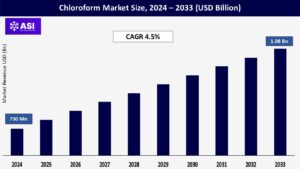
The global chloroform market size was valued at approximately USD 730 million in 2024 and is projected to reach USD 1.08 billion by 2033, growing at a CAGR of 4.5% during the forecast period.
Chloroform, also known as trichloromethane, is widely used as a solvent and intermediate in chemical synthesis, pharmaceuticals, and agrochemicals. Its usage in anesthesia and refrigerants has declined, but industrial demand remains strong.
In the manufacturing of dyes, agrochemicals, and medications—especially the synthesis of chlorodifluoromethane (HCFC-22)—chloroform is an essential solvent and intermediary.
The need for high-purity chloroform, which is utilized in medication formulation and production, is being driven by the pharmaceutical industry’s explosive growth, particularly in Asia-Pacific nations like China and India.
In molecular biology, chloroform is still frequently used, particularly in organic compound analysis and DNA extraction procedures. Particularly in industrialized nations and economies that rely heavily on research, the growing number of academic institutions, biotechnology companies, and research laboratories is helping to maintain a stable level of market demand.
Because of its toxicity and propensity for cancer, chloroform is categorized as a hazardous material. In places like North America and Europe, where stringent guidelines control its handling, labeling, storage, and disposal, its use is highly regulated. Market expansion is restrained by the substantial operational costs that producers and end users incur as a result of complying with these laws.
The production of hydrochlorofluorocarbon-22 (HCFC-22), a refrigerant that is currently being phased out under international agreements like the Montreal Protocol, has historically relied heavily on chloroform as a raw material.
The demand for chloroform in this market has drastically decreased due to the global shift toward eco-friendly refrigerants, which further restricts prospects for market progress.
| Report Metric | Details |
|---|---|
| Segmentations | |
| By Grade |
Grade Technical Grade of Pharmaceuticals |
| By Application |
Solvent Chemical Synthesis Intermediate The Declining Use of Anesthetics |
| By End-User |
Pharmaceutical Businesses Manufacturers of Chemicals Research Institutes and Laboratories |
| Key Players |
|
| Geographies Covered | |
| North America |
U.S. |
| Europe |
U.K. |
| Asia Pacific |
China |
| Middle East & Africa |
Saudi Arabia |
| Latin America |
Brazil |
The Chloroform Market is segmented by Grade (Grade Technical, Grade of Pharmaceuticals), By Application (Solvent, Chemical Synthesis Intermediate, The Declining Use of Anesthetics), By End User (Pharmaceutical Businesses, Manufacturers of Chemicals, Research Institutes and Laboratories).
Each factor plays a crucial role in enhancing patient safety, increasing the adoption of self-administered anticoagulant therapies, and supporting the development of more convenient, prefilled drug delivery systems that streamline treatment in the management of thromboembolic and cardiovascular conditions.
Technical-grade chloroform is extensively utilized in many industrial processes, such as the production of dyes, insecticides, and solvents for chemical intermediates. It is the most often used grade worldwide, particularly in developing nations, due to its lower cost and sufficient purity for non-medical uses.
This high-purity grade is designed for use in pharmaceutical applications, including the manufacturing of certain anesthetic formulations and active pharmaceutical ingredients (APIs). It needs to meet strict pharmacopeial requirements (e.g., USP, EP). Demand is concentrated in markets with strict regulations, such as the US and the EU, where product quality and compliance are crucial.
Because it can dissolve a variety of non-polar materials, including lipids, alkaloids, rubber, and waxes, chloroform is frequently used as a solvent in organic synthesis. It is the most popular application category worldwide due to its cost-effectiveness and adaptability, which have made it a mainstay in many industrial processes.
In the synthesis of many different compounds, such as dyes, fluoropolymers, and polytetrafluoroethylene (PTFE), chloroform is an essential step. This market is driven by the specialty chemical sector, as the need for high-performance materials in the industrial, automotive, and electronics industries grows.
Because of worries about toxicity and possible carcinogenicity, chloroform’s medicinal use has drastically decreased from its historical use as an inhalation anesthetic. However, in some veterinary settings, limited use continues.
High-purity chloroform is used by pharmaceutical companies for both research and development and the synthesis of particular active pharmaceutical ingredients (APIs). It is crucial at different phases of medication formulation and manufacture because of its function as a solvent and reaction medium.
The majority of chloroform consumption occurs in this segment, mainly for use as an intermediate and solvent in large-scale chemical synthesis. Applications include the manufacturing of insecticides, dyes, fluoropolymers, and refrigerants.
Reagent-grade chloroform is used in diagnostic labs, biotechnology companies, and academic institutions for precision procedures, including chromatography, DNA/RNA extraction, and general chemical analysis. Growth in this market is sustained by steady demand from industries that rely heavily on research.
The use of chloroform is decreasing in North America as a result of strict health and safety rules and environmental regulations. High purity chloroform is still used under strict guidelines in pharmaceutical manufacturing and research facilities, where demand is stable.
The chloroform market’s most dynamic and rapidly expanding region is Asia-Pacific. The rapidly growing pharmaceutical, agrochemical, and specialty chemical industries in nations like China and India are fueling expansion. Regional market expansion is greatly aided by cost-effective production, regulatory forbearance, and a sizable domestic demand base.
Chloroform use has been gradually declining in Europe due to strict regulations imposed because of environmental and occupational health concerns. Laboratory research, specialty chemicals, and pharmaceutical synthesis still have specialized need, nonetheless. Safe handling procedures and the usage of environmentally friendly substitutes are becoming more and more important in the area.
Growing industrialization, especially in the fields of agriculture, basic chemicals, and pharmaceuticals, is driving the emergence of demand in Latin America and Africa. Despite the low level of local production, these regions’ markets are gradually expanding thanks to infrastructure development and import substitution programs.
The market size of chloroform market is USD 730 million.
The projected CAGR of chloroform market is 4.5%
Solvent and Intermediate for Chemical Synthesis
Asia-Pacific, led by China and India
1.1 Summary
1.2 Research methodology
2.1 Research Objectives
2.2 Market Definition
2.3 Limitations & Assumptions
2.4 Market Scope & Segmentation
2.5 Currency & Pricing Considered
3.1 Drivers
3.2 Geopolitical Impact
3.3 Human Factors
3.4 Technology Factors
4.1 Porters Five Forces Analysis
4.2 Value Chain Analysis
4.3 Average Pricing Analysis
4.4 M & A, Agreements & Collaboration Analysis
5.1 Chloroform Market, By Grade
5.1.1 Introduction
5.1.2 Market Size & Forecast
5.2 Chloroform Market, By Application
5.3 Chloroform Market, By End-User
6.1 North America Chloroform Market , By Country
6.1.1 Chloroform Market, By Grade
6.1.2 Chloroform Market, By Application
6.1.3 Chloroform Market, By End-User
6.2 U.S.
6.2.1 Chloroform Market, By Grade
6.2.2 Chloroform Market, By Application
6.2.3 Chloroform Market, By End-User
6.3 Canada
7.1 U.K.
7.2 Germany
7.3 France
7.4 Spain
7.5 Italy
7.6 Russia
7.7 Nordic
7.8 Benelux
7.9 The Rest of Europe
8.1 China
8.2 South Korea
8.3 Japan
8.4 India
8.5 Australia
8.6 Taiwan
8.7 South East Asia
8.8 The Rest of Asia-Pacific
9.1 UAE
9.2 Turkey
9.3 Saudi Arabia
9.4 South Africa
9.5 Egypt
9.6 Nigeria
9.7 Rest of MEA
10.1 Brazil
10.2 Mexico
10.3 Argentina
10.4 Chile
10.5 Colombia
10.6 Rest of Latin America
11.1 Global Market Share (%) By Players
11.2 Market Ranking By Revenue for Players
11.3 Competitive Dashboard
11.4 Product Mapping