

Containerized Solar Generators Market
Containerized Solar Generators Market Size, Market Share & Trends Analysis Report, By Product Type (Off Grid/Hybrid, Grid Connected, Others), By Storage Capacity (10–40 KWH, 40–80 KWH, 80–150 KWH, More than 150 KWH), By Applications (Household Appliances, Manufacturing, Energy, Automotive), By Region (North America, Europe, APAC, Middle East and Africa, LATAM) – Industry Analysis Report, Regional Outlook, Growth Potential, Price Trends, Competitive Market Share & Forecast, 2026–2033

Historical Period: 2019-2024
Forecast Period: 2025-2032
Report Code : ASIEPR1002
CAGR: 15.6%
Last Updated : January 21, 2026
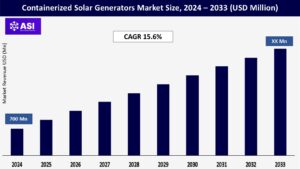
The global containerized solar generators market size was valued at approximately USD 700 million in 2024 and is projected to reach USD XX million by 2033, growing at a CAGR of 15.6% during the forecast period (2026–2033).
Containerized solar generators offer a portable, reliable, and eco-friendly solution to meet diverse energy needs. With increasing demand for sustainable and renewable energy systems across industries and the residential sector, these generators are gaining prominence as cost-effective alternatives to traditional energy sources. Advancements in energy storage technologies and favorable government policies supporting renewable energy further drive containerized solar generators market growth.
Key growth drivers include the rising adoption of off-grid and hybrid power solutions, increasing energy demands from remote and disaster-prone areas, and innovations in energy storage capacities.
The rising demand for off-grid and hybrid energy solutions is a significant driver for the adoption of containerized solar generators, particularly in regions with limited access to traditional energy grids. These systems are increasingly being deployed in rural electrification projects, mining sites, military operations, and disaster relief efforts due to their portability, efficiency, and ability to operate independently of grid infrastructure.
For instance, the International Renewable Energy Agency (IRENA) reported an 11% global growth in off-grid solar systems in 2023, providing electricity to over 240 million people. This growth has been further fueled by government incentives and international funding, directly supporting the growth of the containerized solar generators market size in underserved regions. The World Bank’s $2 billion investment in off-grid solar solutions for Sub-Saharan Africa exemplifies efforts to bridge the energy gap, aiming to provide electricity to 120 million people by 2030.
Beyond rural areas, containerized solar generators are increasingly used in industrial and commercial sectors. Mining operations in remote locations are adopting these solutions to reduce diesel dependency and carbon emissions.
For example, Anglo American deployed a hybrid solar power system in 2024 at a remote Australian mining site, achieving a 45% reduction in diesel use. Disaster relief and emergency response operations also rely heavily on containerized solar systems for their rapid deployment capabilities. During the 2023 earthquakes in Turkey, solar-powered generators provided essential electricity to medical facilities, communication networks, and emergency camps.
Government support plays a crucial role in the market’s growth. Initiatives like India’s National Solar Mission aim to deploy 10,000 MW of decentralized solar systems by 2030, targeting rural schools, hospitals, and businesses. Similarly, the European Investment Bank (EIB) has allocated €500 million to support renewable energy projects in emerging markets, including containerized solar solutions. Military applications further drive demand, as these generators provide secure and low-maintenance energy sources for remote bases. The U.S. and Indian defense sectors, for example, are increasingly investing in solar-based systems to enhance operational efficiency while reducing logistical challenges.
Private sector advancements also bolster the containerized solar generators market. Companies like Tesla and Schneider Electric are innovating with hybrid systems that integrate solar, wind, and battery storage for enhanced performance. In 2024, Tesla expanded its containerized solar generator lineup with integrated Powerwall systems for industrial and commercial use. Meanwhile, Schneider Electric partnered with a South African utility to deploy 50 containerized solar generators for agricultural and residential purposes. These developments, combined with robust government incentives and international investments, are solidifying the role of containerized solar generators as a transformative solution for sustainable energy access worldwide.
The growth in energy storage technologies is a pivotal factor driving the adoption of containerized solar generators. Advancements in battery storage, particularly lithium-ion and emerging solid-state batteries, have significantly improved the efficiency, reliability, and capacity of these systems. These innovations enable longer operational hours, enhanced load management, and seamless integration with renewable energy sources such as solar and wind, making containerized solar generators a versatile solution across various applications.
High-performance storage systems like Tesla’s Powerwall and Powerpack have set new benchmarks for energy storage, demonstrating their capability to sustain power supply during peak demand and outages. Their integration into containerized solar generators has expanded market adoption, particularly in residential, commercial, and industrial sectors. For instance, in 2024, Tesla deployed containerized solar solutions with Powerpack systems in California to support grid resilience during heat waves, ensuring uninterrupted power for industrial users.
Solid-state battery technology, known for its higher energy density and safety features, is also making strides in the containerized solar generators market. Companies like QuantumScape and Toyota are developing solid-state batteries to enhance the energy storage capabilities of portable solar systems, further boosting their appeal in sectors such as telecommunications, healthcare, and disaster management. These advancements are expected to drive market growth as they address critical challenges like energy intermittency and storage efficiency, positioning containerized solar generators as a key component of the global renewable energy landscape.
The high initial investment and maintenance costs of containerized solar generators are significant barriers to their widespread adoption, particularly in developing economies. These systems, while offering long-term cost savings through reduced reliance on fossil fuels and lower operational expenses, require substantial upfront capital for procurement and installation. Advanced features such as integrated battery storage and smart monitoring systems contribute to the elevated costs, making it challenging for small-scale users and budget-constrained projects to adopt this technology.
Moreover, the requirement for skilled labor to maintain and service these systems adds to the cost burden, particularly in remote and underdeveloped areas where technical expertise is scarce. For instance, periodic maintenance of battery storage systems and solar panels, along with the calibration of monitoring equipment, demands specialized knowledge that may not be readily available in regions with limited infrastructure.
In rural and off-grid applications, the lack of adequate financing mechanisms and subsidies further exacerbates the issue, slowing the pace of adoption. Addressing these challenges through cost optimization, government incentives, and localized training programs for maintenance personnel is crucial for unlocking the full potential of containerized solar generators in global markets.
| Report Metric | Details |
|---|---|
| Segmentations | |
| By Product Type |
Off Grid/Hybrid Grid Connected Others |
| By Storage Capacity |
10–40 KWH 40–80 KWH 80–150 KWH More than 150 KWH |
| By Applications |
Household Appliances Manufacturing Energy Automotive |
| Key Players |
Tesla, Inc. Caterpillar Inc. Juwi Holding AG Siemens AG SunPower Corporation General Electric Himoinsa Ecosun Innovations |
| Geographies Covered | |
| North America |
U.S. |
| Europe |
U.K. |
| Asia Pacific |
China |
| Middle East & Africa |
Saudi Arabia |
| Latin America |
Brazil |
Off-grid or hybrid containerized solar generators accounted for 48.3% of the market share in 2024, driven by their application in remote and disaster-prone areas. The containerized solar generators market for these systems is expected to grow at a CAGR of 16.5%, supported by increasing investments in microgrids and decentralized energy systems.
Grid-connected systems, on the other hand, held an estimated xx% market share in 2024. These systems are primarily deployed in urban and peri-urban areas, where they serve to reduce dependency on conventional grids and provide cost savings through net-metering and feed-in-tariff programs. The segment is projected to expand at a CAGR of 15.8% during the forecast period, driven by rising electricity tariffs, supportive government policies, and the integration of renewable energy into urban power systems. For instance, the European Union’s Renewable Energy Directive has incentivized the adoption of grid-connected solar solutions, accelerating their penetration across residential and commercial sectors. This segment includes hybrid and customized solutions, contributing xx% of the containerized solar generators market share in 2024.
10–40 KWH segment dominates the market of containerized solar generators, accounting for 38.3% of the total share in 2024. These systems are particularly used in residential and small-scale industrial applications, where they provide reliable and cost-effective energy solutions for powering household appliances and small industrial machinery. Their affordability, compact design, and ease of installation have driven widespread adoption across urban and rural areas, making them a cornerstone of the market.
40–80 KWH segment cater to mid-sized industrial applications and accounted for xx% of the market in 2024, caters primarily to mid-sized industrial applications such as workshops, small factories, and commercial establishments.
The 80–150 KWH and more than 150 KWH segments are emerging as critical components in large-scale industrial, manufacturing, and energy sector operations. These larger systems are particularly suited for high-energy-consuming activities such as assembly lines, data centers, and energy storage for renewable power plants. Together, these segments are expected to grow at a combined CAGR of 20.1% through 2032, driven by advancements in battery technologies, declining costs of high-capacity systems, and the increasing adoption of renewable energy in large industrial and utility-scale projects.
The household applications segment, including powering home appliances and providing emergency backup solutions, accounted for a substantial 34.4% containerized solar generators market share in 2024. This dominance is attributed to the increasing adoption of smart home technologies and a growing preference for energy-efficient, eco-friendly solutions among consumers. The segment’s growth is further supported by government subsidies for residential solar systems, such as the U.S. Federal Solar Tax Credit, which allows homeowners to claim up to 30% of installation costs. The segment is projected to expand at a CAGR of 16.5%, driven by technological advancements in compact and modular solar generator systems that seamlessly integrate into residential settings, strengthening the containerized solar generators market size.
Manufacturing applications contributed XX% to the market share in 2024, with containerized solar generators being widely used in small- to medium-scale production facilities for powering machinery, assembly lines, and lighting systems. As global manufacturing hubs, such as India and Southeast Asia, expand their renewable energy infrastructure, this segment is projected to grow at an impressive CAGR of 14.8%. Initiatives like India’s “National Mission on Transformative Mobility and Battery Storage” aim to bolster the adoption of sustainable energy systems in industries, further driving demand for containerized solar generators.
The energy sector and automotive applications, including their growing role in powering electric vehicle (EV) charging stations, are witnessing rapid adoption. These applications combined accounted for approximately XX% of the market in 2024.
North America held a commanding 37.6% of the global containerized solar generator market share in 2024, propelled by the increasing adoption of renewable energy technologies and robust disaster recovery initiatives. The U.S. dominates the regional market, accounting for over 85% of the share, owing to substantial investments in microgrid solutions and government incentives such as the Federal Renewable Energy Tax Credit. For instance, California has pioneered the deployment of containerized solar generators for wildfire mitigation and emergency backup, significantly driving regional demand.
Europe emerged as the second-largest market, driven by stringent carbon reduction policies, rising electricity tariffs, and supportive government initiatives. Countries such as Germany and the Netherlands are leading in adopting portable solar generators, accounting for a combined xx% market share in 2024. Germany’s Renewable Energy Sources Act (EEG) and the Netherlands’ solar energy expansion programs are key factors accelerating market penetration in residential, industrial, and automotive applications.
Asia-Pacific (APAC) is the fastest-growing region, with a projected CAGR of 14.3% from 2024 to 2032. This growth is supported by ambitious renewable energy initiatives like India’s National Solar Mission, which targets 100 GW of solar capacity by 2030, and China’s 14th Five-Year Plan, which emphasizes the adoption of distributed renewable energy systems. APAC’s burgeoning manufacturing sector and expanding rural electrification projects further contribute to its rapid growth.
The Middle East and Africa (MEA) are poised for significant growth, driven by large-scale infrastructure projects like Saudi Arabia’s NEOM, a futuristic city that integrates renewable energy systems, including containerized solar generators, into its design. By 2032, the MEA region is expected to play a critical role in the containerized solar generators market, particularly in remote and off-grid applications.
Latin America, led by Brazil, is gaining momentum due to its abundant solar resources and a growing focus on energy exports. Brazil’s ProGD Program promotes the use of decentralized solar energy systems, creating favorable conditions for market growth. Countries like Chile and Mexico are also investing in containerized solar generators to support their renewable energy targets, contributing to the region’s expanding footprint in the global market.
The global containerized solar generators market was valued at approximately USD 700 million in 2024. It is projected to reach USD XX million by 2033, growing at a CAGR of 15.6% during the forecast period (2026–2033).
North America dominated with 37.6% of the global market share in 2024, largely driven by the U.S., with significant investments in microgrids and disaster recovery solutions.
The prominent players of the market include: Tesla, Inc., Caterpillar Inc., Juwi Holding AG, Siemens AG, SunPower Corporation, General Electric, Himoinsa, and Ecosun Innovations.
The market is expected to grow at a CAGR of 15.6% from 2026 to 2033, driven by increased demand for sustainable energy solutions, technological advancements, and government support for renewable energy systems worldwide.