

Ethanol Market
Ethanol Market & Trends Analysis Report, By Source (Ethanol Made from Corn, Ethanol Made from Sugarcane), By Application (Fuel and Blending, Use in Industry, Alcoholic Beverages, Personal Care and Cosmetics) – Industry Analysis Report, Regional Outlook, Growth Potential, Price Trends, Competitive Market Share & Forecast, 2025–2033.

Historical Period: 2019-2024
Forecast Period: 2025-2033
Report Code :
CAGR: 5.1%
Last Updated : March 16, 2026
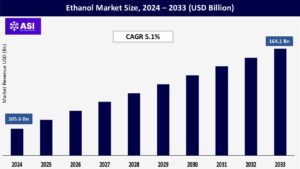
The global ethanol market size was valued at approximately USD 105.6 billion in 2024 and is projected to reach USD 164.1 billion by 2033, growing at a CAGR of 5.1% during the forecast period.
Ethanol is a versatile compound widely used as a biofuel, industrial solvent, and in the production of alcoholic beverages. It plays a pivotal role in the energy transition, serving as a renewable fuel component and a clean-burning gasoline additive that helps reduce greenhouse gas emissions.
Government policies in key markets such as the United States, Brazil, India, and the European Union are boosting ethanol demand through fuel blending mandates (e.g., E10, E15, E20). Enhancing energy security, lowering reliance on fossil fuels, and lowering carbon emissions in the transportation sector are the goals of these initiatives.
Because it is used in hand sanitizers, disinfectants, and medical formulations, the demand for industrial and pharmaceutical grade ethanol has remained strong since the COVID-19 epidemic. Furthermore, the alcoholic beverage sector is a significant end-use market that supports consistent consumption, especially in Latin America and Europe.
Sustainability issues have been brought up by the ethanol industry’s reliance on agricultural feedstocks such as maize, sugarcane, and cereals. Food supply restrictions and price instability may result from the diversion of food crops for fuel production, which adds to the continuous debate between food and fuel, particularly in developing nations.
Import restrictions, taxes, and protectionist trade policies pose serious obstacles to the global ethanol trade. Trade restrictions imposed by major markets such as the United States, Brazil, and China hinder the flow of ethanol across international borders, impeding market integration and lowering regional price competitiveness.
| Report Metric | Details |
|---|---|
| Segmentations | |
| By Source |
Ethanol Made from Corn Ethanol Made from Sugarcane |
| By Application |
Fuel and Blending Use in Industry Alcoholic Beverages Personal Care and Cosmetics |
| Key Players |
|
| Geographies Covered | |
| North America |
U.S. |
| Europe |
U.K. |
| Asia Pacific |
China |
| Middle East & Africa |
Saudi Arabia |
| Latin America |
Brazil |
The Ethanol Market is segmented by Source (Ethanol Made from Corn, Ethanol Made from Sugarcane), By Application (Fuel and Blending, Use in Industry, Alcoholic Beverages, Personal Care and Cosmetics).
Ethanol Made from Corn (Largest Market)
The most common type is corn-based ethanol, especially in the US, where large-scale production and distribution are supported by a strong agricultural output, a well-established infrastructure, and advantageous government subsidies.
Ethanol Made from Sugarcane
Due to its better energy return on investment (EROI) and lower carbon intensity, sugarcane-based ethanol is produced in large quantities in Brazil. Sugarcane ethanol has become a vital part of the nation’s energy mix due to its fleet of flexible-fuel vehicles (FFVs) and long-standing biofuel legislation.
The largest segment, fuel and blending
More than 70% of the ethanol consumed worldwide comes from the major application area, gasoline and blending. In order to increase combustion efficiency, lower tailpipe emissions, and support renewable energy requirements in transportation, ethanol is frequently combined with gasoline (e.g., E10, E15, E85).
Use in Industry
In the production of paints, coatings, inks, and chemicals, ethanol is a crucial solvent and intermediary. It is perfect for use in a variety of industrial processes because of its low toxicity and volatility.
Alcoholic Beverages
The manufacturing of alcoholic beverages, such as wines, liquors, and spirits, requires high-purity ethanol. Due to cultural consumption habits and consumer demand, this market is especially robust in Europe, Latin America, and Asia.
Personal Care and Cosmetics
Because of its qualities as an astringent, preservative, and carrier solvent, ethanol is utilized in the cosmetics and personal care sector in items including skin tones, mouthwashes, and scents.
The United States is the world’s largest producer and exporter of ethanol, with production primarily based on corn. Strong government mandates, blending standards, and a mature infrastructure support the region’s dominance in both domestic use and global trade.
Brazil leads the region with its extensive sugarcane-based ethanol industry and widespread adoption of flex-fuel vehicles. Government policies and cost-effective production make Brazil a global benchmark for renewable fuel integration.
India and China are actively expanding ethanol blending in fuels through national biofuel policies aimed at reducing oil imports and improving energy security. Both countries are investing in production capacity and promoting E10/E20 mandates.
The European ethanol market is shaped by the push for decarbonizing transport and compliance with the Renewable Energy Directive II (RED II). The region emphasizes bioethanol derived from sustainable feedstocks to meet climate targets and reduce vehicle emissions.
Still in its nascent stages, the ethanol market in this region is expected to grow, supported by the development of agro-based ethanol production in countries such as South Africa and Egypt. Growing energy demand and rural development initiatives are also encouraging investment.
The market size of Ethanol in 2024 was USD 105.6 billion.
The projected CAGR of the Ethanol market is 5.1%.
POET, ADM, Green Plains, Valero, Raízen
Automotive fuel blending
1.1 Summary
1.2 Research methodology
2.1 Research Objectives
2.2 Market Definition
2.3 Limitations & Assumptions
2.4 Market Scope & Segmentation
2.5 Currency & Pricing Considered
3.1 Drivers
3.2 Geopolitical Impact
3.3 Human Factors
3.4 Technology Factors
4.1 Porters Five Forces Analysis
4.2 Value Chain Analysis
4.3 Average Pricing Analysis
4.4 M & A, Agreements & Collaboration Analysis
5.1 Ethanol Market, By Source
5.1.1 Introduction
5.1.2 Market Size & Forecast
5.2 Ethanol Market, By Application
6.1 North America Ethanol Market , By Country
6.1.1 Ethanol Market, By Source
6.1.2 Ethanol Market, By Application
6.2 U.S.
6.2.1 Ethanol Market, By Source
6.2.2 Ethanol Market, By Application
6.3 Canada
7.1 U.K.
7.2 Germany
7.3 France
7.4 Spain
7.5 Italy
7.6 Russia
7.7 Nordic
7.8 Benelux
7.9 The Rest of Europe
8.1 China
8.2 South Korea
8.3 Japan
8.4 India
8.5 Australia
8.6 Taiwan
8.7 South East Asia
8.8 The Rest of Asia-Pacific
9.1 UAE
9.2 Turkey
9.3 Saudi Arabia
9.4 South Africa
9.5 Egypt
9.6 Nigeria
9.7 Rest of MEA
10.1 Brazil
10.2 Mexico
10.3 Argentina
10.4 Chile
10.5 Colombia
10.6 Rest of Latin America
11.1 Global Market Share (%) By Players
11.2 Market Ranking By Revenue for Players
11.3 Competitive Dashboard
11.4 Product Mapping