

Glycerol Monostearate Powder Market
Glycerol Monostearate Powder Market Report & Trends Analysis Report, By Grade (Food Grade, Pharmaceutical Grade, Industrial Grade), By Application (Food & Beverage, Pharmaceuticals, Personal Care & Cosmetics, Plastics & Industrial Uses)– Industry Analysis Report, Regional Outlook, Growth Potential, Price Trends, Competitive Market Share & Forecast, 2025–2033.

Historical Period: 2019-2024
Forecast Period: 2025-2033
Report Code :
CAGR: 5.6%
Last Updated : March 16, 2026
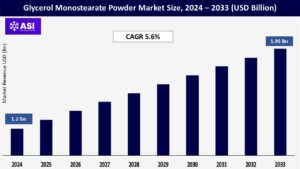
The global Glycerol Monostearate (GMS) Powder Market size was valued at approximately USD 1.2 billion in 2024 and is projected to reach USD 1.95 billion by 2033, growing at a CAGR of 5.6% during the forecast period.
Glycerol Monostearate is a non-ionic emulsifier widely used to improve texture, stability, and shelf life in food, pharmaceuticals, cosmetics, and plastics. In powder form, it offers superior handling, dispersion, and blending properties, making it a preferred choice in industrial-scale applications.
Growth is fueled by increasing processed food consumption, rising demand for natural and safe emulsifiers, and expanding cosmetic and pharmaceutical manufacturing. Additionally, the trend toward clean-label ingredients is boosting adoption in health-conscious consumer markets.
The need for glycerol monostearate (GMS) powder as a food emulsifier, stabilizer, and anti-staling agent is being driven by the rising consumption of convenience foods, baked goods, and functional beverages worldwide.
By increasing dough strength, avoiding fat separation, and preserving moisture, food-grade GMS improves product quality and increases shelf life and consumer appeal.
GMS powder works well as an emulsifying and thickening agent in skin cream, lotion, and hair care formulations, producing stable compositions with smooth textures. One major factor propelling the market’s growth is the beauty industry’s explosive global expansion, especially in Asia-Pacific and Latin America.
Price volatility of raw materials Glycerol and stearic acid, which are both impacted by shifts in the markets for palm oil and animal fat, are necessary for the synthesis of GMS powder. Global commodity price volatility can have a big impact on businesses’ profit margins and production costs.
GMS powder faces competition from the increasing number of plant-based and synthetic emulsifiers with improved multifunctional qualities, especially in applications where performance and cost-effectiveness are crucial.Growth in market share in some segments may be constrained by this rivalry.
| Report Metric | Details |
|---|---|
| Segmentations | |
| By Grade |
Food Grade Pharmaceutical Grade Industrial Grade |
| By Application |
Food & Beverage Pharmaceuticals Personal Care & Cosmetics Plastics & Industrial Uses |
| Key Players |
|
| Geographies Covered | |
| North America |
U.S. |
| Europe |
U.K. |
| Asia Pacific |
China |
| Middle East & Africa |
Saudi Arabia |
| Latin America |
Brazil |
The Glycerol Monostearate Powder Market is segmented by Grade (Food Grade, Pharmaceutical Grade, Industrial Grade), By Application (Food & Beverage, Pharmaceuticals, Personal Care & Cosmetics, Plastics & Industrial Uses).
Each factor plays a crucial role in enhancing patient safety, increasing the adoption of self-administered anticoagulant therapies, and supporting the development of more convenient, prefilled drug delivery systems that streamline treatment in the management of thromboembolic and cardiovascular conditions.
Food Grade (Largest Segment)
Due to its widespread use in the dairy, confectionery, beverage, and pastry industries, this grade accounts for the majority of GMS powder consumption worldwide. It delays staling, increases loaf volume, and improves dough elasticity in bakery applications.
It helps with flavor emulsification and cloud stability in beverages, and it stabilizes emulsions in dairy and ice cream products to stop fat separation. Its use in food processing around the world is further supported by regulatory approvals from organizations like the FDA and EFSA.
Pharmaceutical Grade
Prized for its many uses as a lubricant, stabilizer, and emulsifier in the production of pharmaceuticals. It is an essential excipient for topical ointments, controlled-release tablets, and capsule shells, allowing for more stable formulations and reliable drug administration. Strict pharmacopeia requirements must be followed by pharmaceutical-grade GMS to guarantee purity.
Industrial Grade
Used as a mold release aid, processing additive, and antistatic agent in the rubber, plastics, resin, and lubricant industries. It improves surface quality and lowers friction during extrusion in the production of plastics. It enhances viscosity control and oxidation resistance in lubricants and greases, making them appropriate for high-stress machinery.
Food & Beverage (Largest Market)
Represents the largest share of GMS powder demand, driven by its critical role in bakery, dairy, confectionery, and beverage products. In bakery goods, it improves dough stability, increases loaf volume, and delays staling.
In dairy and frozen desserts, it prevents fat separation and enhances creaminess, while in confectionery it stabilizes emulsions and improves mouthfeel. In beverages, GMS is used for flavor emulsification and to maintain product homogeneity.
Pharmaceuticals
Used extensively in tablet coatings, emulsions, ointments, and controlled-release formulations. It functions as a stabilizer and emulsifier, improving the bioavailability of active ingredients and ensuring consistent dosage performance.
Personal Care & Cosmetics
Applied in creams, lotions, shampoos, and conditioners as an emulsifier and thickening agent, providing a smooth texture, stable formulation, and enhanced sensory appeal. Its compatibility with natural oils and other cosmetic actives makes it a preferred choice in skincare and haircare products.
Plastics & Industrial Uses
Serves as a PVC processing aid, enhancing flow properties and surface finish, and as an anti-fog agent in food packaging films to improve visibility and product appeal. It is also used in lubricants and other industrial formulations for its anti-static and stabilizing functions.
With the help of robust food processing skills, a fast growing cosmetics manufacturing base, and rising middle-class demand for packaged and functional foods, China, India, Japan, and South Korea dominate both production and consumption. Market expansion is also being fueled by government programs to strengthen the domestic food processing and personal care industries.
The processed food, beverage, and cosmetics industries continue to have a strong demand for GMS powder. Due to its sophisticated manufacturing infrastructure, robust R&D capabilities, and rising consumer desire for natural and clean-label emulsifiers, the United States dominates the regional industry.
Europe is a developed but steady market with strict regulations for food safety and cosmetic formulation, which guarantees a steady need for premium GMS powder. The main markets are Germany, France, and the UK, which are bolstered by robust production of baked goods, confections, and high-end personal care products.
The baking, confectionery, dairy, and cosmetics industries in Latin America and the Middle East especially in Brazil, Mexico, Saudi Arabia, and the United Arab Emirates—are seeing an increase in use. The development in the production of plastics, packaging, and lubricants is also propelling the expansion of industrial-grade uses.
The GMS Powder market size in 2024 is USD USD 1.2 billion.
The GMS Powder market projected CAGR is 5.6%.
Food Grade, driven by bakery and dairy demand
Asia-Pacific, due to rapid industrialization and rising processed food consumption
1.1 Summary
1.2 Research methodology
2.1 Research Objectives
2.2 Market Definition
2.3 Limitations & Assumptions
2.4 Market Scope & Segmentation
2.5 Currency & Pricing Considered
3.1 Drivers
3.2 Geopolitical Impact
3.3 Human Factors
3.4 Technology Factors
4.1 Porters Five Forces Analysis
4.2 Value Chain Analysis
4.3 Average Pricing Analysis
4.4 M & A, Agreements & Collaboration Analysis
5.1 Glycerol Monostearate Powder Market, By Grade
5.1.1 Introduction
5.1.2 Market Size & Forecast
5.2 Glycerol Monostearate Powder Market, By Application
6.1 North America Glycerol Monostearate Powder Market, By Country
6.1.1 Glycerol Monostearate Powder Market, By Grade
6.1.2 Glycerol Monostearate Powder Market, By Application
6.2.1 Glycerol Monostearate Powder Market, By Grade
6.2.2 Glycerol Monostearate Powder Market, By Application
6.3 Canada
7.1 U.K.
7.2 Germany
7.3 France
7.4 Spain
7.5 Italy
7.6 Russia
7.7 Nordic
7.8 Benelux
7.9 The Rest of Europe
8.1 China
8.2 South Korea
8.3 Japan
8.4 India
8.5 Australia
8.6 Taiwan
8.7 South East Asia
8.8 The Rest of Asia-Pacific
9.1 UAE
9.2 Turkey
9.3 Saudi Arabia
9.4 South Africa
9.5 Egypt
9.6 Nigeria
9.7 Rest of MEA
10.1 Brazil
10.2 Mexico
10.3 Argentina
10.4 Chile
10.5 Colombia
10.6 Rest of Latin America
11.1 Global Market Share (%) By Players
11.2 Market Ranking By Revenue for Players
11.3 Competitive Dashboard
11.4 Product Mapping