

Healthcare Finance Solutions Market
Healthcare Finance Solutions Market Share & Trends Analysis Report By Type of Solution (Medical Billing and Coding Solutions, Revenue Cycle Management (RCM) Solutions, Claims Management Solutions, Patient Payment and Billing Solutions, Financial Analytics and Reporting Solutions, Credit and Loan Management Solutions, Insurance Verification Solutions, Healthcare Accounting Software) By End User (Hospitals and Healthcare Providers, Clinics and Physician Practices, Diagnostic Centers, Pharmacies, Health Insurance Companies, Government Healthcare Agencies, Patients (Direct Financing Solutions), Third-party Administrators (TPAs) By Service Type (Consulting and Advisory Services, Implementation and Integration Services, Support and Maintenance Services, Managed Services) Industry Analysis Report, Regional Outlook, Growth Potential, Price Trends, Competitive Market Share & Forecast, 2025–2033

Historical Period: 2019-2024
Forecast Period: 2025-2033
Report Code :
CAGR: 7.8%
Last Updated : March 7, 2026
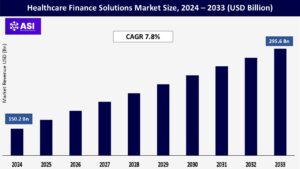
The global Healthcare Finance Solutions Market was valued at approximately USD 150.2 billion in 2024 and is projected to reach USD 295.6 billion by 2033, growing at a CAGR of 7.8% during the forecast period (2025–2033).
Healthcare finance solutions involve a variety of services (leasing, loans, project finance, and revenue cycle management) that are specifically designed to accommodate the capital-intensive nature of the healthcare space. Healthcare finance solutions assist in the procurement of high-cost medical equipment, infrastructure development, and proper operational cash flow management. Financing also helps reduce the financial burden on both providers and patients through managed payment plans, insurance, and risk management.
The market is driven by rising costs in healthcare, demand for sophisticated technologies, and the need for effective financial management through hospitals, clinics and diagnostic centers. Increasing digitization and a continual push towards cloud-based finance platforms are also an added driver to the market.
Healthcare providers around the world are investing heavily in advanced diagnostic and therapeutic equipment to meet patient demand, improve clinical outcomes, and compete. However, healthcare providers must contend with the capital costs of acquiring modern technologies such as robotic surgery systems, AI-enabled imaging devices, and electronic health record (EHR) systems, which pose a significant initial financial burden, especially on mid-sized hospitals and outpatient centers.
This has prompted rapid adoption of tailored healthcare finance solutions such as equipment leasing, vendor financing, and operating leases. For example, in February 2024, GE HealthCare announced a $760 million global financing partnership with Citigroup and Barclays to help hospitals acquire AI-integrated imaging systems. These arrangements enable healthcare providers to manage capital expenditures over time; preserve working capital; and leverage the rapidly evolving technologies.
Government strategic initiatives to modernize healthcare capabilities—like Ayushman Bharat Digital Mission in India and Hospital Infrastructure Renewal Programs in the USA—are developing an ecosystem where healthcare financing is a basic enabler to scaling operations. Emerging economies are leaning into this trend, where healthcare infrastructure is in need of modernization while access to capital is limited, and financial partnerships are necessary to close care gaps.
The global healthcare sector is in a period of extraordinary cost inflation from labor costs, supply chain costs, energy costs, and costs associated with compliance to regulations. A recent report issued by the American Hospital Association (AHA) in 2023 reported that over 50% of U.S. hospitals ended the most recent fiscal year with negative operating margins, which they attributed to wage increases, drug price increases, and increases in other operating expenses that were not sustainable.
These pressures are driving healthcare systems to find flexible forms of financing that deliver liquidity support, stable cash flow, and more predictable budgeting. As a result, finance providers are offering tailored forms of revenue cycle management (RCM) services, working capital loans, and receivables financing. For example, in October 2023, Siemens Financial Services expanded its healthcare portfolio with a new RCM financing product for small to medium practices experiencing reimbursement delays.
Additionally, InstaMed, a JPMorgan company, reported a 40% increase in demand for patient payment plans and healthcare lending between 2022 and 2024. These finance tools are helping to keep providers afloat during economic volatility while also making strategic investments in technology and patient services without the risk of harming their financial viability.
The multifaceted regulatory environment governing healthcare payments, insurance reimbursements, and financial transactions is one of the main barriers to growth in the healthcare finance solutions market. Healthcare is among the most heavily regulated sectors, resulting in financing institutions having to work around stringent, legal frameworks like the Health Insurance Portability and Accountability Act (HIPAA) in the U.S., General Data Protection Regulation (GDPR) in Europe, and applicable framework of health data and finance laws within each region.
Moreover, there are regulations affecting how financing institutions design and deliver lending, leasing, and revenue cycle management services to healthcare providers. For instance, financing institutions need to ensure that any shared data in relation to financing of electronic health records (EHR) or other medical equipment adheres to strict data protection and patient privacy obligations.
Failure to meet statutory obligations in relation to data protection and patient privacy can result in severe legal sanctions and reputational loss. Regulatory changes occur frequently, which can result in sudden disruption, uncertainties, and marketplace instability. Such changes can include policy and reimbursement reform under Medicare and Medicaid or new processes introduced under financial transparency legislation.
| Report Metric | Details |
|---|---|
| Segmentations | |
| By Type of Solution |
Medical Billing and Coding Solutions Revenue Cycle Management (RCM) Solutions Claims Management Solutions Patient Payment and Billing Solutions Financial Analytics and Reporting Solutions Credit and Loan Management Solutions Insurance Verification Solutions Healthcare Accounting Software |
| By End User |
Hospitals and Healthcare Providers Clinics and Physician Practices Diagnostic Centers, Pharmacies Health Insurance Companies Government Healthcare Agencies, Patients (Direct Financing Solutions) Third-party Administrators (TPAs) |
| By Service Type |
Consulting and Advisory Services Implementation and Integration Services Support and Maintenance Services Managed Services |
| Key Players |
Siemens Financial Services GE HealthCare Financial Services McKesson Corporation JPMorgan Chase (InstaMed) Commerce Bank Wells Fargo Healthcare Finance Synchrony Financial Bank of America Merrill Lynch First American Healthcare Finance TIAA Bank |
| Geographies Covered | |
| North America |
U.S. |
| Europe |
U.K. |
| Asia Pacific |
China |
| Middle East & Africa |
Saudi Arabia |
| Latin America |
Brazil |
Medical Billing and Coding Solutions: This segment has a sizable share due to these solutions being vital areas of healthcare finance. Medical billing and coding are responsible for documenting patient services accurately, allowing a timely claims submission with less chance of errors and denials. Healthcare providers demand more automated and efficient coding software as medical codes (i.e., ICD-10) becomes more intricate, thus relying on technology to improve billing accuracy and overall compliance.
RCM solutions are central to the revenue cycle process (i.e., every aspect of patient revenue from scheduling the appointment, coding, and billing to submitting the claim and then collecting the payment). This segment is reporting high growth due to the overall trend to manage cash flows and decrease outstanding accounts receivables. Hospitals and large healthcare systems prefer to use complete RCM platforms for comprehensive management of their financial workflow.
Claims management tools help healthcare providers automate the verification, submission, and tracking of claims to the relevant insurance company. They assist in eliminating claims denials and delays, which promotes faster reimbursement. This segment is gaining traction with increasing complexities of health insurance and regulatory compliance, particularly in markets with a high volume of insured patients.
Patient Payment and Billing Solutions: As higher deductibles and copays leave patients with larger amounts of risk-bearing responsibility, patient-centric solutions to facilitate billing and payment are growing. These platforms frequently have online portals, payment plans, and reminders, driving patient engagement and collection.
Financial Analytics and Reporting Solutions: These applications ensure the health organizations are assessing financial performance, forecasting revenues, managing costs and staying in compliance. Demand for analytics solutions combined with finance systems is being enhanced by a continued focus on data-driven decision-making.
Hospitals are the largest end consumers of healthcare finance solutions because of their complex billing requirements, multi-department functionality, and high patient volumes. Hospitals benefit from integrated systems jointly applied to billing, coding, claims, and collections. The number of hospitals upgrading their legacy finance systems drives demand.
Clinics and Physician Practices Smaller clinics and practices are only concerned with cost-effective and easy-to-use finance solutions that combine billing and collecting patient payments efficiently. These clinics and practices apply cloud-based and SaaS models because they have lower up-front costs and minimal IT infrastructure requirements.
Diagnostic Centers Diagnostic centers also require finance solutions that specialize in billing for particular test codes and insurance protocols. The increased utilization of diagnostic tests and outpatient procedures drives the adoption of tailored finance solutions in this area. Pharmacies spend their financial solutions on insurance claims, payment reconciliations, and inventory controls.
The increased volume of prescription drugs and pharmacy services requires integrated financial management. Health Insurance Companies’ payers use finance solutions primarily for processing claims, dealing with fraud and managing payments. Increased regulatory scrutiny, as well as operational efficiencies is driving investment in sophisticated financial technologies.
Consulting and Advisory Services: Adoption of healthcare financing solutions often requires expert consulting for workflow redesign, compliance, and technology integration. Consulting services can assist organizations in selecting and configuring solutions to meet their needs.
Implementation and Integration Services: Successful implementation of healthcare financing solutions hinges on seamless integration with an organization’s existing EMR/EHR, practice management, and insurance systems. This planning and implementation service represents an important component, especially for large, integrated healthcare systems.
Support and Maintenance Services: Ongoing technical support is critical in ensuring that all systems stay up, to maintain regular software updates and to remain compliant with regulatory changes in an ever-evolving healthcare landscape.
Managed Services: Some healthcare providers have opted to outsource their entire finance function to third-party managed service providers – reducing the healthcare provider’s overhead costs, while allowing them to gain an improved focus on top-of-mind issues related to patient care.
North America captured the largest base market share with 38.5%, driven by a comprehensive healthcare system, high demand for advanced medical technology, and financial services tailored to the healthcare sector. The United States commands the regional market mainly as a result of major capital investment in the hospital sector, rising operational costs, and the growing dependence on financing models such as leasing and revenue cycle management (RCM) to maintain financial viability.
Major players, including Siemens Financial Services and GE HealthCare Finance, provide financing packages tailored to both large and independent care facilities. The ongoing trend of hospital consolidations, along with increasing spend on capital infrastructure changes related to digital health transformation, also continues to stimulate the marketplace for specialized finance solutions.
Europe represents an important section of the healthcare finance solutions market, with countries such as Germany, France, the UK, and the Netherlands leading on adoption. The region saw a strong public and private health care investment and a very strong demand for medical equipment financing in 2024. The European Investment Bank (EIB) has been funding hospital modernization and digital health projects across the EU and has driven demand for more structured funding solutions.
In addition, healthcare facilities are also addressing financial risk alongside upgrading to next-gen technologies in Europe using operating leases or pay-per-use models. The aging population and ongoing burden of chronic diseases on health systems, particularly within the likes of Italy and Spain, raise the demand for sustainable frameworks for healthcare finance.
The Asia-Pacific region is forecasted to grow the fastest at 9.1% from 2025 to 2033. Rapid urbanization, expansion of private healthcare infrastructure, and government initiatives are the key growth factors. The key countries, such as China, India, Japan, and South Korea, are heavily investing in accomplishing the modernization of healthcare systems and increasing accessibility.
In India, public-private partnerships (PPPs) and financial schemes focused on healthcare through the Ayushman Bharat program are enabling widespread adoption of financial models for hospitals and clinics. Development of healthcare infrastructure through the Healthy China 2030 initiative, combined with significant financial investment, are driving demand for capital leasing in healthcare and vendor-financed medical equipment in China. Additionally, increased adoption of cloud-based financial platforms and the increased number of fintech healthcare start-ups will contribute to regional growth.
Latin America and the Middle East & Africa (MEA) continue to grow moderately due to rises in healthcare investments and ongoing improvements to healthcare systems. In 2021, Brazil, Mexico and to a lesser extent, Colombia, will continue to see demand for growing diagnostic imaging and surgical services.
This provides opportunities in financing providers to develop equipment leasing and short-term lending options to private hospitals. The GCC, such as Saudi Arabia and the UAE, will develop healthcare investments as they seek to diversify and expand their economies and are developing more opportunities, considering some form of project financing and PPP models.
Areas of Sub-Saharan Africa and in rural parts of Latin America face challenges of economic instability, access to financial infrastructure, and regulatory challenges, not areas most conducive to developing sustainable healthcare markets on timescales that allow to monetize appropriate healthcare investments.
The market was valued at USD 150.2 billion in 2024.
The market is projected to grow at a CAGR of 7.8% from 2025 to 2033.
The Services hold the largest market share.
The Asia-Pacific region is expected to witness the highest growth rate.
Major players include Siemens Financial Services, GE HealthCare Financial Services, McKesson Corporation.
1.1 Summary
1.2 Research methodology
2.1 Research Objectives
2.2 Market Definition
2.3 Limitations & Assumptions
2.4 Market Scope & Segmentation
2.5 Currency & Pricing Considered
3.1 Drivers
3.2 Geopolitical Impact
3.3 Human Factors
3.4 Technology Factors
4.1 Porters Five Forces Analysis
4.2 Value Chain Analysis
4.3 Average Pricing Analysis
4.4 M & A, Agreements & Collaboration Analysis
5.1 Healthcare Finance Solutions Market, By Type of Solution
5.1.1 Introduction
5.1.2 Market Size & Forecast
5.2 Healthcare Finance Solutions Market, By End User
5.3 Healthcare Finance Solutions Market, By Service Type
6.1 North America Healthcare Finance Solutions Market, By Country
6.1.1 Healthcare Finance Solutions Market, By Type of Solution
6.1.2 Healthcare Finance Solutions Market, By End User
6.1.3 Healthcare Finance Solutions Market, By Service Type
6.2 U.S.
6.2.1 Healthcare Finance Solutions Market, By Type of Solution
6.2.2 Healthcare Finance Solutions Market, By End User
6.2.3 Healthcare Finance Solutions Market, By Service Type
6.3 Canada
7.1 U.K.
7.2 Germany
7.3 France
7.4 Spain
7.5 Italy
7.6 Russia
7.7 Nordic
7.8 Benelux
7.9 The Rest of Europe
8.1 China
8.2 South Korea
8.3 Japan
8.4 India
8.5 Australia
8.6 Taiwan
8.7 South East Asia
8.8 The Rest of Asia-Pacific
9.1 UAE
9.2 Turkey
9.3 Saudi Arabia
9.4 South Africa
9.5 Egypt
9.6 Nigeria
9.7 Rest of MEA
10.1 Brazil
10.2 Mexico
10.3 Argentina
10.4 Chile
10.5 Colombia
10.6 Rest of Latin America
11.1 Global Market Share (%) By Players
11.2 Market Ranking By Revenue for Players
11.3 Competitive Dashboard
11.4 Product Mapping