

In-Wheel Motor Market
In-Wheel Motor Market Share & Trends Analysis Report, By Motor (Axial Flux Motor, Radial Flux Motor), By Cooling (Air Cooled, Liquid Cooled), By Vehicle (Paseenger Car, Commercial Vehicle,) Industry Analysis Report, Regional Outlook, Growth Potential, Price Trends, Competitive Market Share & Forecast, 2025–2033.

Historical Period: 2019-2024
Forecast Period: 2025-2033
Report Code :
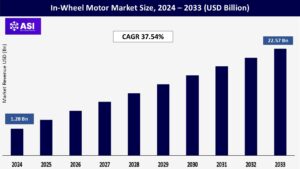
CAGR: 37.54%
Last Updated : June 11, 2026
The In-Wheel Motor Market Size was valued at USD 1.28 billion in 2024 and is expected to grow from USD 1.76 billion in 2025 to reach USD 22.57 billion by 2033, growing at a CAGR of 37.54% during the forecast period (2025-2033).
An in-wheel motor is installed to power an electric vehicle (EV). Conventional EVs are built around electric motors rather than gasoline engines. However, the In-wheel motor EV has motors installed directly around each wheel used for propulsion.
With the in-wheel motor, the car’s behavior is more in tune with the steering, in addition to the high accelerator responsiveness that is a benefit of EVs.
The governments and respective state governments of various countries are taking certain initiatives to increase awareness about using electric commercial vehicles to control the adverse impact on the environment and foreign exchange reserves.
For instance, the International Council on Clean Transportation is working with the Zero Emission Vehicle regulation, progressive electric utility policies, greater model availability & marketing, consumer rebates, access to carpool lanes on congested highways, extensive electric vehicle charging infrastructure, access to high-occupancy vehicle lanes, and continued growth of local electric vehicle promotions. This is because crude oil prices are continuously increasing.
The electric vehicle reduces the amount of noise and pollution generated compared to conventional vehicles. Commercial vehicles offer opportunities for more transport work at night, thus reducing the burden on the roads during the day. Therefore, many electric vehicle manufacturing companies are investing in product development to cater to the increasing demand from customers.
Automakers prefer to keep the unsprung mass in the vehicle to a minimum to improve the ride quality. The incorporation of in-wheel motor technology in a vehicle increases unsprung weight, which can deteriorate ride comfort.
The unsprung weight or mass includes the weight of the suspension, brakes, bearings, wheels or tracks, and a few other components directly connected to the wheel. The unsprung weight also includes the weight of components such as wheel axles, wheel bearings, wheel hubs, tires, and a portion of the weight of driveshafts, springs, shock absorbers, and suspension links.
If the vehicle’s brakes are mounted on the wheel, which is directly subjected to unsprung weight, it will increase the stress of the wheel. Thus, the increase in unsprung weight can restrain the incorporation of in-wheel motor technology in vehicles.
| Report Metric | Details |
|---|---|
| Segmentations | |
| By Vehicle Type |
Passenger Car Commercial Vehicle |
| By Motor Type |
Axial Flux Motor Radial Flux Motor |
| By Cooling Type |
Air-cooled Liquid-cooled |
| Key Players |
|
| Geographies Covered | |
| North America |
U.S. |
| Europe |
U.K. |
| Asia Pacific |
China |
| Middle East & Africa |
Saudi Arabia |
| Latin America |
Brazil |
The passenger cars segment is the highest 46% contributor to the market and is expected to grow during the forecast period. Increases in efficiency, torque, power, and vehicle control may contribute to the widespread adoption of in-wheel motors in modern passenger vehicles.
Most electric vehicle producers focus on enhancing vehicles with longer ranges, lighter weights, and more efficient layouts. Manufacturers of electric vehicles can guarantee efficient use of space and increased power output by installing motors on the wheels.
The commercial vehicles segment is rapidly emerging as the fastest-growing market with the 28% market shares of the in-wheel motor industry, driven by several key factors that are reshaping the transportation landscape globally.
In-wheel motors, which integrate electric motors directly into the wheels of vehicles, offer unique advantages that are particularly beneficial for commercial applications.
One of the primary reasons for the growth of in-wheel motors in commercial vehicles is the increasing demand for efficiency and sustainability in logistics and transportation. With stricter emissions regulations and rising fuel costs, fleet operators are under pressure to adopt cleaner and more cost-effective technologies.
The axial flux motor segment is the highest 37% contributor to the market and is expected to grow during the forecast period. The axial flux motor outperforms the radial flux motor in terms of power density and efficiency. It’s small enough to fit in or near each wheel.
It finds its primary use in low-speed, high-torque situations. Miniature, lightweight, and powerful axial flux motors are becoming increasingly popular. They can be used as direct drives in electric vehicles, increasing output torque and efficiency.
Radial flux is acquired the most 63% market shares of the global In wheel motor markets. Radial flux motors follow a conventional design, where magnetic flux is produced at a right angle to the rotation axis. They are commonly utilized and provide a combination of performance, efficiency, and production expenses.
Air cooling and Liquid cooling are the segments based on the application of the Global In-wheel motor Market. The liquid cooling segment is expected to have the highest CAGR and dominate the market share during the forecast period.
Liquid cooling is the most common method among electric vehicles. In this method, the water flows into a jacket installed in the housing and exchanges the generated heat. As a result, it achieves better cooling uniformity and lower system costs than oil cooling.
Liquid cooling is holding the market with the 37% market shares of the global In wheel motor markets. Liquid cooling is more efficient in heat management, especially in high-performance or heavy-duty scenarios. The process includes flowing a coolant through the engine to soak up and release heat, making it adequate for harsher environments.
Asia-Pacific is the most significant 44% shareholder in the global in-wheel motor market and is expected to grow during the forecast period. Since in-wheel motors are used in electric vehicles, the rapid increase in sales of such vehicles in countries like China and Japan, rapid urbanization, and rising demand for environmentally friendly transportation solutions in emerging economies like India and China are all contributing to the expansion of the In-Wheel Motor Market.
Throughout the projected study period, the In Wheel Motor Market will expand thanks to several factors, chief among them an increase in the urban population and a subsequent rise in per capita income, both encouraging people to buy electric vehicles.
Europe is 28% market share holder of the global markets. As a result of the highest EV sales in recent years, the European market is predicted to expand rapidly over the forecast period. In addition, the region’s expansion is fueled by stringent emission rules and regulations and the massive investments made by significant vehicle OEMs to meet the region’s demand for fuel-efficient and lightweight automobiles.
In addition, there are a growing number of additional requirements for maintaining air quality and noise pollution as a result of the high volume of traffic in cities. Several European cities have implemented environmental zones that restrict entry to vehicles that do not meet specific emission criteria to protect residents’ health from harmful air pollutants.
North America is the most significant 20% shareholder in the global In-Wheel motor market. North American market, the United States is poised to take the lead in the global automotive in-wheel motor market.
Growth in the market is anticipated to be fueled by rising demand for vehicles with enhanced convenience, safety, and comfort in developed economies. High demand and sustained market growth are expected for the forecast period thanks to features like steering-mounted controls, cutting-edge infotainment systems, telematics, centralized controllers, and the comfort, safety, luxury, and security they provide.
MEA is acquired the 8% market shares of the global markets. MEA is expected to show rapid growth due to strong EV sales in recent years. Many governments are shifting their incentives away from conventional cars because of falling sales and toward electric vehicles as more of them offer subsidies for purchasing these vehicles.
As more people learn about the potential of in-wheel motors to improve fuel efficiency, and as electric in-wheel motors gain popularity in developing countries, the market can access lucrative new growth avenues over the forecast time frame.
The market is expected to grow CAGR of 37.54% from 2025 to 2033.
The current market size is USD 1.76 Billions in 2025.
Asia -Pacific currently holds the largest market shares.
High prices of electric vehicles is a key restraining factor for the Global In-wheel motor Market.
Key players include Toyota, Nissan, Hyundai, Honda.
1.1 Summary
1.2 Research methodology
2.1 Research Objectives
2.2 Market Definition
2.3 Limitations & Assumptions
2.4 Market Scope & Segmentation
2.5 Currency & Pricing Considered
3.1 Drivers
3.2 Geopolitical Impact
3.3 Human Factors
3.4 Technology Factors
4.1 Porters Five Forces Analysis
4.2 Value Chain Analysis
4.3 Average Pricing Analysis
4.4 M & A, Agreements & Collaboration Analysis
5.1 In-Wheel Motor Market, By Vehicle Type
5.1.1 Introduction
5.1.2 Market Size & Forecast
5.2 In-Wheel Motor Market, By Motor Type
5.3 In-Wheel Motor Market, By Cooling Type
6.1 North America In-Wheel Motor Market , By Country
6.1.1 In-Wheel Motor Market, By Vehicle Type
6.1.2 In-Wheel Motor Market, By Motor Type
6.1.3 In-Wheel Motor Market, By Cooling Type
6.2 U.S.
6.2.1 In-Wheel Motor Market, By Vehicle Type
6.2.2 In-Wheel Motor Market, By Motor Type
6.2.3 In-Wheel Motor Market, By Cooling Type
6.3 Canada
7.1 U.K.
7.2 Germany
7.3 France
7.4 Spain
7.5 Italy
7.6 Russia
7.7 Nordic
7.8 Benelux
7.9 The Rest of Europe
8.1 China
8.2 South Korea
8.3 Japan
8.4 India
8.5 Australia
8.6 Taiwan
8.7 South East Asia
8.8 The Rest of Asia-Pacific
9.1 UAE
9.2 Turkey
9.3 Saudi Arabia
9.4 South Africa
9.5 Egypt
9.6 Nigeria
9.7 Rest of MEA
10.1 Brazil
10.2 Mexico
10.3 Argentina
10.4 Chile
10.5 Colombia
10.6 Rest of Latin America
11.1 Global Market Share (%) By Players
11.2 Market Ranking By Revenue for Players
11.3 Competitive Dashboard
11.4 Product Mapping