

Inhalation Anaesthesia Market
Inhalation Anaesthesia Market Share & Trends Analysis Report, By Anesthetic Agent (Sevoflurane, Desflurane, Isoflurane, Nitrous Oxide), By Application (Induction, Maintenance), By End‑User (Hospitals, Ambulatory Surgical Centers), By Delivery System (Anesthesia Machines, Vaporizers, Scavenging Systems, Breathing Circuits)– Industry Analysis Report, Regional Outlook, Growth Potential, Price Trends, Competitive Market Share & Forecast, 2025–2033.

Historical Period: 2019-2024
Forecast Period: 2025-2033
Report Code :
CAGR: 6.75%
Last Updated : November 22, 2025
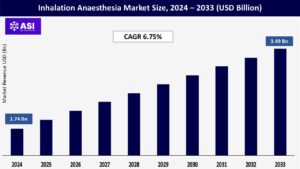
The global inhalation anaesthesia market size was valued at approximately USD 1.74 billion in 2024 and is projected to reach USD 3.49 billion by 2033, growing at a CAGR of 6.75% during the forecast period (2025–2033).
The inhalation anaesthesia market centers on the use of volatile anesthetic agents that are administered through the respiratory system to induce and maintain general anaesthesia during surgical procedures. These agents, such as sevoflurane, isoflurane, and desflurane, are delivered via vaporizers and anesthesia machines, where they are inhaled by the patient and absorbed through the lungs into the bloodstream to reach the brain, resulting in controlled unconsciousness.
Inhalation anaesthetics are widely used in both human and veterinary medicine, particularly for procedures requiring rapid induction and recovery. Key properties of inhalation anaesthetic agents include their volatility, lipid solubility (which enables quick passage through the blood-brain barrier), and low blood-gas solubility (which influences onset and recovery time).
These agents are also characterized by their minimum alveolar concentration (MAC), which indicates their potency. Safety, ease of administration, and predictable pharmacokinetics make inhalation anaesthetics a mainstay in modern surgical and emergency care settings.
The global rise in surgical interventions driven by aging populations, trauma cases, and chronic illness treatment has led to a higher demand for effective and fast-acting anesthetic agents. Inhalation anaesthesia, known for rapid induction and recovery, is preferred in both elective and emergency surgical settings.
The development of safer, more precise vaporizers, anesthesia machines, and monitoring devices has enhanced the administration of inhalation anaesthetics. These innovations minimize dosage errors, reduce recovery time, and improve patient safety, encouraging wider adoption across hospitals and clinics.
A major restraint in the inhalation anaesthesia market is the growing concern over the environmental and occupational health impact of volatile anaesthetic gases such as sevoflurane, isoflurane, and desflurane.
These agents are known to have high global warming potential (GWP) and contribute to greenhouse gas emissions when released into the atmosphere through scavenging systems. Additionally, long-term exposure to trace levels of anesthetic gases in operating rooms poses potential health risks to healthcare personnel.
As environmental regulations tighten and hospitals prioritize sustainability, there is increasing scrutiny over the use of inhaled anesthetics leading some institutions to adopt intravenous alternatives, which could hamper growth in this segment.
| Report Metric | Details |
|---|---|
| Segmentations | |
| By Anesthetic Agent |
Sevoflurane Desflurane Isoflurane Nitrous Oxide |
| By Application |
Induction Maintenance |
| By End‑User |
Hospitals Ambulatory Surgical Centers |
| By Delivery System |
Anesthesia Machines Vaporizers Scavenging Systems Breathing Circuits |
| Key Players |
|
| Geographies Covered | |
| North America |
U.S. |
| Europe |
U.K. |
| Asia Pacific |
China |
| Middle East & Africa |
Saudi Arabia |
| Latin America |
Brazil |
The Inhalation Anaesthesia Market is segmented by Anesthetic agent, Application, End User and Delivery System. Each factor contributes significantly to improving patient outcomes, simplifying anesthetic delivery, and enabling faster recovery in surgical and critical care settings.
Advancements in inhalation anaesthesia support safer, more controlled procedures by reducing the risk of dosing errors and facilitating precise anesthetic depth monitoring. These developments are key to enhancing surgical efficiency, patient comfort, and overall healthcare quality across both human and veterinary applications.
The market includes sevoflurane, desflurane, isoflurane, and nitrous oxide. Among these, sevoflurane holds the largest market share due to its rapid onset, minimal airway irritation, and favorable safety profile, making it ideal for both adult and pediatric use.
Desflurane, known for its low blood-gas solubility, is preferred for faster patient recovery, while isoflurane continues to be widely used for its cost-effectiveness and reliability. Nitrous oxide is often used as an adjunct for its analgesic properties but is facing regulatory scrutiny due to environmental concerns.
The market is divided into induction and maintenance of anesthesia. While both segments are essential, the maintenance segment dominates in value due to longer exposure periods during surgery.
Inhalation agents are commonly used after intravenous induction to sustain anesthesia levels safely and consistently throughout procedures.
The market is segmented into hospitals and ambulatory surgical centers (ASCs). Hospitals account for the largest share, as they handle the majority of major and complex surgical procedures requiring general anesthesia.
However, ASCs are witnessing fast growth, driven by the increasing trend of outpatient surgeries and the rising demand for cost-effective and efficient anesthesia solutions.
The market is categorized into anesthesia machines, vaporizers, scavenging systems, and breathing circuits. Anesthesia machines form the backbone of inhalation delivery, integrating vaporizers and monitoring systems for precise dosage control.
Vaporizers are essential for converting volatile liquid anesthetics into inhalable vapor form. Scavenging systems are critical for environmental safety, capturing waste anesthetic gases to protect healthcare personnel and reduce greenhouse emissions.
Breathing circuits ensure the safe and consistent delivery of anesthetic gases to the patient and are increasingly designed for single-use to minimize infection risks.
North America holds a leading position in the inhalation anaesthesia market, driven by a high volume of surgical procedures, advanced healthcare infrastructure, and the widespread adoption of modern anaesthesia delivery systems.
The United States, in particular, accounts for a significant share due to the presence of well-established hospitals, strong insurance coverage, and favorable reimbursement policies.
Additionally, ongoing technological innovations in anaesthesia monitoring, vaporizer systems, and environmental safety solutions support market growth.
Rising numbers of outpatient surgeries and an aging population further contribute to the demand for fast-acting and safe inhalation anaesthetic agents like sevoflurane and desflurane.
Europe represents the second-largest market for inhalation anaesthesia, with strong demand across countries like Germany, France, the United Kingdom, and Italy. The region benefits from a large elderly population undergoing surgical interventions, as well as government-supported universal healthcare systems that ensure widespread access to advanced surgical care.
Furthermore, strict regulatory standards set by the European Medicines Agency (EMA) ensure the consistent use of high-quality anaesthetic products. The adoption of environmentally safer anesthetic gases and low-flow anaesthesia techniques is growing, particularly in Western Europe, where environmental impact and occupational safety are major concerns for healthcare providers.
Asia-Pacific is the fastest-growing region in the inhalation anaesthesia market, driven by expanding healthcare infrastructure, increasing surgical volumes, and rising awareness of safe anaesthesia practices.
Countries like China, India, Japan, South Korea, and Australia are witnessing rapid growth in both public and private hospital investments. Rising disposable incomes, medical tourism, and government initiatives to improve surgical and emergency care facilities are further propelling the market.
In addition, Japan is a leading consumer of advanced inhalation anaesthetic agents due to its aging population and innovation-driven healthcare system. However, some regions still face challenges in adopting newer delivery technologies due to cost constraints and limited skilled workforce.
The inhalation anaesthesia market in Latin America is showing moderate growth, with Brazil and Mexico emerging as key contributors. Growth in this region is supported by an increasing number of surgical procedures, greater access to healthcare in urban areas, and growing government investments in hospital infrastructure.
Despite these positive trends, challenges such as inconsistent reimbursement systems, regulatory barriers, and uneven access to modern anaesthesia technologies in rural areas may limit market expansion. Nonetheless, the adoption of cost-effective inhalation agents and training programs for anesthesiologists is helping bridge the gap in clinical practice and drive market penetration.
The Middle East & Africa region represents a developing market for inhalation anaesthesia. Countries such as the UAE, Saudi Arabia, and South Africa are investing in improving surgical care through hospital expansions and technology partnerships. In these regions, elective surgeries, organ transplants, and emergency care are becoming more common, increasing the need for reliable anaesthetic solutions.
However, access to advanced inhalation anaesthesia systems and agents remains limited in many parts of sub-Saharan Africa due to economic constraints, shortages of trained medical personnel, and underdeveloped healthcare systems. Despite these challenges, international collaborations and government reforms are gradually improving access to modern surgical care and anaesthesia services.
The Inhalation Anaesthesia market was valued at USD 36.49 billion in 2024.
The market is projected to grow at a CAGR of 1.74% from 2025 to 2033.
Sevofluran hold the largest market share.
The North America region is expected to witness the highest growth rate.
Major players include Baxter International Inc., AbbVie Inc. and Piramal Critical Care.
1.1 Summary
1.2 Research methodology
2.1 Research Objectives
2.2 Market Definition
2.3 Limitations & Assumptions
2.4 Market Scope & Segmentation
2.5 Currency & Pricing Considered
3.1 Drivers
3.2 Geopolitical Impact
3.3 Human Factors
3.4 Technology Factors
4.1 Porters Five Forces Analysis
4.2 Value Chain Analysis
4.3 Average Pricing Analysis
4.4 M & A, Agreements & Collaboration Analysis
5.1 Inhalation Anaesthesia Market, By Anesthetic Agent
5.1.1 Introduction
5.1.2 Market Size & Forecast
5.2 Inhalation Anaesthesia Market, By Application
5.3 Inhalation Anaesthesia Market, By End‑User
5.4 Inhalation Anaesthesia Market, By Delivery System
6.1 North America Inhalation Anaesthesia Market, By Country
6.1.1 Inhalation Anaesthesia Market, By Anesthetic Agent
6.1.2 Inhalation Anaesthesia Market, By Application
6.1.3 Inhalation Anaesthesia Market, By End‑User
6.1.4 Inhalation Anaesthesia Market, By Delivery System
6.2 U.S.
6.2.1 Inhalation Anaesthesia Market, By Anesthetic Agent
6.2.2 Inhalation Anaesthesia Market, By Application
6.2.3 Inhalation Anaesthesia Market, By End‑User
6.2.4 Inhalation Anaesthesia Market, By Delivery System
6.3 Canada
7.1 U.K.
7.2 Germany
7.3 France
7.4 Spain
7.5 Italy
7.6 Russia
7.7 Nordic
7.8 Benelux
7.9 The Rest of Europe
8.1 China
8.2 South Korea
8.3 Japan
8.4 India
8.5 Australia
8.6 Taiwan
8.7 South East Asia
8.8 The Rest of Asia-Pacific
9.1 UAE
9.2 Turkey
9.3 Saudi Arabia
9.4 South Africa
9.5 Egypt
9.6 Nigeria
9.7 Rest of MEA
10.1 Brazil
10.2 Mexico
10.3 Argentina
10.4 Chile
10.5 Colombia
10.6 Rest of Latin America
11.1 Global Market Share (%) By Players
11.2 Market Ranking By Revenue for Players
11.3 Competitive Dashboard
11.4 Product Mapping