

Lidocaine Market
Lidocaine Market Share and Trend Analysis, By formulation (Injections, Creams, Ointments, Gel), By Application (Dentistry, Cardiac Arrhythmia, Epilepsy, Cosmetic Surgery, General Surgery), By Distribution Channel (Hospitals Outlets, Retail Pharmacies)– Industry Analysis Report, Regional Outlook, Growth Potential, Price Trends, Competitive Market Share & Forecast, 2026–2033

Historical Period: 2019-2024
Forecast Period: 2025-2033
Report Code :
CAGR: 9.20 %
Last Updated : July 19, 2025
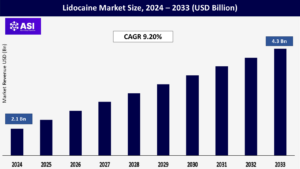
The global lidocaine market was valued at USD 2.1 billion in 2024 and is projected to reach USD 4.3 billion by 2033, growing at a CAGR of 9.20% during the forecast period (2025–2033).
Lidocaine functions by blocking voltage-gated sodium channels in neuronal membranes, effectively preventing the transmission of pain signals. Its dual function as an antiarrhythmic and local anesthetic highlights its importance in a number of medical specialties, including general surgery, cardiology, dentistry, and dermatology. In order to improve patient comfort and convenience, lidocaine formulations have developed over time, moving from simple injectable solutions to sophisticated controlled-release creams and gels. Because of this development, it is now used for chronic pain management in outpatient settings in addition to acute procedural uses.
Additionally, the market’s reach is being expanded by regulatory approvals for innovative lidocaine patches and compounded creams. Lidocaine’s cost-effectiveness and good safety record solidify its place among anesthesia and analgesia options as healthcare systems place a greater emphasis on value-based care. Two major factors driving the lidocaine market forward are the increasing prevalence of chronic pain conditions and the growing demand for minimally invasive procedures.
Its therapeutic efficacy and market penetration are also anticipated to be further improved by developments in combination therapies and drug delivery systems. Lidocaine remains a crucial element in contemporary medical practice due to its proven clinical utility and continuous advancements.
The growing number of surgical procedures across specialties like general surgery, orthopedics, and dentistry is propelling the global lidocaine market. Lidocaine’s effectiveness in guaranteeing patient comfort during procedures and recovery afterward accounts for its position as a preferred local anesthetic. Because of its quick onset and safety record, lidocaine has become increasingly popular in minimally invasive and outpatient procedures that emphasize quicker recovery times.
Demand is further driven by aging populations, especially in developed areas, as more and more older adults need surgeries for long-term conditions like joint replacements or cardiovascular problems. Growth is also being aided by emerging economies, as increased access to surgical care is made possible by growing healthcare infrastructure. The versatility of lidocaine’s formulations—injectables for accurate numbing, topical creams for minor procedures, and patches for long-lasting pain relief—increases its usefulness in a range of clinical contexts.
Its significance is further cemented by regulatory developments, such as the approval of medical devices containing lidocaine. The need for lidocaine is in line with trends that favor ambulatory and outpatient surgeries as healthcare systems place an emphasis on patient-centered, cost-effective models. This dynamic supports lidocaine’s continued market expansion by positioning it as an essential part of contemporary surgical procedures.
The fast expansion of the aesthetics sector, especially non-invasive procedures like injectables, laser treatments, and dermal fillers, supports the lidocaine market. Lidocaine is essential to these procedures because it reduces discomfort during administration, increasing adoption rates and patient satisfaction.
Social media influence, growing disposable incomes, and cultural shifts toward youth-oriented aesthetics are the main drivers of the popularity of cosmetic enhancements. The need for painless experiences is met by advancements in formulation technologies, such as fast acting topical numbing agents and hyaluronic acid fillers blended with lidocaine. Lidocaine use is also influenced by the trend toward minimally invasive procedures, which provide faster results and less recovery time. Because affordable cosmetic procedures draw clients from all over the world, medical tourism also plays a role in places like Asia and Latin America.
While improvements in drug delivery systems increase the use of lidocaine in specialized aesthetic protocols, regulatory support for the drug in over-the-counter topical products improves accessibility. Lidocaine continues to be essential in fulfilling safety and comfort standards as consumers place a greater emphasis on aesthetic improvements with little recovery time. Lidocaine’s growing demand is supported by the synergy between the expansion of the cosmetics industry and its adaptability, which is consistent with larger market forecasts.
Complicated regulatory frameworks controlling the manufacture and distribution of pharmaceuticals pose challenges for the lidocaine market. Global health authorities’ strict safety, efficacy, and quality standards necessitate a great deal of clinical testing, documentation, and quality control procedures; this raises development costs and delays product launches.
Manufacturers’ resources are strained, for instance, when novel formulations are approved through drawn-out review procedures that frequently include thorough pharmacological and toxicological evaluations. Due to lengthy approval timelines caused by some countries’ requirements for local clinical trials or stability studies, even for products that have already received approval in other regions, regional regulatory differences further impede market expansion. These regulations are particularly difficult for smaller manufacturers to comply with, which restricts innovation and market competition. Costs and operational complexity are increased by environmental regulations, such as waste management requirements for solvent recovery in production. Emerging economies are disproportionately affected by these issues since their regulatory frameworks might not be standardized or have the infrastructure necessary to make compliance easier.
Despite the anticipated substantial growth of the lidocaine market, these obstacles may hinder accessibility and affordability, especially in areas where consumers are price-sensitive. Maintaining growth in the face of growing demand for surgical and aesthetic applications requires striking a balance between market agility and regulatory rigor.
| Report Metric | Details |
|---|---|
| Segmentations | |
| By Formulation |
Injections Creams Ointments Gel
|
| By Application |
Dentistry Cardiac Arrhythmia Epilepsy Cosmetic Surgery General Surgery |
| By Distribution Channel |
Hospital Outlets Retail Pharmacies |
| Key Players |
|
| Geographies Covered | |
| North America |
U.S. |
| Europe |
U.K. |
| Asia Pacific |
China |
| Middle East & Africa |
Saudi Arabia |
| Latin America |
Brazil |
Based on formulation, the lidocaine market is divided into injections, creams, ointments, and gels, each of which is designed to meet specific clinical needs. Because of their quick onset and accurate dosage, injections are used extensively in clinical settings and are essential for emergency care, dental procedures, and surgery.
Creams are preferred for topical applications because they are simple to use and provide non-invasive pain relief for ailments like post-herpetic neuralgia or peripheral neuropathy, especially for patients who are needle averse. Because of their thicker consistency, ointments are perfect for treating burns, abrasions, and dermatological irritations because they offer long-lasting moisturization and a protective barrier.
Because of their smooth texture and quick absorption, gels are frequently used in dental offices for mucosal anesthesia as well as in cosmetic procedures like laser treatments, where precise numbing is essential.
Healthcare professionals can choose the best delivery method depending on patient needs, procedural complexity, and desired duration of effect thanks to the variety of formulations that guarantee versatility. This versatility highlights lidocaine’s wide range of applications in various medical specialties and solidifies its status as a fundamental anesthetic in both acute and long-term care settings.
Lidocaine’s effectiveness as a local anesthetic and antiarrhythmic agent has led to its use in a wide range of medical specialties. It is the gold standard in dentistry for managing pain during periodontal surgeries, root canals, and extractions. Intravenous lidocaine is used in cardiac care to stabilize potentially fatal ventricular arrhythmias, providing quick therapeutic action in emergency situations.
It is used as a rescue treatment for seizures in neonatal epilepsy that are not alleviated by traditional antiepileptic medications. Lidocaine is used extensively in cosmetic surgery to improve patient comfort and procedural tolerance during procedures like lip augmentation and laser resurfacing. Lidocaine is used in general surgery to reduce postoperative pain and opioid dependence through nerve blocks and wound infiltration.
Transdermal patches provide long-lasting relief for ailments like diabetic neuropathy in the field of chronic pain management, one of the emerging applications. To satisfy specific clinical needs, each application makes use of lidocaine’s special pharmacological characteristics, which include quick onset, low systemic toxicity, and adaptability. Lidocaine’s role keeps growing as medical procedures shift toward less invasive methods and individualized treatment, bridging therapeutic gaps across disciplines and enhancing its applicability in contemporary healthcare.
Hospital networks and retail pharmacies, each of which caters to different patient needs, are the distribution channels for lidocaine products. Injectable formulations and intravenous solutions are given priority in hospital outlets, guaranteeing prompt access to inpatient, emergency, and surgical care.
Particularly for sterile products used in critical interventions, these environments require strict quality assurance, cold-chain logistics, and adherence to regulatory protocols. On the other hand, retail pharmacies concentrate on over-the-counter (OTC) topical formulations, such as creams, gels, and patches, to serve the outpatient and self-care markets.
These products prioritize patient autonomy and convenience while treating minor injuries, chronic pain, and dermatological conditions. With online platforms providing home delivery of over-the-counter lidocaine products, the growth of e-commerce has further diversified distribution and increased accessibility in underserved or rural areas. Both channels are essential: retail networks support long-term and preventive care, while hospitals guarantee the availability of lidocaine in high-acuity situations.
When healthcare systems prioritize cost effectiveness and patient centred models, the combination of these channels expands the reach of lidocaine, guaranteeing its availability in a variety of clinical settings and demographics.
With a projected 39.7% market share in 2024, North America is a major player in the global lidocaine market. The region’s strong reimbursement frameworks, high procedural volumes, and well-established healthcare infrastructure particularly for antiarrhythmic applications are responsible for this dominance. Due to the extensive use of lidocaine in pain management treatments, minor surgeries, and dental procedures, the United States leads the North American market with 72.3%. The market is growing as a result of the rising demand for cosmetic procedures and the increasing prevalence of chronic pain conditions. The region’s dedication to improving patient comfort and procedural efficiency is demonstrated by innovations in drug delivery systems, such as the introduction of lidocaine thin films for dental applications. To guarantee steady product availability, strategic planning is necessary due to the challenges posed by sporadic supply chain interruptions.
With nations like Germany, France, and the United Kingdom leading the way in dental and minor surgical applications, Europe will hold about xx% of the global lidocaine market share in 2024. The rising incidence of chronic pain, an aging population, and an increased need for topical anesthetics, such as lidocaine patches, are the main factors propelling the region’s market expansion.
The safety and effectiveness of lidocaine products are guaranteed by regulatory support from organizations such as the European Medicines Agency (EMA), which promotes patient and healthcare provider trust. The market’s resilience is influenced by the existence of significant pharmaceutical corporations as well as continuous research and development initiatives. Additionally, the incorporation of lidocaine into a variety of formulations, including gels and creams, meets a range of medical requirements and promotes its use throughout the region.
The lidocaine market is expected to grow at the fastest rate in the Asia Pacific region, with a projected compound annual growth rate (CAGR) of roughly 7.3% during the forecast period. Leading the way in this expansion are nations like China, India, and Japan, which are being fueled by factors like growing healthcare costs, growing pain management awareness, and an increase in the number of surgical and cosmetic procedures.
The growing middle class and easier access to medical care are two factors driving up demand for products containing lidocaine. Further driving market expansion are government programs to improve healthcare infrastructure and the region’s growing biotechnology and pharmaceutical industries. New developments in lidocaine formulations, such as improved adhesion technologies and extended-release systems, are becoming more popular because they increase patient comfort and compliance.
Together, Latin America, the Middle East, and Africa make up about xx% of the world market for lidocaine. Increasing investments in healthcare infrastructure and a growing demand for cutting-edge medical devices are driving the moderate growth of Latin American nations like Brazil, Mexico, and Argentina.
The market is further boosted by the expanding use of lidocaine in cosmetic procedures and pain relief for ailments like eczema and small cuts. Growing healthcare infrastructure development, an increase in the prevalence of chronic diseases, and a growing demand for efficient pain management solutions are driving market expansion in the Middle East and Africa. However, obstacles like restricted access to healthcare in some areas and financial limitations might restrain market expansion.
The lidocaine market was valued at USD 2.1 billion in 2024.
The lidocaine market is projected to grow at a CAGR of 9.20 % from 2025 to 2033.
The Injections hold the largest market share.
The Asia-Pacific region is expected to witness the highest growth rate.
Major players include Pfizer, Merck, Teva, AstraZeneca, Glenmark.
1.1 Summary
1.2 Research methodology
2.1 Research Objectives
2.2 Market Definition
2.3 Limitations & Assumptions
2.4 Market Scope & Segmentation
2.5 Currency & Pricing Considered
3.1 Drivers
3.2 Geopolitical Impact
3.3 Human Factors
3.4 Technology Factors
4.1 Porters Five Forces Analysis
4.2 Value Chain Analysis
4.3 Average Pricing Analysis
4.4 M & A, Agreements & Collaboration Analysis
5.1 Lidocaine Market By formulation
5.1.1 Introduction
5.1.2 Market Size & Forecast
5.2 Lidocaine Market By Application
5.3 Lidocaine Market By Distribution Channel
6.1 North America Lidocaine Market, By Country
6.1.1 Lidocaine Market, By formulation
6.1.2 Lidocaine Market By Application
6.1.3 Lidocaine Market By Distribution Channel
6.2 U.S.
6.2.1 Lidocaine Market, By formulation
6.2.2 Lidocaine Market By Application
6.2.3 Lidocaine Market By Distribution Channel
6.3 Canada
7.1 U.K.
7.2 Germany
7.3 France
7.4 Spain
7.5 Italy
7.6 Russia
7.7 Nordic
7.8 Benelux
7.9 The Rest of Europe
8.1 China
8.2 South Korea
8.3 Japan
8.4 India
8.5 Australia
8.6 Taiwan
8.7 South East Asia
8.8 The Rest of Asia-Pacific
9.1 UAE
9.2 Turkey
9.3 Saudi Arabia
9.4 South Africa
9.5 Egypt
9.6 Nigeria
9.7 Rest of MEA
10.1 Brazil
10.2 Mexico
10.3 Argentina
10.4 Chile
10.5 Colombia
10.6 Rest of Latin America
11.1 Global Market Share (%) By Players
11.2 Market Ranking By Revenue for Players
11.3 Competitive Dashboard
11.4 Product Mapping